
SRI RAMANASRAMAM
SEPTEMBER 2025 VOL. 19, NO. 9

Dear Devotees,
As we near the end of the month of August, the Ashram is still glowing in the aftermath of Mahakumbhabhishekam in the third week of August. Work continues on the New Ashram Dispensary extension as well as additional repairs and painting not completed prior to the festival.
In this issue we continue with the autobiographical account from G. V. Subbaramayya and his highlights in the Hall with Bhagavan, including the days of Mahakumbhabhishekam in March 1949. (see p. 3).
In Ramana Reflections, we conclude the series entitled “The Dream of Self” and Bhagavan’s suggestions for how to come free of it. (see p. 10).
For videos, photos and other news of events: https://www.gururamana.org or write to us at: saranagati@gururamana.org. For the web version: https://www.sriramana.org/saranagati/September_2025/.
In Sri Bhagavan,
Saranagati
Table of Content
- In Profile: G.V. Subbaramayya (part four)
- Mahakumbhabhishekam: Sri Ramanasramam March 1949
- Mahakumbhabhishekam 2025: Balalayam Ceremony
- Mahakumbhabhishekam: Temple Consecration
- Mahakumbhabhishekam 2025: Sanctum Sanctorum Repairs
- Mahakumbhabhishekam 2025: Yagasala Pujas
- In Focus: August Edition
- Ramana Reflections: The Dream of Self (part three)
- Events at Sri Ramanasramam: Muruganar Day
- Mahakumbhabhishekam 2025: Go Puja
- Announcement: Saranagati on the Ashram’s WhatsApp Channel
- Mahakumbhabhishekam 2025: Kalasha Installation Ceremony
- Mahakumbhabhishekam 2025: Kalakarshanam
- Mahakumbhabhishekam 2025: Bhagavan’s Prasad
- Mahakumbhabhishekam 2025: Technical Features and Logistics
- Best Shot: Consecrating the Path up to the Gopuram
- Events at Sri Ramanasramam: Vinayaka Chaturthi
- Mahakumbhabhishekam 2025: Bhagavan’s Prasad (part two)
- Obituary: Major P. Parthasarathy (1940-2025)
Calendar of Ashram Events
1st Sep (Mon) Advent Day |
2nd Oct (Thu) Vijayadasami |
5th Sep (Fri) Pradosham |
4th Oct (Sat) Pradosham |
7th Sep (Sun) Full Moon |
6th Oct (Mon) Full Moon |
19th Sep (Fri) Pradosham |
14th Oct (Tue) Punarvasu |
21st Sep (Sun) Amavasya |
18th Oct (Sat) Pradosham |
22nd Sep (Mon) Navaratri |
21st Oct (Tue) Amavasya |
IN PROFILE
G.V. Subbaramayya (part III)
G.V. Subbaramayya (part III)
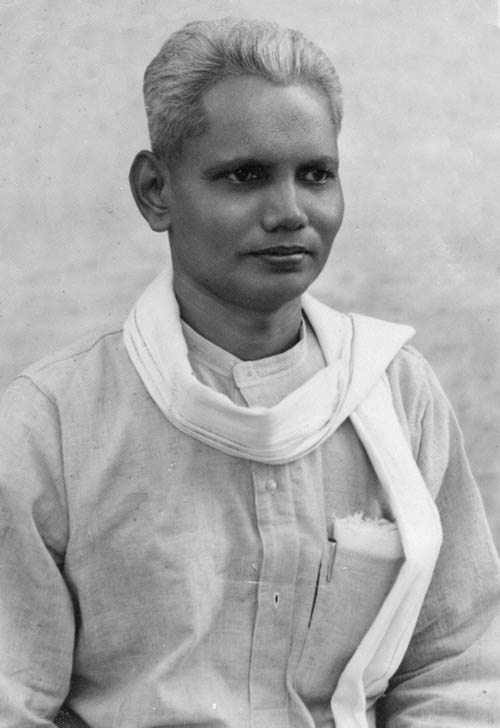
In the last segment, we had poignant glimpses into G.V. Subbaramayya's deepening bond with Sri Bhagavan. Laments about Bhagavan's giving up of chewing paan and his withdrawal from the kitchen overflow with warmth and colour. His children, especially Indira and Lalita, became favourites, and Bhagavan encouraged them to sing and dance in the Hall. A powerful moment came when Indira recited deham nāham koham soham, which Bhagavan praised as the "quintessence of wisdom."
Yet sorrow also visited: GVS lost his beloved wife and later Indira. These tragedies were softened by Bhagavan's compassionate words and silent grace. Amidst the sorrow, GVS continued his poetic and devotional offerings. Bhagavan reminded him quietly and powerfully that only the Self is real.
Part three concluded with moments of joy—Lalita's wedding, Bhagavan's teasing of young Alagamma, and the children using Bhagavan's verses as playful codewords.
As we begin the fourth part, GVS, still reeling from loss, had found solace in translating Ulladu Narpadu and Anubandham into Telugu verse. During Christmas 1946, he offered the manuscript to Bhagavan, who graciously corrected it—removing the word "That" before "Reality," explaining that Reality must never be qualified. On 26th December, Bhagavan read from Mahabhakta Vijayam about Jnaneswar and Janaka. When GVS translated a line describing Janaka's mind as dancing like a monkey to the trainer's stick, Bhagavan said:
So the trainer is coming with the rod, and to its movement the monkey here (pointing to himself) dances!
Navaratri October 1948
During the Navaratri vacation, GVS visited the Ashram. At 7:15 pm, GVS quietly entered the Jubilee pandal just as the Telugu Upadesa Saram recitation began. Bhagavan, seated with eyes closed, opened them as it ended,
saw GVS, and remarked:
Just as they began the Telugu Upadesa Saram, you came to my mind. Now, I see you.
In December, GVS returned to the Ashram. Bhagavan, spotting him, smiled and said to Nagamma, "So he has come." She replied that she had expected him, having heard the "crow's message", i.e. Nagamma had heard a crow cawing which indicates that a visitor is on the way.
After lunch, GVS saw Bhagavan walking down the Hill—a sight which had become rare due to his health. It felt like beholding Lord Siva descending Mount Kailasa. That afternoon, the Sankaracharya of Puri Mutt arrived. At 2:30 pm, GVS saw Bhagavan alone in the pandal. He remarked, "Now our boy would be placing the pindam at Vishnupadam," referring to GVS's son, Sundararajan, who was at Gaya performing his mother's shraddha. Bhagavan graciously read GVS's verses. The last one read:
In this night of my life in which the path is shrouded in darkness Lo! two sacred lights do pierce the gloom. /One is Sri Ramana, the Light of Arunachala; the other is the light of thy memory, O beloved."
GVS's son later wrote:
Yesterday I placed the six pindams over Vishnupad... It felt as though Bhagavan was guiding me throughout.
Mahakumbhabhishekam
Preparations were in full swing at the Ashram for the Mahakumbhabhishekam of Bhagavan's Mother's Shrine, scheduled for March 1949. The cost was estimated at Rs. 50,000. Due to famine in North Arcot, rice was scarce. Chief Minister O.P.
Ramaswami Reddiar, a devotee, asked Sambasiva Rao and GVS to collect twenty candies of paddy from Nellore district, assuring them of full transport support.
With Bhagavan's grace, their efforts exceeded expectations. Municipal Chairman A.C. Subba Reddy promised to cover any shortfall, mill the paddy, and transport the rice. His brother, A. Venkata Reddy, and others like N. Balarama Reddy and T. Rami Reddy contributed generously. A. Subrahmanyam donated paddy and ghee for the homam. Eventually, Subba Reddy fulfilled the final shortfall with great generosity. GVS narrates:
On Mahasivaratri, Sambasiva Rao and I missed our stop at Mopur and ended up in Allur, where I met my old student, M. Narasimhachary, now a Headmaster. He welcomed us warmly, hosted us for meals, accompanied us to donors, and pledged to collect and dispatch the paddy—all despite never having met Bhagavan. His generous support on that sacred day deeply moved us. As Smartas (Saivites) we were lovingly served by a Vaishnava, and the experience felt emblematic of Sri Bhagavan's universal spirit, where distinctions dissolve in the light of shared devotion and service. When everything seemed ready, a last-minute obstacle arose. Though the Government approved transport permits, the Regional Transport Officer in Vellore refused petrol coupons. GVS narrates:
On 13th March—just a day before the event—I rushed to Madras. Chief Minister Reddiar, shocked, phoned the officer, saying, "This is like a priest denying a boon granted by God!" With help from D.S. Sastri, I obtained the coupons at
10:30 pm. Though the station was closed and I lay hungry that night, I was deeply fulfilled.
The next day, I accompanied the rice-laden lorry to the Ashram. As I entered, Bhagavan, seated in the Jubilee pandal, turned to Sambasiva Rao and said, smiling, "Look there! GVS has come." That radiant smile was my reward.
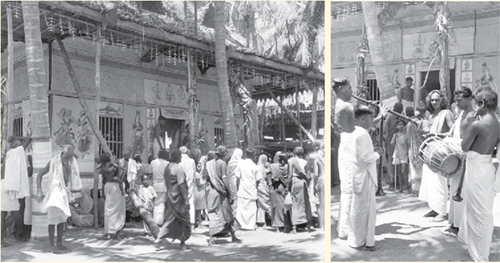
Nellore's response had been overwhelming—devotees offered paddy despite rationing and steep prices. Many came personally to pay homage. The Ashram was transformed: festive pandals, electric lights, Vedic chanting, music, and homams created an atmosphere of spiritual splendour.
From 14th to 17th March 1949, the Ashram was alive with sacred devotion. On the 17th, the sanctification atop the Mother's Shrine drew vast crowds. Many watched from rooftops, trees, even from the slopes of Arunachala. The Sankaracharya of Puri graced the occasion. That night, Sri Chakra Puja went on till 11 pm. Inside the shrine, Bhagavan sat on a tiger-skin-draped stone couch, radiating peace amidst decorations akin to those of a king's durbar (court). GVS continues:
Though dinner was served at 8pm, Bhagavan didn't rise until the puja concluded. I stood nearby, guiding the crowd. He turned to me and asked, "Why have you not gone for food?" I replied, "I shall go with Bhagavan." He nodded with
quiet kindness. It was a moment
I shall never forget. —
(to be continued)
MAHAKUMBHABHISHEKAM
Sri Ramanasramam, March 1949
When Bhagavan came down the Hill to stay at Mother's Samadhi in December 1922, her shrine was only a thatched hut where he meditated day and night. In 1925, half-baked bricks from a nearby kiln were used—Bhagavan himself among the masons—to raise mud-mortar walls with a thatched roof, and around this time the Old Hall also arose.
By the 1930s, Ashram construction gathered pace: the gosala with Burmese teak beams, then the office, bookstore, storeroom, patasala, and, in 1938, the dining hall and kitchen. Still, the dream of a proper stone temple above the Mother's Shrine remained.
Asked about it, Bhagavan said, "It will be good if it is constructed well, and on a large scale." Chinnaswami, anxious about funds, followed Bhagavan's rule forbidding appeals: "Arunachala will provide." In 1936, teak was purchased from Burma, but skilled artisans were still lacking.
Fortune intervened when Chinnaswami, travelling by train, met Mahizhvana Sthapati. His son, Vaidyanatha, 36th in a lineage that had built the Brihadeeswara Temple, was engaged to oversee the work. He was versed in vastu, silpa, agamas, astronomy, Vedas, and mantra sastra, and his team of fifty masons was among South India's finest. More valuable than his skill was his reverence for Bhagavan; he regarded the shrine as a sacred trust, not a contract. He agreed to modest monthly pay, sparing Chinnaswami the burden of advances. Bhagavan reminded all:
What is to happen will happen. If you now go and ask for money, will not the donous ask whether you have my agreement? Did the construction of these buildings take place because of my begging?
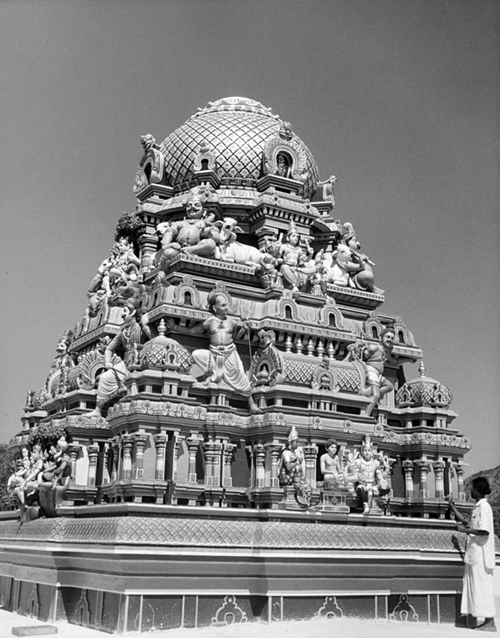
Funds flowed unsolicited, and on 1st September 1939, Bhagavan's Advent Day, the foundation stone was laid. Vaidyanatha moved to Tiruvannamalai to direct the work. Every decision was placed before Bhagavan, and each day the sthapati reported progress, drawing courage from him. Granite was quarried at Vaira Kunru, hauled by bullock cart, and cut on site. Devotee-engineer K.K. Nambiar, trained in Western methods, assisted, and Bhagavan affectionately called him the "modern Sthapati." The work lasted ten years, with many trials, but Bhagavan's silent presence sanctified it all. He attended ceremonies, walked the site at night, and blessed icons. At the final dedication, he placed both hands on the Meru Chakra in blessing. On 1st January 1949, the foundation for the Sri Chakra was laid. By March, preparations were complete for the Mahakumbhabhishekam of Sri Mathrubhuteshwarar, a Pallipadai Koil, or temple over a saint's remains, built according to Devalaya Vastu Shastra. The shrine is a Siva temple—the Lord manifesting as Mother. At its core, according to the Vaidyanatha Sthapti lineage, is the garbhagriha, entered through the Mukha Mantapam and flanked by Dwara Ganapati and Dwara Murugan:
Above rises a three-storeyed vimanam. The Rajagopuram, also three storeys, opens into the Mahamandapam with Nandi facing the Siva Linga and shrines for Nataraja, Bhairava, and the Navagrahas. The pradakshina path holds Ganapati in the southwest, Subrahmanya with consorts in the northwest, and koshtam images of Ganesha, Dakshinamurti, Lingodbhava, Brahma, and Durga, with Chandikeshwara separately enshrined. Beyond lies the Dhyana Mantapam, the New Hall, with a life-size greenstone image of Bhagavan carved during his lifetime. When he first saw it, nearly complete, he exclaimed: "Adede Ramanan vanduttane!"—"Ah, Ramana himself has come!" The sculptor stopped work, believing the life force had entered the image 1
On 14th March 1949, the four-day consecration began. Thousands arrived by special trains and buses. The Shankaracharya of Puri presided, guiding dozens of priests who chanted the four Vedas in the yagasala before kalasams filled with waters from the Ganga and other sacred rivers. It was the Ashram's crowning moment.
After Bhagavan's Mahanirvana, the place where his Samadhi was to be constructed was revealed in a dream to Nambiar. Though custom required the body face east, devotees wished it turned toward Arunachala. With Vaidyanatha Sthapati, Nambiar measured a spot midway between the Old Hall and the Mother's Shrine. There the burial pit was dug, and Bhagavan's body was interred, seated in full lotus, facing the Hill. A bamboo shelter first covered the Samadhi. In 1952, Sri Anandamayi Ma laid the foundation stone. In 1964, the central shrine with polished black granite pillars was raised; in 1966, the vimanam and granite exterior was completed, with Mahakumbhabhishekam in 1967. Finally, in 1969, work began on the enclosing hall, and on 3rd May 1970, the 20th anniversary of Bhagavan's Mahanirvana, the Samadhi Hall was inaugurated. —
Mahakumbhabhishekam 2025: Balalayam Ceremony
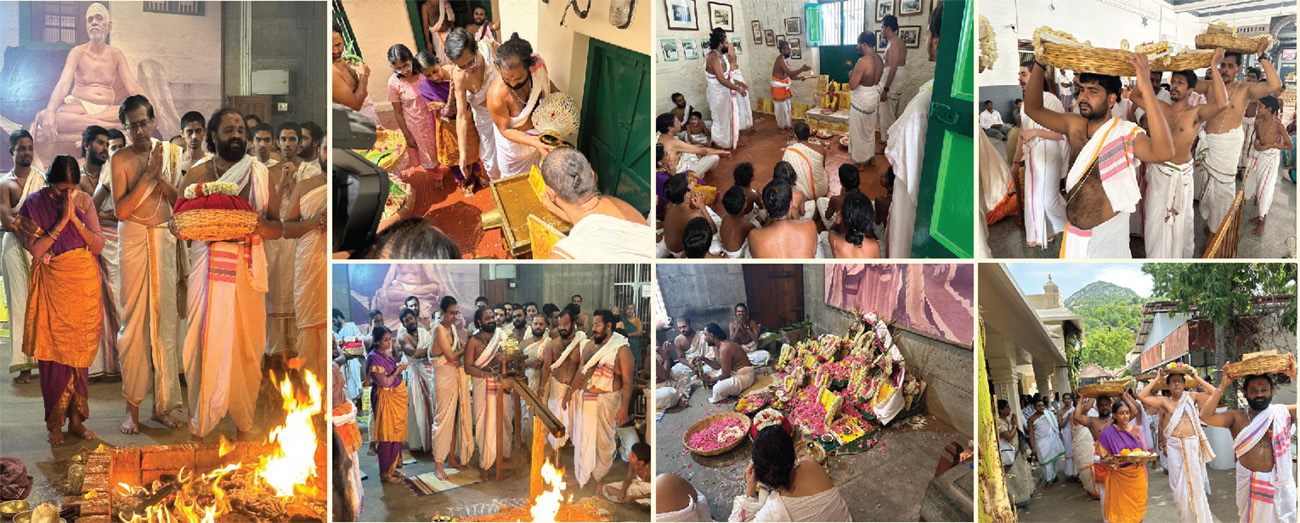
On 31st July, the sacred power of the Ashram's deities and lingams was 'transferred' in the Balalayam ceremony. A preliminary rite, the purpose of the Balalayam ceremony is to safeguard and preserve the divine energy (shakti) of the presiding deities while the temple undergoes renovation. The process begins with Kalakarshanam, where the deity's power is transferred first into sacred vessels (kalasams) and then into smaller temporary wooden images (pratibimbas). The Balalayam altar was set up in the Ashram's Old Office (1937), a temporary shrine for the deities while the sanctum and idols were repaired. Pujas took place twice daily (plus the morning milk offering) during the next twenty days while the two main shrines were closed to the public. By this means, the liturgical and sacramental rhythm of the community was maintained while the physical temple rested under scaffolding.
MAHAKUMBHABHISHEKAM
Temple Consecration
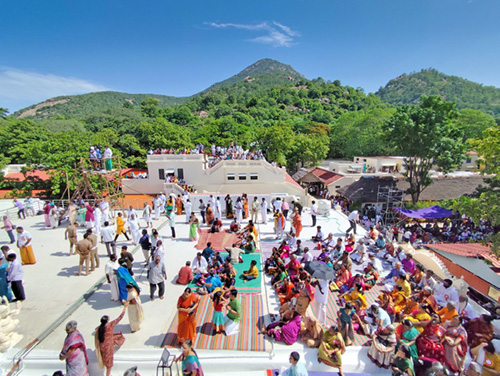
Great traditions have moments when their essence shines brightly—when ritual, symbol, and devotion converge to renew the bond between human and Divine. In India, Mahakumbhabhishekam is just such a moment. More than a festival, it is the celebration of Divine presence, enacted with exuberance and tremendous sacramental power.
Maha (great) plus kumbha (pot) plus abhisheka (ritual anointing) centres on water—sanctified by mantra and fire. Mahakumbhabhishekam refers to the sacred pouring over or ritual anointing of the temple tower crowns (shikhara) and the deities housed below them.
Temples are not lifeless structures but living entities whose prana must be periodically recharged. Each twelve years, priests, scholars, and devotees gather to bathe the temple anew, first by yajna and Vedic recitation and then, abhisheka.
The yagasala's ambience is unique in all the world: kalasha pots brim with waters drawn from holy rivers; smoke rises from sacrificial fires; ancient Vedic mantras merge with drums and conches as Oduvars sing Tevarum and other ancient Tamil devotional songs.
When priests pour tirtha from the kalashas over the temple's crowns, it cascades like rain upon the earth, and the divine power descends into the sanctum sanctorum below. At that instant, the sculpted image is revealed not as mere stone but as a living deity, blessing all who come into Its Presence.
Mahakumbhabhisekam is thus the rekindling of Divine grace, the affirmation of Sanaatana Dharma ever pulsing at the heart of the created order—the timeless made present in time. —
Mahakumbhabhishekam 2025: Sanctum Sanctorum Repairs
The post important repairs in preparation for Mahakumbhabhishekam 2025 took place on the vimanam above the Mother's and Bhagavan's Shrines as well as at lingas, Rishabhas, and Bali Peetams. Replacing the lingas' astabhandha,* the sacred herbal adhesive applied to all main and subsidiary deities to affix them securely to their pedestals, was also performed. Further repairs included polishing Bhagavan's samadhi platform and making use of traditional maakappu, a rice flour paste that is painted on the lingam, Nandi, and other sacred sites. The paste is left to dry for several days as a way of soaking up any oil that may have percolated into the stone.
Other renovation work included replacing rotted wood, painting surfaces and waterproofing exposed areas. Workers removed old paint, restored damaged plaster, and cleaned and re-painted the stone walls of the garbhagriha. —
* From ashta (eight) and bandhanam (binding), a sealing paste made from eight sacred herbs mixed with resin, limestone, beeswax, butter, and other substances is rolled into 'cords' and applied around the base of the image, creating a watertight seal to preserve the deity's spiritual vitality for the next twelve years. Ramanalingam has a swarnabandhanam (gold binding), a protective coating placed over the asthabandam.
Mahakumbhabhishekam 2025: Yagasala Pujas
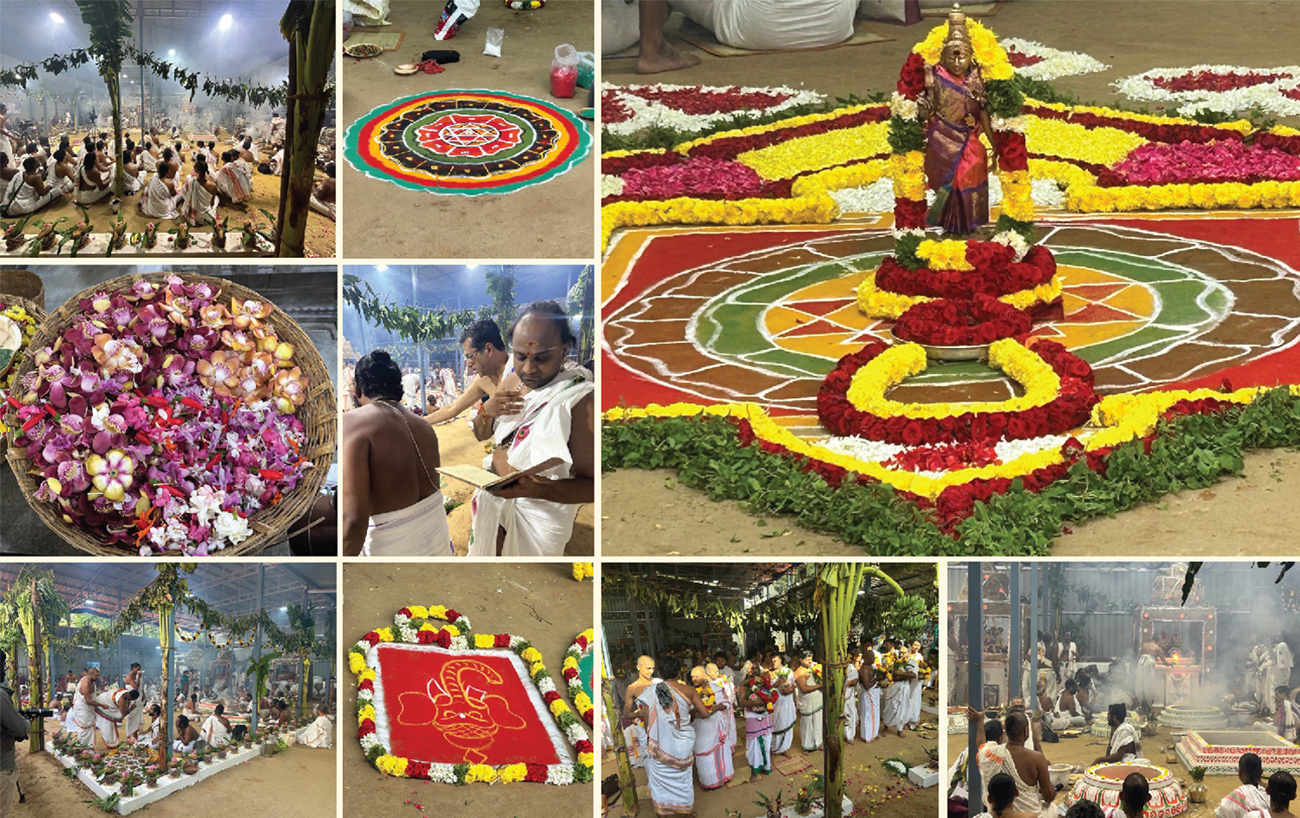
Yagasala pujas are preparatory rites performed in the temporary sacred enclosure called the yagasala, constructed just outside the main temple. Yagasala rites focus on purifying the environment, invoking the Divine, and energizing sacred elements, not least of all, the contents of the kalasha (sacred pots filled with water and herbs) on the yagasala altar.
At the heart of these rites is the homam, or fire sacrifice, where Sivachariyars offer grains, ghee, herbs, and other items into the sacred fire while reciting the Vedas. All four Vedas are recited during the days of yagasala puja. Each hava kunda (fire pit) is directed to a specific deity, inviting them to participate in and bless the forthcoming consecration. Lord Agni (Fire) is the conduit by which offerings ascend to heaven and blessings return to sanctify the earth. Energizing the kalasams through homam and other yagasala rites serves as the indispensable foundation for Mahakumbhabhishekam, ensuring that the temple and its deities are spiritually recharged. —
In Focus: August Edition
For the August edition of In Focus, copy the following URL into your browser August Infocus
RAMANA REFLECTIONS
The Dream of Self (pt. III)
RAMANA REFLECTIONS
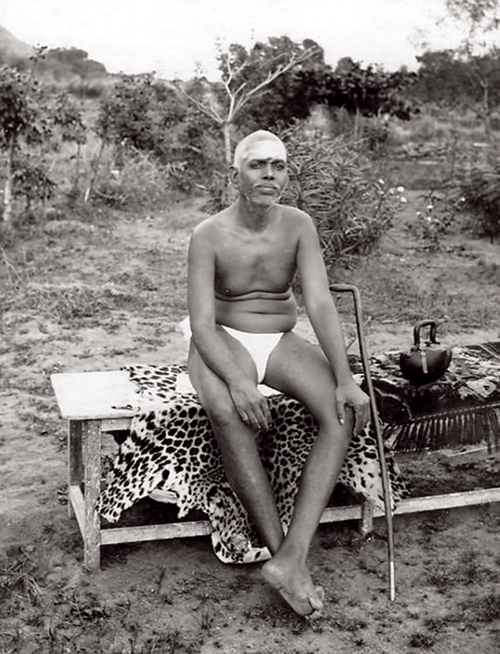
In Tang dynasty China (8th–10th centuries), a golden era of meditation study, a rich body of teaching stories emerged. These recorded encounters between masters and meditators served as training texts for monks, designed to illuminate subtle truths beyond verbal instruction. One such tale, dating to around 800 CE, recounts the following:
As the officer Riku Taifu spoke with Master Nansen, he said, "Jo Hossi once said, 'Heaven, earth, and I have the same root; myriad things and I are one body.'1 How marvellous!" Nansen called to the officer and pointed to a flower in the garden and said, "People these days see this flower as if in a dream". 2
The task for the meditator is to inquire into the mystery of Nansen's statement. What is the dream he refers to? In the last two segments, we saw how Bhagavan employed dream metaphors to reveal how the ego constructs a world and creates suffering by mistaking the waking state for ultimate reality. Like the dream avatar, the waking 'I' clings to its centrality. The mind impersonates the Self and takes ownership of experience. The deception is all-pervading and penetrates each moment of experience. It becomes the only world we know, in other words, it is a dream. All we see comes to us through the filter of separateness. Thus, there is no backdrop to contrast what we experience because the egoic vision is total. This is what Nansen seems to be talking about.
Bhagavan identified deep sleep—where the ego vanishes—as closest to the Self. In that state, awareness remains even in the absence of a perceiving subject, indicating that the Self is constant. The waking dream persists by mistaking perception of the world as proof of ego's validity.
We saw last time how the spiritual bypass is born of taking refuge in this deception, reducing enquiry to sterile questioning and thereby freeing ourselves from the obligation to anything that looks like Bhagavan's surrender. We also saw how true meditation entails meeting darkness—what depth psychology calls the shadow, a radical descent into the unknown within. The waking dream persists because we cling to light, clarity, and control. But transformation requires faith in the unseen. The parable of the hornet and housefly showed us how true freedom often lies in moving away from the obvious, into the uncertain.
The ego likes tidy formulas and graspable phrases. Yet only by embracing what we fear and staying close to our karmic burdens can we dissolve the illusion of separation. The integration of opposites—light and dark, joy and sorrow—is the mark of the true spiritual seeker. This invariably includes distress which can point us to faith. Liberation lies not in escaping reality but in consenting to it through faith.
The above story from Tang master Nansen points out how the waking dream becomes normalized. It is so pervasive in the collective that we no longer recognize the dream as a dream. We search, we grasp, we seek as if the path were an object to be chased after and acquired. This is how we perpetuate the illusion. Another story from Nansen illustrates this:
Joshu asked Nansen, "What is the Way?"
Nansen replied, "Ordinary mind is the Way."
"How can I direct myself toward it?" Joshu asked.
"If you try to turn toward it, you turn away from it."
"Then how can I know it's the Way?"
"The Way does not belong to knowing or not knowing. Knowing is delusion. Not knowing is blankness. When you truly reach the Way, it is as vast and boundless as space—how can it be spoken of in terms of right and wrong?"
At these
words, Joshu was suddenly enlightened.3
Nansen mirrors Bhagavan's instructions. Bhagavan tells us there is no "attaining" the Self; rather it is the illusion of a separate ego that is the bondage.4 Give up the illusion, Bhagavan tells us, and the bondage disappears on its own. To seek the Self is to move away from it, Nansen insists: firstly, because seeking assumes separation, and secondly, because chasing is another form of grasping—egoic at its source.
The Two Birds
In earlier Saranagati articles5, we explored the Upanishadic image of two birds on a single branch: one eats the fruit; the other just watches. This image reveals the split between the experiencing ego and the witnessing
Presence.6
The bird that eats symbolizes the acquiring mind— analytical, conceptual, linguistic. In modern terms, it aligns with the left hemisphere: reflective, logical, denotative, self-aware. From this capacity arises the spiritual ego—which seeks to grasp the Self as an object of knowledge, as if the Infinite could be contained. But the Self is not one object among many. It is not knowable through thought or image. It is not the content of awareness, but Awareness Itself—infinite, ungraspable, formless. It is not in the world but is that from which the world arises. It cannot be approached as something "other," not revealed through inner visions or imaginations, nor through philosophical systems but, like the drop that merges into the ocean, can only be lived into. As has been said, known is the drop; unknown is the ocean. The drop "dies" as a separate entity and thus comes to know the ocean by becoming the ocean. All other knowing is unreliable, a mere reflection inside ego's hall of mirrors.
If the ego's daylight dream-world has no room for deities (except for one—the ego itself), it ever seeks to compensate for the all-pervading sense of lack by elevating itself to a divinity. Appropriating the light of the Self, ego is invested in ego alone and stops at nothing to maintain a sense of dominance in an otherwise fragile self-created dream—ever afraid to die, ever refusing to merge with the ocean.
Ego eternally seeks a loophole: to attain the Absolute while preserving itself. It wants to cross the threshold without dissolving. But the Self cannot be stolen. The Divine insists on taking everything from us instead; therefore, we must vanish to arrive.
The Boundaries of Science
The ancients tell us that the deepest truths cannot be grasped by the thinking mind but only surrendered to. This truth echoes powerfully even into the modern world where the urge to systematize reveals the limitations of the
conceptual mind. Here we see how science risks becoming dogmatic. It promises mastery over reality through mediation of the discursive mind. Seeking the theory of everything—an ontology7 that encapsulates the whole of
Being—science as metaphysics collapses under its own weight. Consider Gödel's incompleteness theorems (1931) which reveal the inherent limits of formal mathematical systems: no consistent axiomatized system can contain all truths,
nor prove its own consistency.8 The attempt at a totalizing rationalist scientific framework is thwarted by the inherent boundaries of what logic and mathematical representations can achieve.
The 2022 Nobel Prize in Physics, awarded for experimental validation of quantum entanglement9, affirms that particles influence each other across vast distances instantaneously and, in fact, only appear as particles, i.e. as matter, when observed. Many physicists now view particles as emergent, i.e. derived from some more fundamental substrate. If matter is only a projection of some deeper ontological primitive,10 then we must wonder what it might be. As the Newtonian model transcended Copernicus and Einstein's relativity superseded Newton, quantum physics seems to be moving away from Einsteinian space-time.
The New Physics
The foundation of classical realism in physics, which assumes that matter exists independently and locally, is starting to fracture. We find in its place a relational universe, where meaning and form arise not from isolated entities but
from observation, interaction, and deep entanglement. The observable physicality of our world may not be distinct from our perception of it, i.e. from cognition. This would seem to suggest that the observable physical universe is
conditioned, arising, as Bhagavan has said, out of the immaterial.11
Such developments offer little comfort to materialists who ground their truth in a world that is composed solely of matter. For those steeped in the Ramana vision, on the other hand, the developments in high-energy physics come as a quiet confirmation. Bhagavan describes it in his own terms:
Space is bhootakasa (physical ether), mind is manakasa (mental ether) which is contained in chidakasa (transcendental ether). The mind is thus akasa tattva (the ether principle). Being the principle of knowledge, there is no difficulty in reconciling the apparent contradiction [between form and consciousness]. In short, the whole universe is only mental. 12
Echoed at the cutting edge of science now is the idea that the world is not what it appears but a projection. Though many physicists cling to former models, the tide is shifting,13 converging on cosmologies like those of the Rishis of by-gone days.
The Thing-in-Itself
The sages of ancient India spoke of the "world" as mind-made—a fabric woven by thought and skewed by perception. To resolve the distortion, we turn inward.
In the West, it was the 18th century thinker Immanuel Kant who problematised the inherent inability to access the thing-in-itself,14 i.e. reality, as it is. This is because, he assumed, we are ever confined to external representations. Arthur Schopenhauer, however, influenced by Sanskrit and Pali texts and an abiding interest in Indian philosophy, went further. He declared that we can indeed know the thing-in-itself, because we are the thing-in-itself. To know the thing-in-itself, we need only look within.
The Law of the Excluded Middle
The ego resists looking within. It is allergic to interiority and anything that appears indistinct or ambiguous. It clings to fixed categories and reduces Bhagavan's radical nonduality to a simplistic monism. "All is One," it proclaims,
while secretly maintaining dualistic strongholds. The ego cannot hold the paradox of simultaneous unity and multiplicity, nor the dynamic dance of inner and outer as perceptually distinct yet ultimately inseparable.
Bhagavan affirmed the indivisibility of the Self yet engaged in daily life making use of the pronouns "I" and "you." He maintained social conventions and exhibited compassion and care for others, all the while rooted in the nondual substratum. The ego, however, insists on binaries: either "one" or "two", never the subtle "not-two."
While the classical law of the excluded middle15 is suitable for courts or mathematics, it collapses before the subtlety of nondual awareness. Bhagavan tells us that the Self is neither two in relation nor singular like an object, but a non-oppositional unity transcending all binaries. See the following words of Bhagavan:
Subject, object and perception form the triad (triputi). There is a reality beyond these three. These appear and disappear, whereas the truth is eternal. [...] If there is unity, there will also be duality. The numeral one gives rise to the other numbers. Truth is neither one nor two. It is as It is. 16
The ego domesticates Mystery by forcing it into binary moulds. Bhagavan's realisation, however, abides where logic breaks down—where silence and speech, self and other, being and non-being interpenetrate without division.
The Age of Unused Maps
We live in an age overflowing with spiritual and philosophical maps—clear, luminous. Yet despite this guidance, we remain lost. The problem is not the maps but how we use them. Instead of walking the terrain, we study the diagrams. We
admire them from a distance, mistaking reverence for practice.
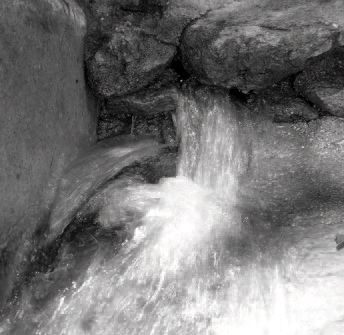
The trap of armchair spirituality is fluently quoting Ramana, Rumi, or Sankara while remaining inwardly unchanged. We seek to know about rather than to be. This is because the ego craves tidy categories. But the more we analyse, the more distant the Self becomes. If we imagine the Self as a mere observer—whether as "witness" or as "pure consciousness"—we fall into reductionism. Bhagavan elaborates:
The 'witness' is applicable when there is an object to be seen. That is duality. The Truth lies beyond both.17 In short, the maps point, but only Silence reveals.
Bhagavan's Silence
Here the real pilgrimage begins, namely, by moving toward Silence. Bhagavan's Silence is not something we manufacture; it is the ever-present ground that remains when thought and striving fall away. Bhagavan comments:
Dakshinamurti's silence dispelled the doubts of the four sages, revealing that true exposition needs no voice. While vocal speech depends on thought, this deeper speech—para vak —transcends both. It is the ultimate, unspoken word. 18
Silence means stilling the mind, the source of our sense of individuality and separateness. Without it, the inner doorway clogs with repressed pain.
Cultivating Silence means expanding the Heart. A spacious Heart can hold life's trials while a contracted Heart resists them and hardens. Silence allows afflictions to soften and dissolve. Bhagavan adds:
When stillness prevails, there will be no agitation of mind. Agitation of mind is the cause of desire, the sense of doership and personality. If that is moderated, only quiet remains.19
If unused maps leave us circling concepts, Silence gives us the courage to enter the unknown. But what happens when the vessel of the Heart feels too fragile—too fractured, or even broken—to contain Silence's vast expanse?
The Shattered Vessels
There is an allegory from the Middle Ages that speaks of shattered vessels. A vision of the mystic Izak Luria's imagines divine light breaking its containers and scattering sparks across creation.20 If our psyches fracture
under the weight of shame, fear, and loss, ego rises up to patch things together.
But we need not repair the dream, nor imagine that the Heart's cracks are the source of our trouble. Each wound is itself a vessel. Rather than mending it, we use it to hold—however imperfectly—the sparks which guide us into a deeper understanding.
Luria's image points to Jung's individuation and ultimately to Bhagavan's Self-realization. The broken vessel, surrendered in Silence, reveals the Self 's hidden radiance.
Brokenness is not a flaw but initiation. Healing means becoming vessels ourselves—empty, available, willing. Each wound is the doorway to respite from life's difficulty and a return to wholeness. Yajnavalkya tells Maitreyi:
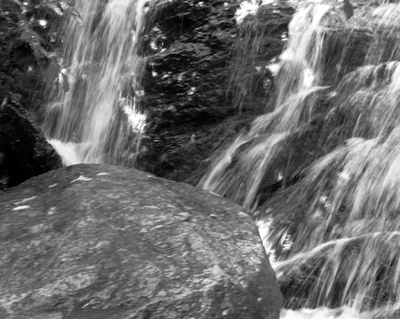
One does not love another for their own sake, but for the Self in them... This Self is Brahman... made of everything.21
Narada's Dream
The Yoga Vasistha, a favourite among devotees, revered by Sri Bhagavan, offers a parable. Narada once approached Sage Vasistha in despair after witnessing tragedy in a dream. To dispel his confusion, the sage told him to bathe
in a river. As Narada plunged into the water, he lost memory of himself and awoke as Shukavati—a young princess.
She lived a full life—growing up in royalty, marrying, bearing children, facing court intrigues, and ultimately enduring terrific losses. Finally, broken by sorrow, she sought death in the same river. As her head submerged, Narada suddenly emerged again—as himself— standing before the sage. Only seconds had passed, though he had lived an entire lifetime in the dream.
Vasistha told him, "Why grieve for what is only a dream?" Narada stands stunned, feeling the echoes of a pained and broken life that never was.22
The story mirrors the nature of the waking state—a vivid but passing dream. It reiterates Bhagavan's observation—we do not mourn the death of a dream character upon waking; thus, we should not be bound to the sorrow or elation of this fleeting life.23 Instead, we take things at face value, all the while holding the paradox that something far deeper, far truer, lies within—waiting to be uncovered.
Conclusion
Nansen said, "people see this flower as if in a dream," in other words, as if the flower were out there and the I were in here. This is the egoically driven delusion of separateness. But Bhagavan tells us objects and
the viewing subject are inextricably bound to one another. If the ego tries to impersonate the Self, mistaking its visual daylight world for reality, science too affirms the limits of perception: physical reality dissolves under
observation. Bhagavan reminds us that the Self is neither one nor two, but That which IS. Cognitive maps cannot take us there; only Silence reveals the vast, boundless Presence that is our birthright.
Stated briefly, Silence amid brokenness is the remedy for the waking dream. The waking dream born of separateness is an adaptive response to adverse internal conditions. If we imagine our world as hostile, Bhagavan asks us to consider that the world is just as it should be and that uncomfortable conditions need not be other than what they are but may in fact be the portals that would lead us out from discomfort.
The dream thrives by non-acceptance. When we are no longer in an oppositional relationship with our world, then nothing can menace us. With the mind at ease, we see for the first time that all the imperfections of the past were just the filters of our resistances. Seen as such, they need not be indulged any longer. An ancient verse reads:
Ten thousand flowers in spring, the warm sun in summer, the rain in autumn, and the cold in winter. If your mind is not clouded by unnecessary things, then no season will be too much for you.24 —
(series concluded)
Announcement: Saranagati on the Ashram’s WhatsApp Channel
Now users can subscribe to Saranagati e-newsletter in pdf or web version formats at: https://whatsapp.com/channel/0029VaByrGSC1FuLjCG2fW2P as well as receive Ashram updates. For those wanting to register for Saranagati by email, go to: https://www.gururamana.org/Resources/saranagati-enewsletter
Events at Sri Ramanasramam: Muruganar Day
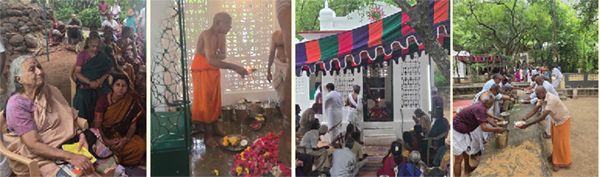
Muruganar Bhagavan's close devotee, was a poet-saint who composed thousands of Tamil verses, later compiled as Guru Vachaka Kovai, Ramana Sannidhi Murai, etc. A memorial to his life was observed at his Samadhi on 22nd August with devotees chanting his works. —
Mahakumbhabhishekam 2025: Go Puja
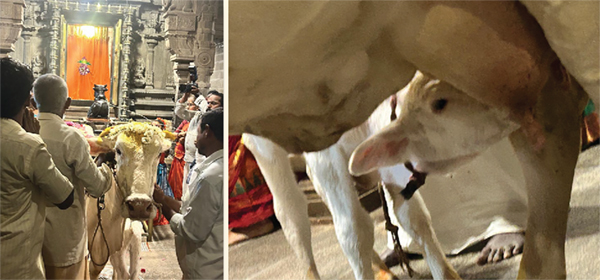
On Tuesday, 19th August, in keeping with ancient tradition, a cow and calf from the Ashram's gosala were ceremonially brought to the Mother's Shrine for go puja.
In India, the cow and calf are revered as symbols of abundance and prosperity. The cow is Kamadhenu, the wish-fulfilling divine mother who emerged along with the goddess of prosperity when the Ocean of Milk was churned to get amrita. According to the sastras, all Devas and Devis dwell within different parts of the cow, making her a living embodiment of the Divine. For this reason, the cow has been honoured for millennia as the embodiment of spiritual merit. In important ceremonies such as a grihapravesam (housewarming), it is customary for a cow and calf to enter the home, sanctifying the space before the family takes residence. Similarly, in the renovation and re-consecration of a temple, the cow and calf are ceremonially led into the Shrine. Their presence purifies the space following repairs, removing obstacles and inviting divine blessings before the commencement of the main event. —
Mahakumbhabhishekam 2025: Kalasha Installation Ceremony

On 19th August, in preparation for the great event, the Ashram President and temple architects ascended the towering Rajagopuram, the Matrubhuteswara vimanam, and Bhagavan's vimanam to reinstall the newly gold-electroplated kalasams. In South Indian temple architecture, the gopuram is the majestic gateway between worlds. Draped with sculpted gods, goddesses, and guardians, it proclaims timeless stories while lifting the gaze heavenward. Its mystery is evoked in the tale of Sundaramurthi Nayanar seeking Kalaya Kovil who, blinded by Lord Siva, sang verses of praise of the Lord until suddenly he beheld the temple's mighty gopuram—a reminder that pure devotion transforms stone into vision of the Divine.
Near the gopuram stands the vimanam, rising above the sanctum and celebrated in the Vedas as the very axis of the world. The kalashas (sometimes called shikara) crowning both gopuram and vimanam are not mere ornaments but summits of power, gathering celestial energies and channelling them into the mulasthana below, where the deity resides in silent majesty. —
Mahakumbhabhishekam 2025: Kalakarshanam
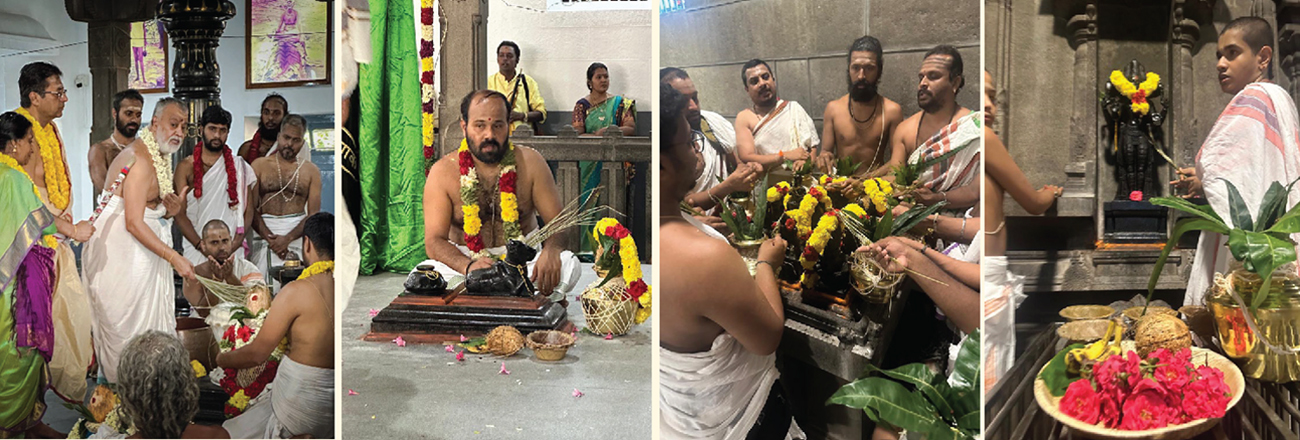
Kalakarshanam is a vital ceremony performed before Mahakumbhabhishekam to safeguard and restore divine energy after temple renovations. According to agama sastra, each deity embodies sixteen splendours, easily disturbed by repairs or shifting of the image. To prevent disruption, the deity's power is first transferred into consecrated vessels filled with grains and herbs, then into smaller temporary images—pratibimbas—before work begins. The process is reversed after work is completed and the pots have been charged in the yagasala through homam and mantra. Before the climax of Mahakumbhabhishekam, when the sanctified water ritually anoints the deities—renewing their potency and divine power—kalakarshanam is performed. —
Mahakumbhabhishekam 2025: Bhagavan’s Prasad
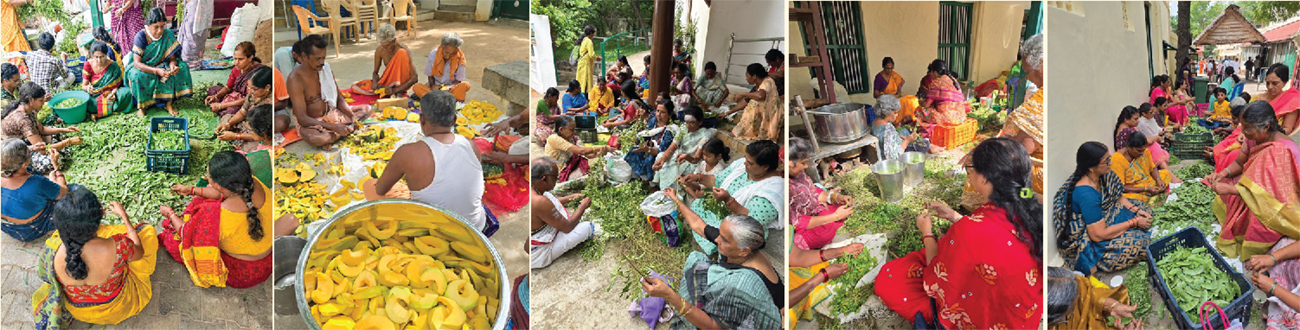
As the crowds swelled during the Mahakumbhabhishekam celebrations, the Ashram kitchen became a lively hub of joyful service. From early morning until late at night, devotees volunteered to chop vegetables and prepare meals, working side by side in a spirit of light-hearted camaraderie.
Three days of sustained collective effort culminated on Mahakumbhabhishekam day, when more than 15,000 were served lunch. With every guest treated as none other than the Lord Himself, meals were offered at multiple locations: the Narayana Seva area near the front gate, a large dining space beside the men's dormitories, and the Granthalaya Auditorium, where devotees were welcomed with warm hospitality. Volunteers moved tirelessly, ensuring that everyone received prasad. —
Mahakumbhabhishekam 2025: Technical Features and Logistics
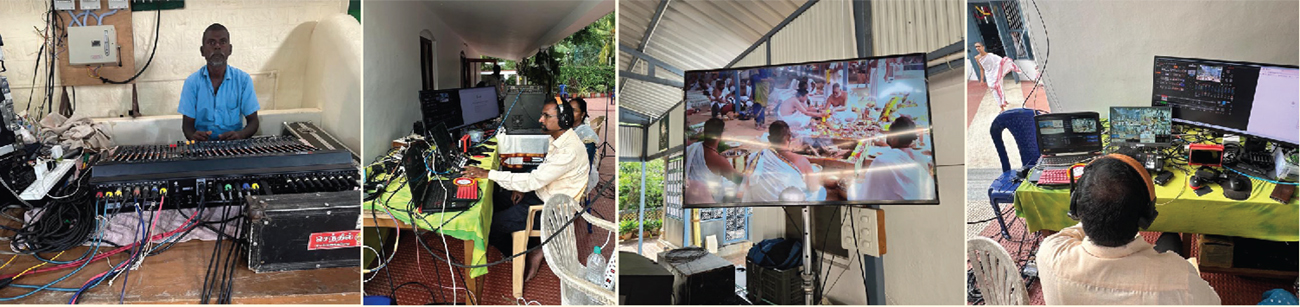
This year's Mahakumbhabhishekam required a technical upgrade, as attendance exceeded the Ashram's capacity. Traditionally, South Indian Mahakumbhabhishekams are rooftop events, with thousands watching from the shrine and nearby buildings. But in August 2025, with intense heat and an aging devotee base, only about 200 gathered on the Mother's Shrine/Samadhi Hall roof and 110 on the Dining Hall roof.
To ensure no one was excluded, large viewing screens were placed at key locations—the Sri Vidya Havan mantapam, the front office, beside the men's dormitory, and inside Bhagavan's Samadhi Hall—offering devotees the equivalent of front-row seats. The screens proved invaluable for rites within the Mother's Shrine sanctum, normally hidden from view. High-quality live broadcasts captured homams, abhishekams, and final consecrations in real time.
Around 2,600 devotees attended the main event on 20th August, while live-streaming extended participation worldwide. Many in Tiruvannamalai who could not come, and countless devotees abroad, joined from their homes. In this way, technology bridged distance, climate, and age, ensuring Bhagavan's grace reached all who longed to share in this sacred moment. —
Best Shot: Consecrating the Path Up to the Gopuram
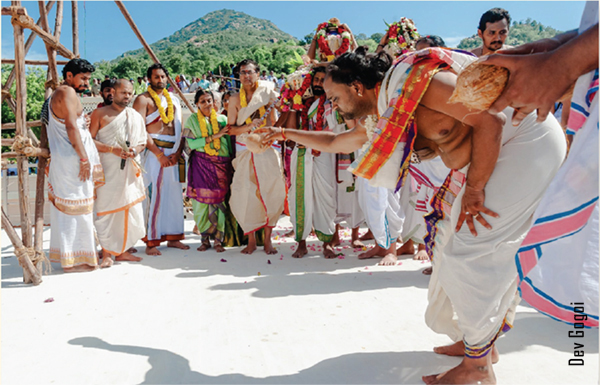
During the final procession on Mahakumbhabhishekam Day, the pots containing sanctified water—personifying the deities—are carried in solemn procession. Along the way, coconuts are broken to purify the ground they pass over and to honour the divine presence contained within the pots.
The coconut tree is regarded as auspicious. Tradition holds that when Lord Vishnu descended to earth, He brought with Him a coconut tree and the wishfulfilling cow, Kamadhenu, as gifts to Goddess Lakshmi for the welfare of humankind. The act of breaking a coconut carries deep symbolic meaning. The hard shell represents the ego—the principal source of defilement—which must be shattered. When the shell is broken, the inner purity is revealed: the soft, white kernel symbolises what is true and good, while the act itself signifies the release of impurities, leaving both the devotee and the surroundings sanctified. —
Events at Sri Ramanasramam: Vinayaka Chaturthi
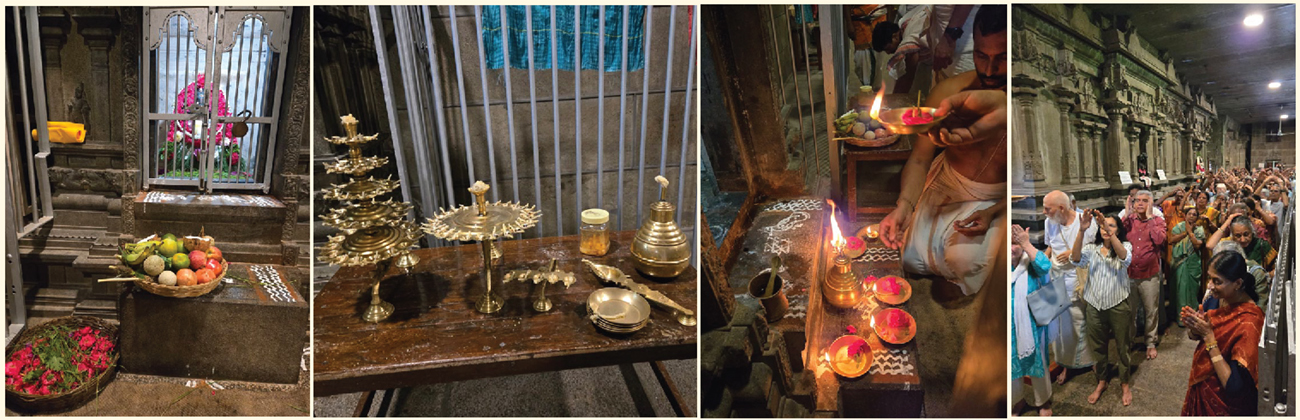
Vinayaka Chaturthi is celebrated during Avani (mid-August to mid-September) and venerates Lord Ganesha, remover of obstacles and giver of wisdom. By tradition, devotees clean and decorate homes, install images of Vinayaka, and perform pujas with flowers, fruits, coconuts, and food items. On the morning of 27th August, devotees gathered in the Mother’s Shrine to observe the day before the two main images of Lord Ganesha. —
Mahakumbhabhishekam 2025: Bhagavan’s Prasad (pt II)
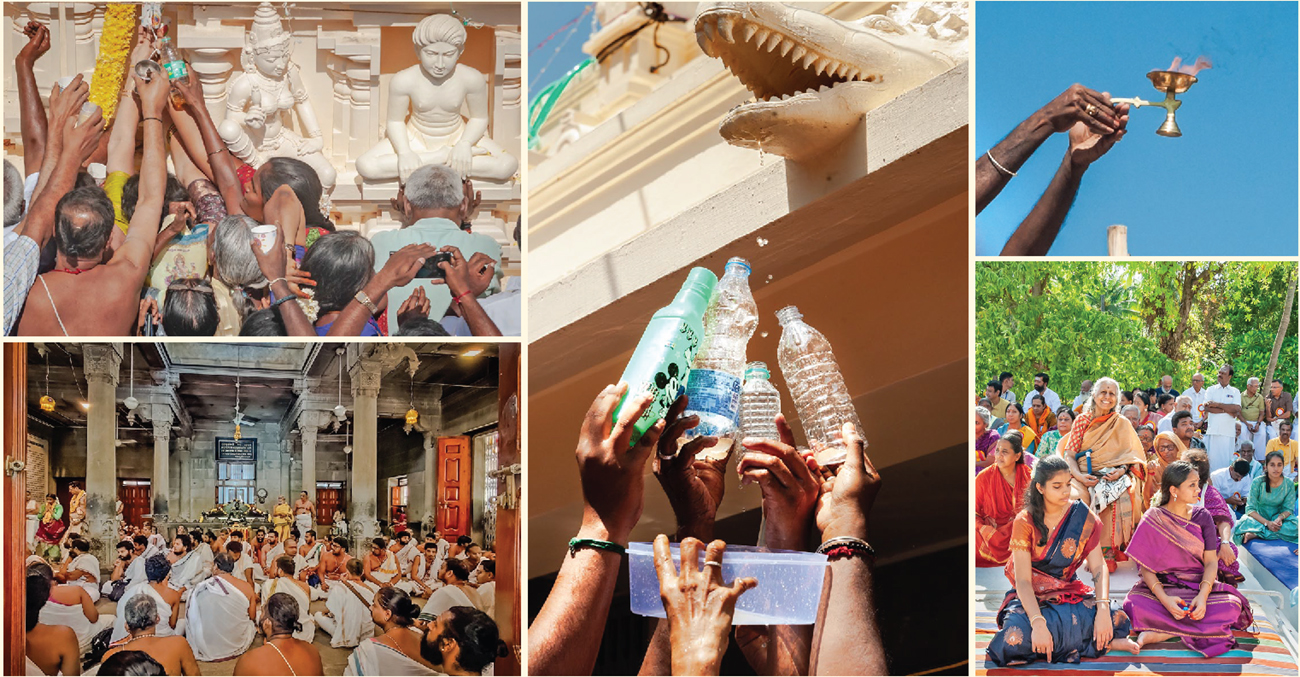
In former days, upon arrival at Sri Ramanasramam, devotees were urged by Bhagavan to go to the kitchen and have their food. This was something they longed for anyway—not to fill their stomachs but to fill their hearts with Bhagavan's grace in the form of prasad. His prasad was not found solely in the tangible items from the Ashram kitchen but also in the awakening influence emanating from the Sage himself. Indeed, prasad is a divine gift—the manifestation of Divine favour and a bridge between the created and the Uncreated. And so much more so during these holy days of Mahakumbhabhishekam. —
Obituary: Major P. Parthasarathy (1940-2025)
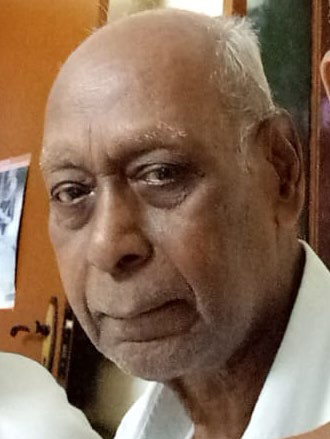
Major P. Parthasarathy was born on 24th April 1940 in Kalicherla, Andhra Pradesh, the eldest of eleven children born to Aswathama and Padmavatamma Pentamsetty. As a young man he joined the Indian Army, serving with distinction in Kashmir along the Chinese border and later in Sri Lanka during the 1980s as part of the peacekeeping force.
After retiring as a Defence Officer, he settled at Sri Ramanasramam in the mid-1990s, where he assisted in various capacities—Ashram room inspections, afternoon public reading of Bhagavan's works, and (Telugu) publications. When advancing age made active service difficult, he devoted himself wholeheartedly to spiritual practice. His days were spent in seated meditation on Bhagavan's path of atma-vichara, together with daily recitation of the Sri Rudram and the Taittiriya Upanishad.
In July 2019, he was diagnosed with inoperable, though treatable, prostate cancer. Despite health challenges, he continued to visit the Ashram twice daily and participated fully in the recent Mahakumbhabhishekam. Shortly after the celebrations in August, he fell ill and spent his final week bedridden. Though the Major had sometimes lamented the difficulties he faced in the course of his life, those who were with him during his last hours spoke of the deep peace with which he met his end. On Vinayaka Chaturthi, 27th August 2025, at 9:15 am, he merged peacefully at the Feet of Sri Bhagavan. —
Endnotes
- 1 Or Monk Chao. Dr. Rao Mallampati, a South Indian Pali scholar, notes that 5th-century Chinese monk Sengzhao explored emptiness and the limits of conceptual understanding in Zhaolun, using dreams to illustrate reality's illusory nature and the unreliability of perception.
- 2 Case 40 in the Heikiganroku or Blue Cliff Record.
- 3 Case 19 of the Mumonkan or The Gateless Gate.
- 4 Talks §32, §46, §359, §362, among others.
- 5 For example, Saranagati, January 2024, p. 11.
- 6 Mundaka Upanishad 3.1.1-2.
- 7 The theory of Being.
- 8 Summarised in Wikipedia.
- 9 To Alain Aspect, John F. Clauser and Anton Zellinger.
- 10 The fundamental substance of all reality.
- 11 This is a point regularly made by cognitive scientists and physicists alike, people like Prof. Donald Hoffman, Bernardo Kastrup and Iain McGilchrist, among others.
- 12 Talks §451, 4th February 1938.
- 13 It's not just the Nobel Committee in Stockholm in 2022 that seems to be acknowledging that space-time is not the ultimate ground of the cosmos. A new generation of mathematicians are developing sophisticated models extending beyond traditional space-time frameworks.
- 14 Das Ding an sich.
- 15 Which says that for any proposition P, either P is true, or not-P is true. There's no third option.
- 16 Talks, §376, 21st March 1937; §146, 26th January 1936.
- 17 Talks, §466, 6th March 1938.
- 18 Talks, §68, 21st July 1935.
- 19 Talks, §354, 8th February 1937.
- 20 The Oxford neuropsychologist, Iain McGilchrist is fond of citing this image in his public talks.
- 21 The Brihadaranyaka Upanishad, 4.5.6.
- 22 Book 3, Chapter 109.
- 23 Talks, §49, 24th April 1935; §29, 4th Feb 1935; §53, 15th June 1935.
- 24 The Mumonkan (or The Gateless Barrier) from Zen master Wumen Huikai.
Publisher: Dr Venkat S. Ramanan
saranagati@gururamana.org
