Saranagati October 2026 — Sri Ramanasramam eNewsletter
Saranagati October 2026 — Vol. 20, No. 10
Dear devotees,
In this issue, we conclude the life story of K. K. Nambiar, who first came to Bhagavan in 1932. In this final instalment, we see how he assisted in the construction of the Matrubhutesvara Temple. we also saw how a dream he had on 2nd April 1950 would prove significant in determining the place where Sri Bhagavan’s physical body was interred following the Sage’s Mahanirvana. (See p. 3ff.)
In Ramana Reflections: Vichara in Real Time — The Clarifying Power of Portable Enquiry, we explore how the disorientation that sometimes accompanies daily life is connected with the illusion of a separate self. As the ignorance underlying dehatmabuddhi gradually diminishes through the application of Bhagavan’s teachings, greater clarity begins to emerge about how to live, and the demands of daily life become less burdensome. (See p. 11ff.)
Calendar of Ashram events from October to December 2026
4th Oct (Sun) Punarvasu
8th Nov (Sun) Deepavali
11th Oct (Sun) Navaratri Festival begins
9th Nov (Mon) Annamalai Swami Day
20th Oct (Tue) Saraswati Puja
15th Nov (Sun) Big Temple Deepam Flag-raising
21st Oct (Wed) Vijayadasami
24th Nov (Tue) Karthigai Deepam Day
25th Oct (Sun) Full Moon
28th Nov (Sat) Punarvasu
1st Nov (Sun) Punarvasu (starts at 12noon, 31st Oct)
25th Dec (Fri) Sri Bhagavan’s Jayanti
In Profile
K.K. Nambiar (Part III)
Audio: IN PROFILE
0:00 / 0:00
Unable to play audio. Please check if the file exists.
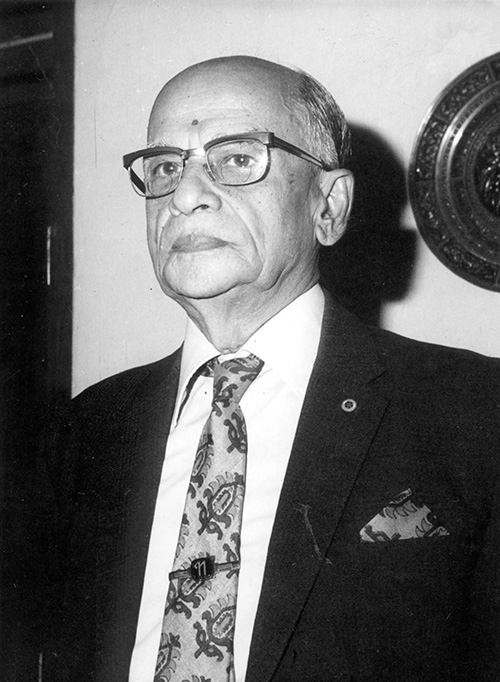
Sri K.K. Nambiar
As K. K. Nambiar’s devotion to Bhagavan deepened, the emphasis of his spiritual life gradually shifted from ritual worship towards the conviction that God dwells within the Heart. Bhagavan’s guidance seemed to accompany Nambiar everywhere. We saw last time how during a dangerous crossing of a flooded causeway, Nambiar inwardly invoked Bhagavan and crossed safely. Later, dreams appeared to anticipate important events, including the correction of an engineering error and an unexpected transfer to Madras, where he would serve for the next fifteen years. Nambiar increasingly interpreted these events as signs of Bhagavan’s grace.
We read in the last issue the story about a playful “wager” over whether Bhagavan would assist him with a suitable train accommodation and the unusual discovery of an empty first-class carriage.
We read about how his foreign deputation in 1946 led him to England where he met the elderly devotee Mrs. Victoria Doe, whose intense love for Bhagavan deeply moved him. In California he visited Eleanor Pauline Noye, with whom he experienced a powerful sense of Bhagavan’s presence despite being thousands of miles from Tiruvannamalai. Striking was the chance meeting with Aurobindo Bose in a New York hotel, which for Nambiar was yet another instance of Bhagavan’s guidance.
Through all these experiences, one conviction steadily matured: Bhagavan was not confined to his physical form. His true dwelling place was the Heart of the devotee. Let us continue our account.
A Gramophone Record from Chicago
While in Chicago in September 1946, Nambiar recorded four Sanskrit slokas in praise of Bhagavan on a gramophone disc and mailed it to Sri Ramanasramam. At the same time, he sent another recording to his wife and children in Madras. Strangely, the record addressed to the Ashram arrived safely, while the one intended for his family never reached them.
When he returned to India in 1947, Nambiar learned that Bhagavan had listened to his recording several times in the hall with the devotees. The thin vinyl disc tended to slip while playing, distorting the sound, and Bhagavan himself suggested fastening it to a heavier record to keep it steady. He also identified for those present the different sources from which the four verses had been taken.
Return to India
Nambiar’s official assignment in America had originally been due to end in October 1946, but just as the delegation was preparing to return home, Nambiar received instructions to remain abroad and undertake another assignment. Following the collapse of a building in Madras, deficiencies had been discovered in the city’s municipal building regulations. He was therefore asked to study the building codes of American and British cities and help prepare a modern code for Madras.
The work involved extensive travel in America and England, meetings with officials and attendance at conferences. Travelling alone was not always easy, particularly in places where racial prejudice remained strong. Yet throughout this period Nambiar felt that Bhagavan was with him, guiding and protecting him. He finally returned to India towards the end of February 1947.
His first desire after being reunited with his family was, naturally, to go to Tiruvannamalai and see Bhagavan:
Before leaving New York I had purchased a cine camera and some spools of 8 mm colour film and I wanted to make a small movie picture at the Ashram. After obtaining necessary permission from Sarvadhikari and Bhagavan I took a number of shots of Bhagavan moving about through the Ashram premises, dining hall, ‘goshala’, etc. Bhagavan asked me to take a picture of the white peacock moving about in the hall and outside. The peacock was the one brought by the Maharani of Baroda and it was said to be Bhagavan’s attendant, Madhavan, reborn after his demise in July 1946. Also included in the film was Bhagavan’s favourite cow Lakshmi being caressed by him, as well as myself and my wife kneeling at his feet. I made sure that my forehead was touching his feet while he was standing in the ashram compound in the company of a large number of devotees, including Sri Niranjanananda Swami and his family members. The spool was completed with some shots of the Ashram Garden and portraits of Chadwick and Dr. Sayeed, and the holy hill of Arunachala.
During the years 1947–50, Nambiar visited the Ashram frequently and became involved in the design and construction of the hall adjoining the Matrubhutesvara Shrine. Sri Vaidyanatha Sthapati, who supervised the stonework and sculpture, kept closely in touch with Nambiar. Bhagavan himself followed the progress of construction and occasionally questioned Nambiar about structural details.
The Yogasana
Aurobindo Bose had arranged for a black granite couch to be made for Bhagavan. It occurred to Nambiar that he could provide the mattress and backrest cushion:
Immediately on my return to Madras I contacted the T. V. S. people and requested them to arrange for preparing the cushion in their upholstery department with the best materials available. When they were completed, I arranged to carry them to Tiruvannamalai. The cushions were made with plush cloth, smooth and shiny like velvet, and they had particularly asked me not to bend the mattresses or attempt to roll them up for transporting to Tiruvannamalai. I had therefore to carry them on the roof of my car. On arrival at the Ashram, when I went and sat before Bhagavan, he mentioned to me that it looked as if I had carried them on my head, though he had no occasion to see the way I carried it on the car. “Thalayil vechukondu varunna mathiriyundu” was what he said. It gave me a pleasant thrill. During one of the subsequent visits when I asked Bhagavan whether he was using the cushion, he replied that he would sit on the new couch at a muhurtham to be fixed for it. Accordingly, he started sitting on the cushion, but when the hot weather came the yogasana and the plush cushions were too warm and Bhagavan restarted using the usual sofa and cushions.
During these years Nambiar acted as an Ashram agent in Madras, obtaining construction materials, paper and other supplies. Bhagavan seemed fully aware of these activities. He would ask why certain materials had been ordered and listen patiently while Nambiar explained their purpose.
Bhagavan showed the same interest in Nambiar’s official career:
Just when I was promoted from the Corporation Engineer’s level to be the Chairman of the City Improvement Trust, Bhagavan asked me what sort of work I would be engaged in, in the new job. I gave him the details which he listened to patiently. Likewise, after a year and a half when I was recalled to P. W. D. Highways Department as Superintending Engineer with the object of making me the Chief Engineer, on the retirement of the then European incumbent, Bhagavan questioned me and also asked me whether I would not be a loser in my emoluments. I replied that there could not be any reduction as per rules. What Bhagavan said was “sambalam kurayumallo”. But despite all rules, I suffered a reduction in my salary for a year and a half, till I was promoted as Chief Engineer.” Bhagavan also used to enquire about my sister Madhavi Amma, who was then in the Ashram with her husband Dr. P. C. Nambiar.
A Direct Route to the Heart
Bhagavan also guided Nambiar whenever doubts arose in his spiritual practice.
At one time Nambiar became uncertain about the proper locus to meditate upon. Ashram publications spoke of the Heart on the right side of the chest, but books on yoga described concentration on such centres as the muladhara, the tip of the nose or the point between the eyebrows. He had also read of Ramakrishna’s guru, Totapuri Maharaj directing Sri Ramakrishna’s attention to the space between the eyebrows. One day, finding Bhagavan alone in the Hall, Nambiar put his doubt before him:
I went and prostrated before him and asked the question. Instead of giving me a straight reply he got down from the sofa and going to the rotating shelf nearby, took out a copy of Ramana Gita and opened it right on the page and read out the sloka 4, Chapter V: “If the Heart be located in anahatachakra how does the practice of Yoga begin in muladhara?” He asked me when the heart centre was there, why not go directly to its instead of going through some other centres? He also asked me in Malayalam: “To come to Tiruvannamalai from Madras why should you go to Banares first and then come down all the way, or why go to Ramesvaram and come up here. Why not come straight?” The instructions were quite clear. But I felt distressed over the fact that Bhagavan had to point out to me chapter and verse from Ramana Gita to dispel my doubt when Hridaya Vidya had been fully detailed in Chapter V. Bhagavan had written out the whole of Ramana Gita in his own handwriting and given me a copy with his blessings and I hadn’t yet found time to study it in detail and follow the instructions therein.
Bhagavan’s Solicitude
For nearly twenty years Nambiar had suffered from a persistent patch of eczema on his ankle. One day Nambiar’s sister mentioned it to Bhagavan. He simply said, “It will go by itself.” After some time it disappeared.
On another occasion Chinnaswami had kept Nambiar occupied with Ashram work all morning, leaving him almost no opportunity to sit with Bhagavan. After lunch the hall was closed while Bhagavan rested, so Nambiar sat outside on the steps and meditated:
I was sitting at the corner of the steps where, even if the door had been open, Bhagavan could not have seen me. Sometime later, one of the attendants went inside, when Bhagavan mentioned to him that I had been sitting outside on the step and asked him to call me in to sit inside the hall. When I went in, Bhagavan was reclining on the couch inside a mosquito net. He signalled me to sit nearby. I closed my eyes and restarted the meditation, when the attendant brought a glass of orange juice and half a dozen tender palmyra fruits (nongus) for Bhagavan.
On instructions from Bhagavan, the attendant passed on two nongus to me. I had not taken a nongu like that before. Only the tip of the nongu was cleaned by removing the fibre and exposing three eyes like holes. I did not know how to strip it and get at the succulent flesh inside. Bhagavan, who was watching my discomfort showed me how by pressing with the thumb at one of the eyes, the pulp would pop up at another one where it could be sucked into the mouth. I followed this method and enjoyed eating both the nongus. Meanwhile Bhagavan drank part of the orange juice and gave me the rest to drink. That was his ‘samadrishti’ and kindness to devotees.
Bhagavan’s Illness
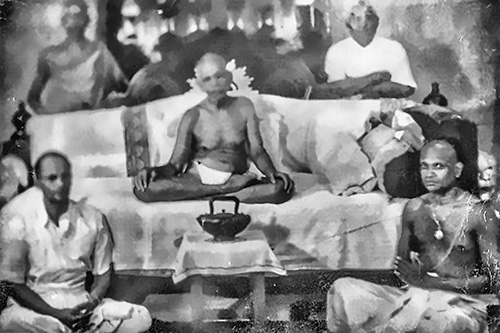
(Top left to rt): Chinnaswami, Chavali Sastri, Nambiar and Vaidyanatha Sthapati, 1949
Towards the end of 1948, a small growth appeared behind Bhagavan’s left elbow. It was removed on 9th February 1949, but soon returned. In March, shortly after the Mahakumbhabhishekam of the Matrubhutesvara Temple, a second operation was performed. The growth was diagnosed as sarcoma.
The temple consecration took place from 14th-17th March. On the final day Bhagavan, already physically weak, wished to witness the abhishekam of the temple tower. Nambiar had the privilege of helping him rise from the couch and walk into the garden. With his arm around Bhagavan’s waist, he supported Bhagavan until he was seated in a manner suitable for viewing the ceremony.
That evening elaborate worship of the newly installed Meru Chakra continued beyond the expected hour. The temporary dining hall was already packed with devotees waiting for Bhagavan before the meal could begin. Chinnaswami asked Nambiar to persuade Bhagavan to leave the ritual and go for dinner, which, of course, Bhagavan declined.
As 1949 progressed, Bhagavan’s condition worsened. A third operation was performed in August. Although the wound initially healed, the growth soon returned higher on the arm.
One day, while Nambiar was engaged in work elsewhere in the Ashram, Bhagavan’s bandage was being changed. When the malignant growth was exposed, Bhagavan said, “Let Nambiar come and see it.” Nambiar hurried to the hall:
I was asked to hold Bhagavan’s left outstretched arm. I held his palm in my right hand. Moosa was removing the bandage and cleaning the wound. He spoke in Malayalam, some of which I translated, though I was sure Bhagavan could make out every word of it. My translation of the conversation was more useful to Moosa and others standing nearby. When I was holding Bhagavan’s hand, he bestowed a look of Grace on me and I also felt a gentle squeeze of my palm, while holding his fingers, which sent a thrill all over my body. I was previously nursing a remorse for having unknowingly given some pain to Bhagavan’s body. I had been massaging his legs when he was lying down with his body covered with a white sheet of cloth. Unknowingly, I pressed a tender part of the foot where some drip needle had punctured the skin. Bhagavan’s leg jerked indicating that I had inflicted pain on the body. I felt very sorry for having inadvertently caused him pain. This remorse lingered in me all these days, but when I felt the gentle squeeze from Bhagavan’s hand, it disappeared once and for all.
Let All This Subside
During the final stage of Bhagavan’s illness, Nambiar once mentioned to him a prediction in the Bhrigu Nadi suggesting that he might prolong his life through yogic powers. Nambiar’s sister, Madhavi Amma had likewise written asking Bhagavan to cure himself for the sake of his devotees.
Bhagavan smiled. He remembered the reading and said he would like to see it again. Beyond that, he remained silent.
On 12th April 1950, two days before Bhagavan’s Mahasamadhi, Nambiar was at the Ashram. He had built a new house in Gandhinagar, Madras, and the house-entering ceremony was fixed for the following day, Tamil New Year. He wished to receive Bhagavan’s blessings before returning.
That day Bhagavan declined his usual medicine. Sri Niranjanananda Swami asked Nambiar to see whether he could persuade Bhagavan to take it.
Bhagavan lay reclining with his eyes half closed, occasionally troubled by hiccups. Nambiar raised the cup to his lips. Bhagavan made an effort to open his mouth, and some of the medicine flowed down the side of his face.
In a faint voice Bhagavan said in Malayalam:
Etellam adangatte—“Let all this subside.”
Those were the last words Bhagavan spoke to Nambiar. Nambiar never made out whether Bhagavan meant simply, “Let these hiccups subside,” or whether the words carried a deeper meaning: let all this—the body, the breath, the pranas themselves—come to rest.
Nambiar returned to Madras that afternoon.
Mahasamadhi
On 13th April, a letter arrived from Sri Niranjanananda Swami conveying Bhagavan’s blessings for Nambiar’s house-entering ceremony.
The following evening, 14th April, Nambiar and his wife hung a large photograph of Bhagavan seated in padmasana in the drawing room of their new home. At about 8.45 that night, after dinner, they were standing in the courtyard with their children.
Nambiar’s younger son suddenly pointed towards the sky: “Papa, look! What is that? A big star?”
They saw an extraordinarily bright object moving across the heavens. It travelled too slowly to be a shooting star and too rapidly to be an aircraft.
Nambiar’s intuition was to attribute it to Bhagavan.
“It is Bhagavan passing away,” he exclaimed, and began reciting one of the Sanskrit verses he had recorded for Bhagavan years earlier in Chicago. They watched the luminous object move across the sky until it disappeared towards the eastern horizon. The time was approximately 8.47 pm.
Nambiar told his wife that he should leave immediately for Tiruvannamalai. Soon afterwards a telephone message confirmed that Bhagavan had passed away. Nambiar packed some clothes and set out around midnight, driving through the night. He reached the Ashram in the early morning.
The Site of the Samadhi
At the Ashram gate Nambiar was met by Sri Thoppiah Mudaliar. Mudaliar told him that they had been waiting for his arrival because a dispute had arisen concerning the exact location of Bhagavan’s Samadhi.
Years earlier, while the Matrubhutesvara Shrine and adjoining hall were under construction, the working assumption had been that Bhagavan’s eventual samadhi would be placed beside the Mother’s Shrine, so that devotees could worship both at once. Nambiar had even made certain structural provisions for such an arrangement.
But something had happened shortly before Bhagavan’s passing which had disturbed his confidence in that plan.
On 2nd April 1950, Nambiar had a vivid dream:
In the dream, Bhagavan was lying on the bed in the room now known as Nirvana Room with its doors partially open, speaking to Niranjanananda Swami and Venkattoo standing in front with their backs towards me. Bhagavan could see me standing outside the room at some distance. He told them, “Nambiar is waiting outside; call him in.” On my entering the room Bhagavan got down from the bed and leaning on a walking stick, walked outside followed by three of us. He took us to the side of the Pali Tirtham to a spot parallel to the Mathrubhutesvara Shrine and drew a rectangle on the ground with his walking stick, as though to indicate the place of his Mahasamadhi. The dream ended. The message was very clear to me. I noted it down with a sketch in a notebook as usual. I hurried to the Ashram and mentioned the details of the dream to Sri Omandur Ramaswami Reddiar who was standing outside Bhagavan’s Nirvana Room and explained how the site indicated in the dream conflicted with our earlier plans. He suggested that I should discuss the matter with Sarvadhikari. The latter simply pooh poohed the idea and said “You please go and keep these dreams and visions to yourself. Don’t create complications, we have enough problems already.” I spoke also to Sri T. K. Duraiswami Iyer and some others and left the matter there, thinking that we could face the issue when it arose.
But on the night of Bhagavan’s Mahasamadhi, townspeople and devotees strongly objected to placing Bhagavan’s shrine in a subsidiary position beside the Mother’s Temple. Bhagavan, they insisted, must have a shrine and hall at least equal in dignity and dimensions to that of the Mother.
The place they demanded was precisely the place indicated in Nambiar’s dream. After considerable argument, Chinnaswami finally yielded.
When Nambiar arrived the following morning, excavation had already begun. He checked the dimensions carefully and shifted the centre slightly northward so that the new shrine could have the same interior width as the Matrubhutesvara Shrine. Space permitted nothing larger.
Throughout the day Nambiar remained occupied with preparations for the interment. A central pit was prepared, together with the substances traditionally placed within a samadhi. Amid continuous chanting, Bhagavan’s body, seated in padmasana, was lowered into the place that had been prepared.
The rectangle Bhagavan had traced with his walking stick in Nambiar’s dream had become his earthly resting place.
Bhagavan’s Continuing Presence
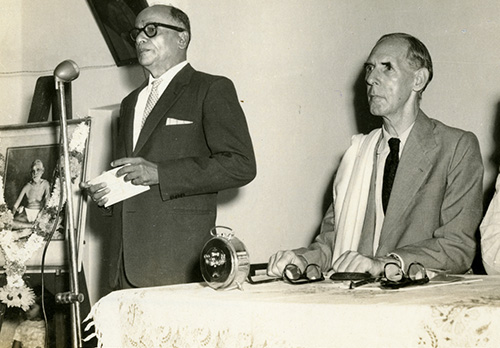
Nambiar giving a talk at an Ashram function (Arthur Osborne seated to his left)
Nambiar’s association with Ramanasramam did not end with Bhagavan’s physical departure. On the contrary, his participation in its affairs continued without interruption.
For Nambiar, Bhagavan’s physical absence never constituted a real separation. The same presence that seemed to guide him during his years abroad, that watched over his professional and family life, corrected his spiritual doubts, accepted his service and drew him again and again to Tiruvannamalai, did not disappear on 14th April 1950.
Bhagavan continued to make his presence felt—in dreams, intuitions, unexpected guidance and innumerable incidents that Nambiar felt could not easily be explained in ordinary terms.
Looking back, the outward events of those years seemed almost secondary: journeys across continents, engineering work, temple construction, photographs and films, illnesses and medical treatments. What gave them meaning was the unseen thread running through them all—the conviction, repeatedly confirmed in Nambiar’s experience, that Bhagavan’s grace was quietly arranging circumstances and drawing devotees inward.
Even while Bhagavan lived in the body, his teaching had always pointed beyond the body. Bhagavan’s illness made this especially clear. While those around him struggled desperately to save his physical form, he remained the detached witness, allowing events to proceed without identifying himself with the suffering body.
His final words to Nambiar—“Let all this subside”—therefore remained deeply significant to him. Whether Bhagavan referred merely to his hiccups or to the final subsiding of bodily life, the words seemed in retrospect to express his entire teaching: that all movements ultimately return to the stillness from which they arise.
The body disappeared, but the Guru, the Self, did not. —
(series concluded)
[Editor’s note: This series is taken from the Sri Ramanasramam publication of Nambiar’s account of his life with Bhagavan, entitled, The Guiding Presence of Sri Ramana.]
Similes from Bhagavan: The Form of Love Itself
O Arunachala, Thou Form of Love Itself! I am loveless and do not think of Thee and melt with love for Thee like wax over a fire. But does it become Thee, once having claimed me, if instead of producing such love in me, Thou let me now be lost? O Bliss rising from Love! O Nectar springing in the heart of devotees! Haven of my refuge! Thy pleasure is mine. It is also my joy, O Lord of my Life!
Events at Sri Ramanasramam: Sri Muruganar Day
Sri Muruganar Day at Sri Ramanasramam, 10th September 2026
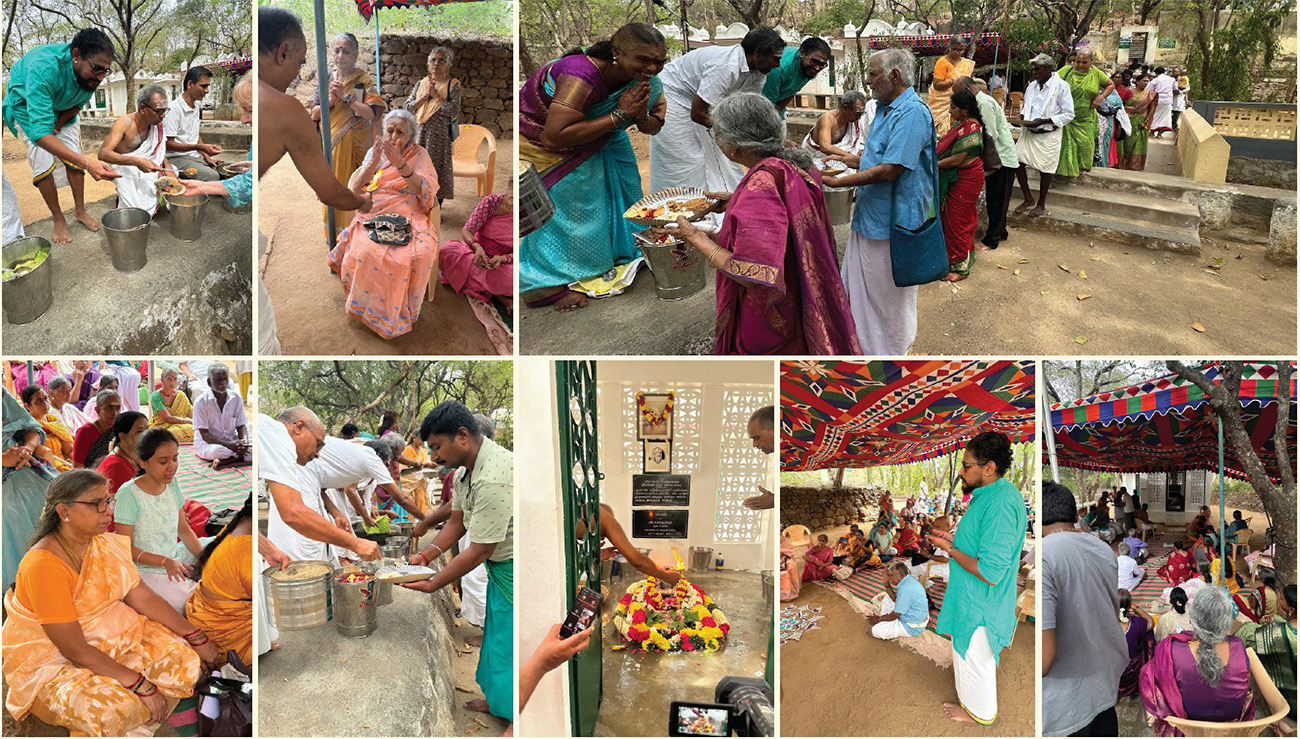
On Thursday 10th September, devotees gathered to observe Muruganar Day at his samadhi shrine. The event began with the recitation of Sri Muruganar’s Sri Ramana Sannidhi Murai. Just prior to arati, Aksharamanamalai was recited as the elaborate puja proceeded. Arati was followed by the distribution of prasad. —
Best Shot: Whispers of Silence
Dev Gogoi
Soft summer stillness
As the light lingers beyond sunset
Whispers of silence
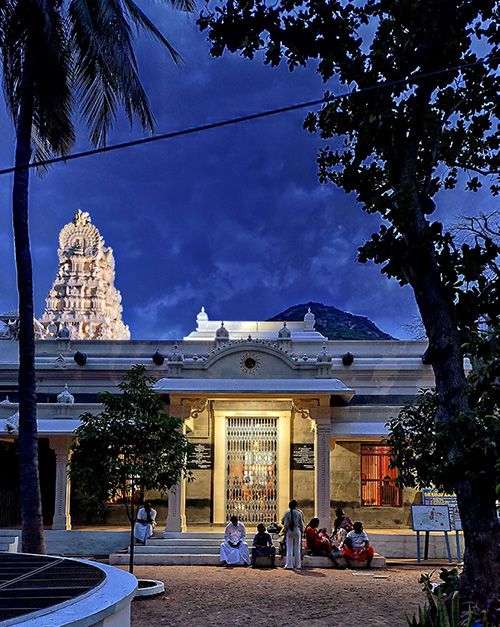
Floodlit gopurams and essential lighting along verandas and walkways around the Ashram shrines provide a luminous counterpoint to the towering presence of Arunachala—ancient, ever-present and supreme.
The weather remains hot thanks to a deep depression in the Bay of Bengal during the retreating phase of the South West Monsoon. Despite widespread cloud cover and rainfall across other parts of India, Tiruvannamalai has seen only a few welcome but inadequate showers.
While El Niño remains a powerful influence on local conditions, climate change is no longer a future possibility but a clear and present global reality. We all need to adapt and adjust our lifestyles and choices, and luckily there is no better exemplar for us than Bhagavan’s own being. —
Events at Sri Ramanasramam: Samvatsara Abhishekam
Pratistha-dina Samvatsara Abhishekam, 7th September 2026
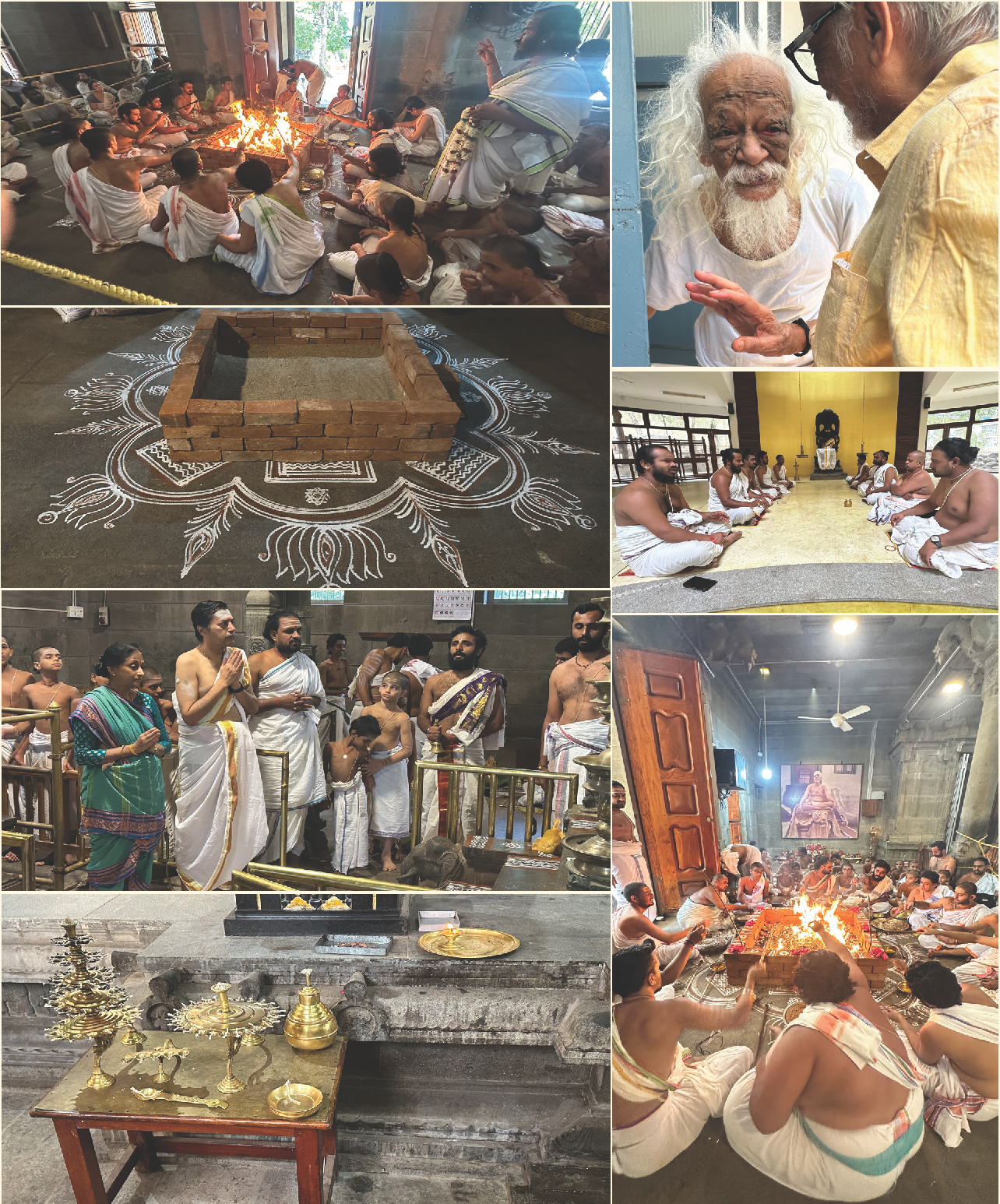
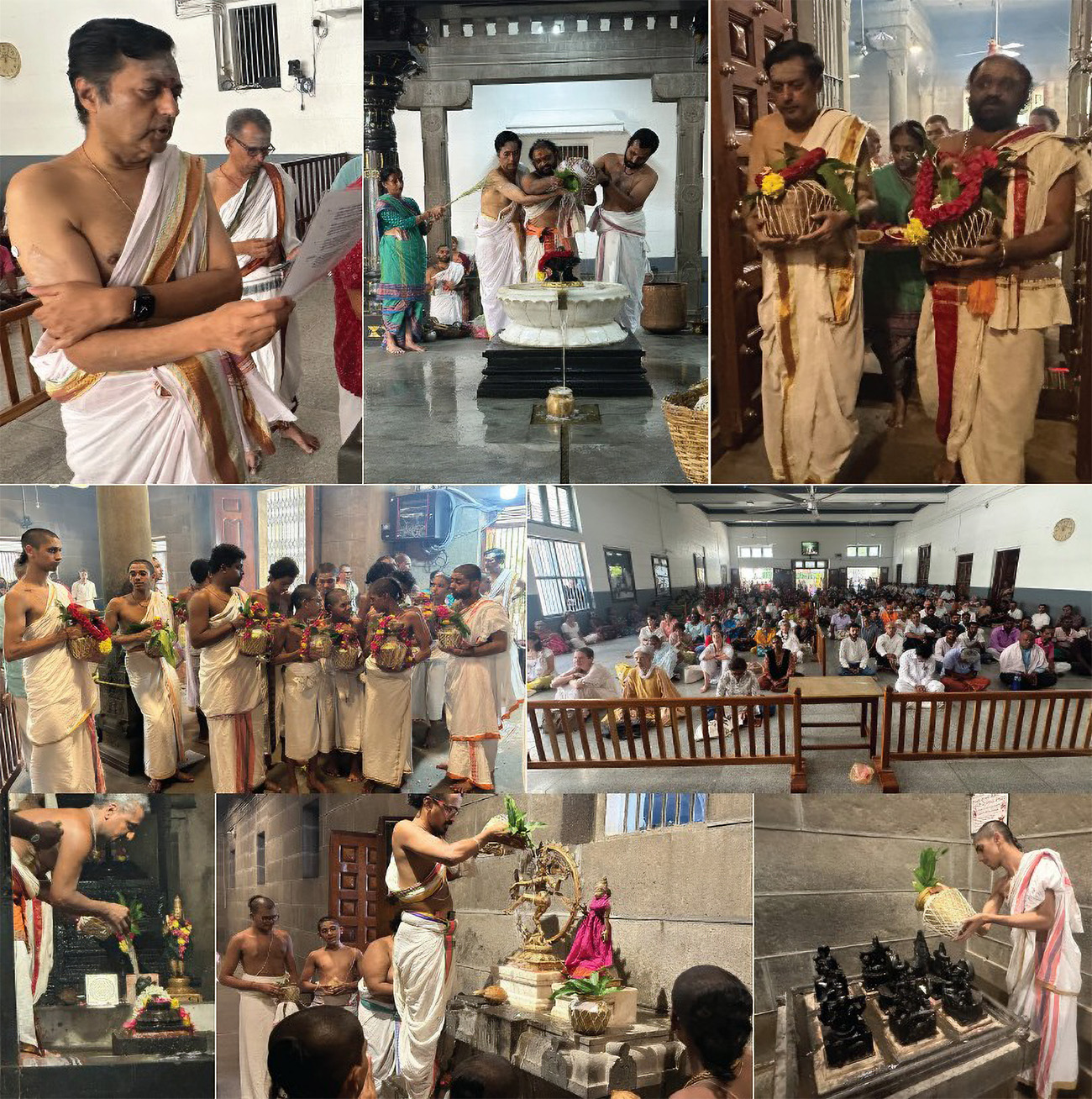
On this first anniversary of the Mahakumbhabhishekam of Sri Ramaneswara and Matrubhuteswara Shrines, Pratistha-dina Samvatsara Abhishekam was performed at the Ashram. Daily Vedic recitations took place in Bhagavan’s Shrine and in the Granthalaya Auditorium for one week in the run-up to the homa conducted in the New Hall on 7th September. Sankalpa and Mahanyasa japa began at 5.30 am, followed by homa, purnahuti, procession and abhishekam in Mother’s and Bhagavan’s Shrines, a liturgical and sacramental reminder of the great event that took place on this day (according to nakshatra) one year ago. —
Ramana Reflections
Vichara in Real Time
The Clarifying Power of Portable Enquiry (Part II)
Audio: RAMANA REFLECTIONS
0:00 / 0:00
Unable to play audio. Please check if the file exists.
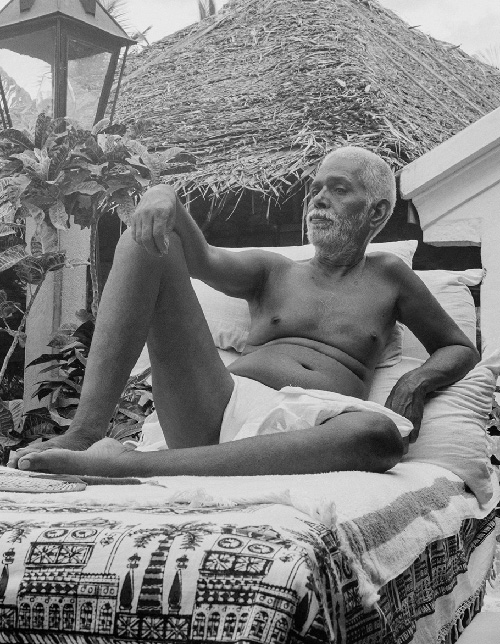
Bhagavan Sri Ramana Maharshi
In the first segment we saw how vichara need not remain confined to formal meditation. Bhagavan’s own decisive enquiry arose spontaneously in response to the fear of death, suggesting that life itself can become the field of enquiry. It is worth noting that Bhagavan had only a few years earlier lost his father, suffered the uprooting of the family, and relocated to Madurai. Bhagavan never commented on whether these were factors in the spontaneous vichara that arose in him in the upper room at Madurai in July 1896, but in general, the death of a parent may profoundly affect a young person. We recall how Ramakrishna once said that the loss of his father at an early age drove him toward God.
The contrasts and disruptions of earthly life can force a deeper questioning, especially when they occur early on. Even ordinary reactions—fear, disappointment, praise, blame, loneliness and frustration—reveal how we repeatedly construct and defend identity in order to gain stability. Portable vichara helps us examine moods, habits, impulses and assumptions, so that we can look beneath the adaptive response rather than seek fulfilment outwardly.
Enquiry turns attention toward the Heart and ultimately toward the one to whom reactions arise. Vichara’s purpose is therefore to weaken identification and reveal that the apparently continuous ego is only a succession of changing mental states.
Feeling States
Portable vichara begins in recognising a feeling: “This is fear.” “This is anger.” “This is yearning.” The purpose is not labelling for its own sake, but distinguishing a passing condition from identity. Fear is present, but fear is not the Self. The difficulty lies in confusing a mental event with an entity called “me.” Bhagavan says:
Thoughts are due to identification of the Self with the non-self.1
Attention Matters
Whatever we repeatedly attend to gathers strength. Rehearsing an insult strengthens resentment; replaying humiliation reinforces shame; imagining a feared future intensifies anxiety. A useful micro-vichara question might be: If I respond this way, what will increase?
We become interested in the contents of thought only insofar as they reveal conditioning and weaken the assumption that thought is “me.” Bhagavan gives the essential admonition:
Suppose someone criticises us. Pain may arise, followed perhaps by anger and mental agitation. Vichara does not require us to deny that the other person behaved badly. Instead, it asks us to discover the point at which pain becomes identity, i.e. the one who has been mistreated. Bhagavan asks:
Which part belongs to the actual event, and which part is added by memory, imagination, resistance and self-defence? We need not immediately call it “my pain.” Pain can be present without becoming an ego.
Changing the Story
The quality of our questions matters. Ignorance often speaks through unskilful enquiries such as, “Why am I always like this?” Such questions transform a passing condition into an identity, as though it were permanent.
Micro-vichara observes thoughts and feelings as conditioned states. Instead of “my anxiety,” we recognise anxiety; instead of “my anger,” anger is present. Even small adjustments in language and our internal conversation can weaken the reflex by which every experience becomes part of the story of “me.”
There is also a distinction between awareness and the direction given to awareness. We may know perfectly well that anger is present while continuing to rehearse every reason why we are justified in being angry. In this instance, awareness alone cannot free us. Micro-vichara asks: What follows if I continue attending in this way?
Attachment can be explored similarly. Praise may bring pleasure and validation, but dependence upon praise makes us hostage to other people’s opinions. The problem is not praise itself, but forming an identity around it.
Bare attention is not always sufficient. If anger has become intense, we may need to redirect attention, e.g. recalling the good qualities of the person involved, remembering those who have shown us kindness, or recollecting the blessing of Bhagavan’s grace. This need not be a departure from enquiry if it can help to loosen the mental condition preventing clear seeing.
Becoming Somebody
Portable vichara applies not only to momentary emotions but also to broader identities and assumptions. The egoic project is often driven by the feeling that we must become somebody—wiser, purer, more accomplished, admired, spiritual, or knowledgeable.
Even wholesome aspirations can be appropriated by ego. In spiritual life we may construct an image of who we imagine we ought to be and spend decades trying to become that person. Bhagavan repeatedly warns against assuming that perfection consists in adding something new to ourselves. Rather, freedom lies in removing what is extraneous. He says:
What are the worldly experiences but those built up on the false “I”? Ask the most successful man of the world if he knows his Self. He will say “No”. What can anyone know without knowing the Self? All worldly knowledge is built upon such a flimsy foundation.4
Spiritual knowledge is not exempt. We can become attached to philosophical positions, insights, interpretations and knowledge of the path. Knowledge that becomes “what I know” and therefore “who I am” can reinforce precisely the structure enquiry is designed to dissolve.
As mentioned above, Bhagavan tells us that whatever is gained afresh in time will eventually be lost in time. True knowledge is not acquired but uncovered through the removal of ignorance. In Ulladu Narpadu, Bhagavan says:
Without knowing the Self that knows, to know all objects is not knowledge; it is only ignorance.5
And again:
The Self that is awareness alone is true. Knowledge which is various is ignorance.6
The purpose of vichara is therefore not to build a more sophisticated ego but to loosen the strands that give ego apparent solidity. Desires, fears, memories, self-images and narratives seem to temporarily complete what feels incomplete. Because they cannot provide lasting fulfilment, the egoic project must begin again and again.
Inner and outer life are not separate in this respect. What remains unexamined within inevitably shapes our speech, actions and relationships. Enquiry gradually brings greater congruence between what we understand inwardly and how we live from day to day.
Human beings appear to possess innate capacities for relationship and belonging. Social forces are powerful, so much so that when we act in ways that challenge the harmony of the collective, the disturbance often registers inwardly as unease, regret or remorse. Portable vichara helps restore equilibrium, within and without.7
Lost
Non-vichara shows up in great stories from the past which often turn upon a violation of expectation. The world’s children’s stories often focus on a crisis, for example, a child getting lost in the woods and experiencing intense fear, confusion, and bewilderment. Of course, such disorientation greets the grown-up as well, forcing the question: Where am I, and what can truly be relied upon?
David Wagoner’s poem “Lost” gives a simple instruction for those moments when we are discombobulated, unable to find our way through the forest of life:
Stand still. The trees ahead and bushes beside you
Are not lost. Wherever you are is called Here.8
The terror of being lost arises from not knowing and not seeing. Yet the poem reverses the perspective: the forest is not lost; the disorientation lies within. If we are continually trying to escape from here, then we are truly lost. When we encounter a here that is unfamiliar or painful and respond by fleeing from it, we set ourselves up for a lifetime of running.
Here is where we meet the Heart amid the apparent imperfections of experience. This is the place where vichara can teach us how to override the impulse to avoid, resist or escape present conditions. Portable vichara reminds us that here is where the work is to be done, where all will be decided.
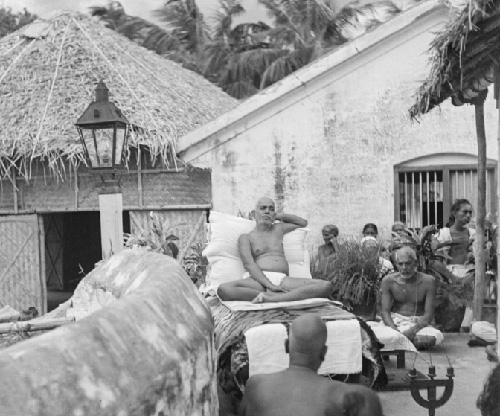
Bhagavan Sri Ramana Maharshi with devotees
And yet, even if we find ourselves running, each moment offers the opportunity to stand still—to observe and register our discomfort without immediately reacting to it, to renew our commitment to the work of knowing ourselves. In this sense, Bhagavan’s silence is equivalent to standing still.
Standing still exposes the mechanisms of identification and turns attention towards that which is neither born nor dies. Things are as they are, and inward order begins when we cease demanding that reality conform to our preferences. If we blame our surroundings or fail to appreciate that the forest knows where we are, we are likely to find ourselves exiled from the spiritual Heart. Stated briefly, everywhere is our home and being “lost” is only a passing mental state born of the inner estrangement. The poet continues:
No two trees are the same to Raven.
No two branches are the same to Wren.
In other words, nothing is alien to Raven and Wren, nor is anything grasped as the familiar place called home. Raven and Wren are not merely at home—they embody home, the belonging we previously imagined could only be found outside ourselves. The poet concludes:
If what a tree or a bush does is lost on you,
You are surely lost. Stand still. The forest knows
Where you are. You must let it find you.9
Clinging to Home
There’s another children’s story about home as the place of safety. Three little pigs build three houses—one of straw, one of wood and one of brick. When the hungry wolf comes to the house of straw and cries, “Little pig, let me in!”, the little pig refuses. The wolf huffs and puffs and blows the house down. He then goes to the house made of wood. When the little pig refuses to let him in, he huffs and puffs and blows the house down. The frightened pigs flee to their brother’s brick house but when the wolf huffs and puffs with all his might, the house does not come down. At last, defeated, the wolf gives up and goes away.
At one level, this story is a parable about establishing a secure place of safety in life, a refuge from danger. Viewed through the lens of Bhagavan’s vichara, however, it could be read as a parable of egoic security: taking refuge in walls behind which the separate “me” finds protection from the threatening gaze of the world. Home becomes a sanctuary from everything outside us, a place that can be called “mine”. In truth, home is not a place, just as rest is not mere sleep. Rest is contentment in the Heart—an inward ease independent of circumstances. Home is the capacity to be at ease wherever we find ourselves.
The sense of being lost arises from the tenuous nature of identification with a separate self. Once we perceive ourselves as separate from the world, we experience the world as something other than ourselves and therefore threatening. Wagoner’s poem points us in another direction: “Wherever you are is called here”, in other words, wherever you find yourself is home.
“No two trees are the same to Raven. /No two branches are the same to Wren.” Raven and Wren do not divide experience into familiar and strange, self and other, home and alien. Each tree and branch is simply encountered as it is, without reference to a private story related to belonging or estrangement.
“If what a tree or a bush does is lost on you, / You are surely lost.” If we inwardly banish any part of experience—whether within ourselves or in the world—we become divided against ourselves, fragmented and ill at ease, inhabiting a way of looking that makes every here appear insufficient.
The desire for home is in part related to the ego’s need for secrecy, born of the fear about what others might think if they could see us and know us fully. Raven and Wren have no such fear, no self-image to curate, conceal or protect, no psychological fortress to defend.
In the Dark Wood
Children’s stories about being lost always contain an element of darkness. Darkness highlights not merely losing one’s bearings but losing touch with oneself. Dante famously begins his journey:
In the middle of the road of my life, I found myself in a dark wood.10
Again, the clue here is that home does not lie somewhere outside us even if this is where we spend all our time and energy. Bhagavan reminds us what our task is and how it can be accomplished:
Everyone seeks absolute, lasting happiness, which cannot be found in external objects but only in the Absolute within.11
The way out of the dark wood is knowing ourselves directly. To acquire something of the freedom of Raven and Wren, we range the forest of life without imagining that a home must be secured elsewhere. Non-vichara is the root of our dislocation; portable vichara is the means of finding our way again—not by solving a geographical problem, but by correcting a deeper confusion within.
Vichara frees us from endless preoccupation with externals and directs attention towards something more subtle. If being lost is born of inattention, traditions down through the ages have offered hints. The Buddha taught, appamaado amatapadam—“heedfulness is the path to the Deathless.”12 The Christian tradition always called the disciple to wakefulness: “keep watch with lamps alight,”13 awaiting the bridegroom.
Ramana vichara is likewise focused on the orientation of vigilance. Its eye is centred on wakefulness and wise attention as a means of releasing us from the illusion that here is alien.
The Twenty-First-Century Labyrinth
In the contemporary era, we find ourselves wandering through a dark wood. Earlier generations inherited relatively stable cultural and spiritual reference points. Whether or not those structures were adequate, they nevertheless provided frameworks wherein questions of meaning, authority and depth could be approached.
The 21st century is more fragmented. Competing voices, interpretations and technologies constantly solicit our attention. Within the Ramana tradition there is an additional difficulty: Bhagavan left no successor, nor has any authoritative voice of interpretation emerged. The devotees who spent long decades in the Master’s presence are all but gone now. Worse still, those of little dust, i.e. those free of dehatmabuddhi, are hard to come by. Vichara and surrender therefore remain our sole points of reference.
This places a particular responsibility upon the seeker. How do we know whether we have understood the teaching correctly or are following the path wisely? Ultimately, the teaching directs us back to enquiry. Rather than relying upon external authority, we test our assumptions in the light of sustained attention, humility and inward honesty, and share openly with one another what we find, checking each other to see where we fall short.
Conclusion
Vichara can be a portable spiritual practice. Formal meditation establishes an orientation that can gradually accompany us into ordinary activity. The 17th-century French Carmelite monk Brother Lawrence taught that even the most commonplace tasks can become occasions for “practising the presence of God.” Portable vichara carries something of the same spirit.
Daily life becomes the field of practice, and attention becomes the doorway to transformation.
If we preserve something of the silence discovered on the meditation cushion, portable vichara gradually becomes a form of prayer and the cultivation of living intelligence. An alert spiritual presence, we become aware how attention is being used: what identity is being constructed, what desire demands fulfilment, what fear seeks protection, and what narrative is being mistaken for reality.
Vichara’s effects are cumulative. Each moment of clear seeing weakens the reflex of identification. Over time, our lucidity becomes more continuous. When enquiry is accompanied by courage, patience and non-judgement, conditioned patterns can be seen without self-condemnation. Here narcissistic delusion gradually loses its hold. Vichara then becomes less a technique than a way of life, meeting every here with sustained inward attention and repeatedly returning to the fundamental question, “To whom does this arise?”
Again and again, enquiry turns us away from the content of the egoic story and towards the one who appears to be living it. In scrutinising that one, the presumed entity becomes increasingly difficult to locate. What we find instead are just the stories, names, memories, sensations, ideas and passing forms, all resting on something greater that lies deeper within.
As the process becomes natural, daily life itself becomes the field of enquiry. Every reaction, attachment, disappointment, or dark wood points us back towards the source. What once reinforced the sense of a separate self becomes the means for seeing through it.
These are the first steps in developing a portable vichara practice. —
7 Linguists have argued that the human capacity for language contains an innate component (for example, Noam Chomsky’s Syntactic Structures). It is possible that aspects of social and moral cognition likewise have an innate basis. ↩
10 The opening of Canto I of Dante Alighieri’s Inferno in The Divine Comedy reads: Nel mezzo del cammin di nostra vita / mi ritrovai per una selva oscura.↩
The Ashram is live streaming the Sri Chakra Puja on the first and last Friday of each month. Daily live streaming Mon to Sat from 8 to 9.45am and 5 to 6.45pm IST continues and includes the Veda Parayana, puja and Tamil Parayana. (No streaming on Sundays) To access live streams, go to:
<https://youtube.com/@SriRamanasramam/live>
Obituary: Sri Balasubramanian (1968-2026)
Sri Balasubramanian
Sri Balasubramanian, founder of the Sri Arunachala Aksharamanamalai Seva Maiyam, was born 28th February, 1968 at Kanniyur, near Palani. As a child, he had darshan of Kanchi Sri Chandrasekharendra Saraswati Swamigal, know to all as Maha Periyava, during one of the pilgrimages of the saint across India. Although he did not know who Maha Periyava was, his face seemed strangely familiar, as though he had seen him before.
After his marriage in June of 1995 (on Vaikasi Punarvasu day), Balasubramanian lived at Malayandipattinam, near Pollachi. A regular visitor to the local library, he one day came across Ilaiyaraaja’s Ramana Anubavam. The book awakened in him a deep attraction to Bhagavan. He subsequently visited Ramanasramam, where he obtained copies of Aksharamanamalai and Who Am I? and began studying Bhagavan’s teachings.
His work began modestly, with Aksharamanamalai printed as flyers and distributed freely. After coming into contact with other Ramana devotees during the Ramana Ratha Yatra in 2004, he became a regular participant in local satsangs. During one gathering, while devotees were chanting Aksharamanamalai, Balasubramanian had a profound experience in which Bhagavan appeared from his photograph as a radiant jyoti. Thereafter, Balasubramanian devoted himself with even greater intensity to spreading Bhagavan’s Aksharamanamalai.
A schoolteacher by profession, Balasubramanian organised spiritual programmes for children during summer and examination holidays, introducing them to Bhagavan’s teachings, incidents from his life, and traditional spiritual stories.
In 2014, during the centenary of Aksharamanamalai, Sri Ramanasramam and Seva Maiyam together began distributing copies of the text free of cost. Another edition gave a word-by-word breakdown with explanations. In subsequent years, Balasubramanian distributed around 40,000 copies annually.
Balasubramanian did not wait for people to request a book. He actively sought to place it in the hands of sincere seekers, mailing around seventy copies per week. Whenever he travelled to sacred places, he carried copies with him for free distribution.
He also distributed works such as Thevaram, Tiruvachakam and Periyapuranam, as well as other books esteemed by Sri Bhagavan. Since Bhagavan frequently quoted from Tiruvachakam, Balasubramanian taught it to devotees at the Siva temple in his village and regularly organised recitations. He also helped arrange annual Tiruvachakam recitations during Bhagavan’s Jayanti and Aradhana in association with the Pollachi Sivanadiyar Thirukootam.
In 2013, Balasubramanian suffered a massive brain tumour and underwent surgery. As he was a school teacher with a modest salary, he did not have the means to fund the expensive surgery. But word spread among the many for whom he had inspired to take up recitation of Bhagavan’s Akshramanamalai, raised the needed funds on his behalf. After a long recovery period, he resumed distributing Bhagavan’s Asksharamanamalai and enjoyed good health for the next thirteen years. However, on 14th September 2026 (Vinayaka Chaturthi), he went to the temple in the morning. While seated there, he suddenly lost consciousness. Those with him attempted to take him to hospital, but he passed away on the way. He was 58.
Balasubramanian is survived by his wife Thamarai, daughter Keerthana and his son, Vishwa. His life was marked by a simple and sustained purpose: to bring Bhagavan’s teachings and the grace of Aksharamanamalai to as many as possible. May the Arunachala Aksharamanamalai Seva Maiyam he began continue to flourish by Bhagavan’s grace. —
Eternal Trinity, Godhead,
mystery deep as the sea,
You could give me
no greater gift
than the gift of Yourself.
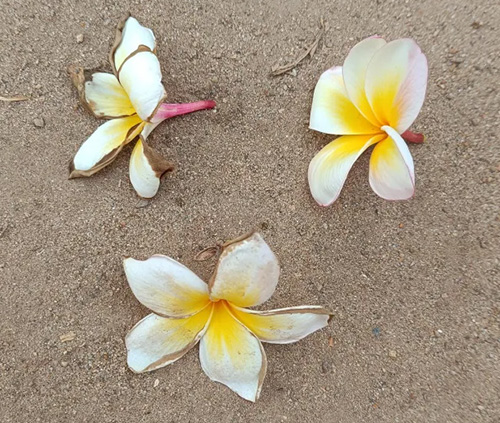
Three Frangipani (or Champa) flowers lie on sandy soil next to the samadhi shrine of Sadhu Om in Tiruvannamalai. The Frangipani is considered a deeply sacred tree symbolising immortality, purity and devotion. Though typically not used form worship in Shiva Temples, it can serve an offering in pujas and rituals at temples dedicated to Lord Vishnu, Goddess Lakshmi, and Lord Ganesha. —
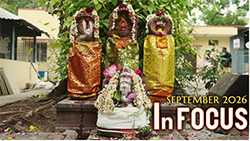
In Focus: September 2026
In Focus: September 2026
Looking back to last month, In Focus presents clips from the Samvatsara Abhishekam, Muruganar Day and Vinayagar Chaturthi. See the video at:
<https://www.youtube.com/watch?v=BPwhIPFYcUY>. —
On the occasion of the celebrations of Sri Bhagavan’s 130th Advent to Arunachala, 1st September 2026, Saranagati e-magazine began its 20th year. Marking this milestone, the publication launched <https://saranagati.online/>. As there have been requests in recent years to make Saranagati articles and content more accessible, the website includes a complete PDF archive of more than two hundred Saranagati issues for free downloading. This archive will soon be Google searchable, once traffic to the site increases and the uploaded files are indexed by Google. In the near future, all sixty-two years of the Mountain Path and eighteen years of the Call Divine will become searchable as they get indexed by online search engines. —