
SRI RAMANASRAMAM
VOL. 18, NO. 9
Dear Devotees,
In this issue, we continue with the amazing life story of Andavan Pichhai, the South Indian saint who as a young girl had a vision of Lord Muruga and devoted her life to composing songs in his praise, and later won the lauds of the great saints of her day. In March 1950, she underwent a transformation in Bhagavan's presence.
Also in this issue, we take a look at Bhagavan's death experience in Ramana Reflections.
For videos, photos and other news of events, go to https://www.gururamana.org or write to us at saranagati@gururamana.org. For the web version: http://sriramana.org/saranagati/September_2024/
In Sri Bhagavan,
Saranagati
Table of Content
- In Profile: Andavan Pichai (pt II)
- Announcement: Daily Live Streaming
- Global Online Advent Celebrations
- The Iconography of the Mother's Shrine: Goddess Durga
- Sadhu Natanananda's Upadesa Ratnavali §12
- Breaking Free from the Trance of 'I'
- Simplicity and Self-Emptying in the Age of Quantity (Postscript)
- Events in Tiruvannamalai: Aadi Kamakshi Temple
- Events in Sri Ramanasramam: Muruganar Day
- Best Shot: Stillness
- In Focus: September Edition
- Events in Tirukoilur: Kilur Temple Kumbhabhishekam
Calendar of Ashram Events
2nd Oct (Weds) Sarva Mahalaya Amavasya |
16th-17th Oct (Wed-Thu) Full moon, Srichakra Puja |
3rd Oct (Thu) Navaratri Commences |
18th Oct (Fri) Tamil Month Aipasi/Srichakra Puja |
10th Oct (Thu) Durgashtami |
22nd Oct (Tue) Viswanatha Swami Day |
12th Oct (Fri) Saraswati Puja |
24th Oct (Thu) Punarvasu |
12th Oct (Sat) Vijayadasami |
29th Oct (Tue) Pradosham |
15th Oct (Tue) Pradosham |
31st Oct (Thu) Deepavall |
16th Oct (Wed) Natarajar Abhishekam |
2nd Nov (Sat) Skanda Sashti commences |
IN PROFILE
Andavan Pichai
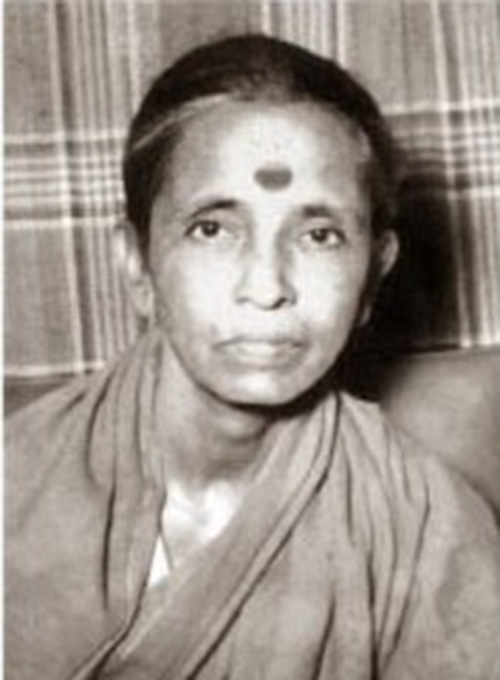
As we saw in the last issue, Andavan Pichhai as born into a prominent family with a rich l and cultural heritage on 6th September 1899,
and named Maragathavalli. Her early life was marked by tragedy when her mother passed away at the age of three. To make matters worse, her father quickly remarried, and the children's new stepmother mostly ignored them, as did their father, occupied as he was with study.
Maragathavalli suffered from a speech impediment, was shy, and showed little interest in formal education, preferring devotional practices. However, a vision of Lord Muruga at the age of nine transformed her life. Maragathavalli's married life began at the early age of nine. With numerous responsibilities in a large joint family, her husband, Narasimhan, though successful as a criminal lawyer, was burdened with supporting numerous relatives, including his brother Subramaniam, who was not an earning member, and his sister's family. Despite these challenges, he took care of everyone with love and equality, while Maragathavalli managed the household, working tirelessly as others did not contribute much.
When at age of thirteen, Maragathavalli's first child was stillborn and the doctor declared she might not have children again, the family to suggested Narasimhan take a second wife. He firmly refused, stating his unwavering commitment to Maragathavalli. Five years later, in 1917, their first son, Guruswamy, was born, bringing great joy all around.
More children followed: Shankar in 1919, Kalpagam in 1921, Ganapathy in 1923, and Seshagiri in 1924. During Seshagiri's birth, Maragathavalli was very ill but managed to give birth without any complications just prior to Skanda Shashthi. That night, a grand celebration took place at their home, which was attended by the entire family, although Maragathavalli could not participate actively due to her health. After the festivities, Maragathavalli had a vision of Bala Muruga. She saw a bright light and a pathway leading to a small temple, where a beautiful child appeared and called himself "Mal-Marugan," asking her to sing. Songs on Muruga, filled with profound meaning, started flowing out from her. The next morning, these songs were written down, amounting to six hundred in all. However, her mother-in-law, worried that singing about Aandi (which means 'beggar') would bring misfortune to the family. She made Maragathavalli take an oath not to sing or write about Muruga again, which she agreed not to do. Though bound by this vow, she continued to contemplate on Muruga inwardly. 1
In 1926, Maragathavalli had another son, Venkataraman. The midwife was intoxicated and did not attend Maragathavalli properly, leaving some of the placenta within. Maragathavalli developed a high fever and a lady doctor was brought in. Dr. Lazarus diagnosed sepsis and was keen to operate immediately. Despite the doctor's advice for anesthesia, Maragathavalli chose to undergo the surgery without it, remaining still by focusing on Muruga. Dr. Lazarus, having developed a deep admiration for Maragathavalli during the procedure, did not charge her usual fee.
Padma
In 1928 Maragathavalli bore a girl named Kamakshi and another in 1929, named Padma. Padma turned out to be a child prodigy, composing songs on Devi at the age of three. A devoted follower of the Kamakoti Acharya, she suffered from a
serious illness and lost her sight. During a visit to the Acharya, Maragathavalli was initiated into the saravanabhava mantra, and Padma's eyesight was miraculously restored. Padma made it a point to visit the nearby Devi
temple every evening and offer to the Goddess a flower garland she made herself.
In 1936, at the age of seven, Padma suddenly died with the flower garland in her hands, just after entering the sanctum sanctorum of the temple that she had been visiting each day. 2
Maragathavalli's mother-in-law was struck by paralysis and needed constant care. Maragathavalli served her with dedication until her death in 1930. That same year, her daughter Kalpagam got married. In 1936, another son, Vasudevan, was born.
Maragathavalli's family life was a mix of joys and sorrows. While her sons excelled academically, her son Shankaran suffered an accident that left him mentally challenged. His suffering, along with other personal tragedies, led to Maragathavalli's increasing detachment from worldly life and her inner connection with Lord Muruga grew ever stronger, as the divinity continued to manifest through visions and songs.
In 1944, during a visit to the Lakshmi Narasimha temple in Sholingapuram, Maragathavalli experienced a profound vision of the deity, inspiring many devotional songs. Her experiences continued to transcend ordinary human consciousness. She would often have visions and hear divine voices, guiding her on her spiritual journey.3
Meeting a Stranger in Srisailam
On Narasimhan's sixtieth birthday in 1948, Maragathavalli's aunt persuaded her to go on a pilgrimage to Srisailam. During the trip, as they were climbing up to the temple, a stranger appeared and helped Maragathavalli carry her heavy water vessel. Later, in a dream, the same stranger initiated her into a mantra, predicting that they would meet again next Sivaratri, and that her life would end around Vaisakhi Purnima.
Upon returning home, Maragathavalli suffered a heart attack. Her two doctor sons attended on her, but she remained bedridden for months. Her condition continued to deteriorate as her family prayed for her recovery. Late in the evening, her heart and pulse stopped, causing great fear and despair among loved ones. At that moment, a profound spiritual intervention occurred.4
Siddha Ramakrishna
At this juncture, Maragathavalli's account gets very interesting. If we had not witnessed her integrity and honesty as evidenced by a life and testimony that was perfect in every way, not to mention timeless verses of devotion, we would doubt the following as mere imagination. The account concerns one Siddha Ramakrishna, a great ascetic-devotee of Sadasiva Brahmendra. He had performed intense penance at the famed Avudaiyar Temple and is said to have acquired numerous siddhis after spending twelve years practicing Devi Upasana with the navakshari (nine-syllabled) mantra. Ramakrishna, although married, never lived with his wife, who in despair cursed him to be reborn as a woman to suffer as she had suffered. Sensing his impending demise, Ramakrishna took apat sannyas (emergency sannyas)5 before his Mahasamadhi in 1943. His Parama Guru, Sadasiva Brahmendra, appeared to him and revealed that Ramakrishna's wife's curse had to be fulfilled. He offered a solution: Ramakrishna could enter a 'pure woman's body' in his subtle form and live out the ordained sufferings.
The way the account is told by Maragathavalli is that following Siddha Ramakrishna's Mahasamadhi, his subtle body remained. On the night of Maragathavalli's heart attack, Ramakrishna's Parama Guru pointed to Maragathavalli's body, saying it was a holy temple of Lord Muruga, and urged Ramakrishna to enter it. Miraculously, Maragathavalli's pulse and heartbeat restarted. As she regained consciousness, everything around her seemed strange, even the familiar faces of her family. She wondered, "Who am I?" She felt disconnected from her identity as mother and wife.
For six months, Maragathavalli was bedridden, taking only liquids. Her family was bewildered by her unusual state. Despite their concerns, Maragathavalli felt an inner peace and a divine command to accept her new role and circumstances, understanding that her body had become a vessel for divine purposes.6
Bhagavan Ramana once said regarding a question in the hall about the subtle body, whether it could get dissolved and be reborn after death, even after several years. Bhagavan replied:
Yes. Surely. Not only can one be reborn, but one may be twenty or forty or even seventy years old in the new body though only a [few] years [have passed since one's] death.7
During the above mentioned exchange in the Hall, it is not clear if Bhagavan intended it to be understood that the arriving subtle body displaces in toto the old one. The question in respect of Maragathavalli would be, when
Siddha Ramakrishna's subtle body entered her body, how was she later able to recall her earlier life and compose songs in her usual way? One way of understanding this is that the organs of her body remained intact and thus memories
stored in the brain were retained as part of the body itself. Another possibility is that Ramakrishna, being a siddha purush, intuited and understood all that had happened to Maragathavalli from her earliest childhood, and
inherited her gifts of composition and devotion. If this is a circumstance few can satisfactorily explain, it is too easy to dismiss it as hagiographical excess.
Rediscovering Songs of Devotion
Maragathavalli and family members accepted that their mother had died on that day and Siddha Ramakrishna had entered her body. Maragathavalli's family continued where they left off. Maragathavalli's cousin, Balambika, visited her during this period and recalled her early compositions, which were hidden in a steel box by her late mother-in-law. Miraculously, while currency notes were destroyed by termites, Maragathavalli's songs remained intact. Balambika sought to publish them in Kumkumam, a journal edited by T. M. Krishnaswamy Iyer, (also known as "Tiruppugazh Mani"). Maragathavalli handed over many compositions, including "Thanikesha Antaadi" and "Muruga Pancharatna."
Maragathavalli's son Ganapathi, deeply devoted to her, kept a watchful eye. One morning, she experienced a divine vision. Lord Muruga appeared before her, asking why she had given away all her songs and whether she had any further need of them. Lord Muruga expressed His love for her songs, comparing them to garlands woven in the heart of the devotee. He urged her to resume singing, assuring her that the earlier vow was no longer binding. Maragathavalli was overwhelmed and cried out, "Muruga! Muruga!!" She then composed a song describing her vision, titled "Arunodaya."
Thatevening,Balambikareturned,sharingTiruppugazh Mani's astonishment at Maragathavalli's compositions. He desired to preserve all her songs as a treasure for the public. Encouraged, Maragathavalli offered more of her poems, including the "Mahalakshmi Ashtakam," which praised Devi Amritavalli of Sholingapuram. Eminent poet V. S. Chengalvarayan Pillai likened her works to those of Manickavachagar, suggesting she be called "Manickavachagi" and her songs, "Arulvachakam."8
A Dazzling Vision
Following her crisis, Maragathavalli moved to her daughter Kalpagam's home for rest. She expressed a desire to meet Tiruppugazh Mani, the person she believed had helped her during her pilgrimage to Srisailam. When they met, Tiruppugazh Mani felt a deep connection and soon became a devoted disciple. Their spiritual bond transcended conventional roles, with both respecting each other profoundly.9
One evening, Maragathavalli experienced another divine vision. Lord Ganesha appeared, leading her gaze upwards to a dazzling light. She saw a rotating wheel inscribed with the shadakshari (six-syllabled) mantra, and a golden seat bearing Muruga's vel (spear), flanked by a peacock and a cock. As she watched, Lord Muruga playfully plucked feathers from the peacock's tail and threw them at her, addressing her with the affectionate name 'Pichhai.' This vision inspired her to compose "Arulvilakka Malai," a collection of 108 verses. From then on Maragathavalli was known as Pichhai meaning 'gift' or 'blessing'. 10
Pilgrimage to Tiruporur
Pichhai's spiritual journey took her to the Muruga temple at Tiruporur. Despite being unfamiliar with the temple, she accurately described its features and composed a song based on a ceiling inscription. When they arrived, the temple
doors were miraculously open, despite normally being closed at that time. The group, astonished by her insights, witnessed the fulfilment of her predictions and experienced profound reverence for her. 11
Darshan at Arunachaleswarar
On 27th March 1950, a group of ladies including Pichhai's sister-in-law were going to Tiruvannamalai to have Ramana Maharshi's darshan. They insisted that Pichhai go along with them. This was a long-wished for moment and when they reached Tiruvannamalai at ten o'clock that night, they entered the big temple and found it was closed. A few pujaris were still there so the group pleaded that they be allowed to have darshan through the grill before the lights were switched off. When they went near the Devi shrine, they saw a young lad sitting on the steps, singing. He told them that he would do puja on their behalf, but they lamented that they had not brought any offerings. The boy replied that there was a plate of flowers and fruits inside the sanctum, and they could share its contents. The boy opened the door of the sanctum and performed archana and arati and gave them the prasad. To their dismay, they discovered that none had brought dakshina with them. However, Pichhai had an old copper coin, the ring-like quarter anna of the olden days, which she gladly offered. The boy received it and happily wore it on his little finger like a ring and said they could offer the full dakshina the following day. When asked his name, he replied, Dandapani. The lights then went out and the group rushed out—all except for Pichhai. The boy caught hold of her and led her inside the temple to a place where there was a small shrine of Lord Muruga. It was the spot where the Lord had emerged from a pillar to give darshan to Arunagirinathar, the great Bhakta saint and author of Tiruppugazh. Dandapani told Pichhai that he always stayed in the temple and narrated several stories for her. Then, helping her catch up with the others, he said, "You have won. I have brought you to light", and then he vanished.
Mystified by the events the night before, the group came to the temple the next day and searched for the boy but could not find him anywhere. When the previous night's incident was narrated to the pujaris, they said incredulously, "How could you perform puja when the temple was already closed and we ourselves had all gone out?"
Ramana Darshan
Now the group set about the purpose of their visit which was to see Bhagavan Ramana. Appropriately, it was a Monday (soma vara), and the auspicious thirteenth tithi (pradosham) to boot. Pichhai's biographers narrate
the moment as follows:
When Pichhai entered Ramanasramam, she felt a great joy and although this was her first visit, she had a feeling of being familiar with the surroundings. She forgot herself and was oblivious of her companions. Her mind stopped and all the five senses completely ceased. She could only vaguely see from far Bhagavan Ramana in his reclining posture with eyes closed. His face was beaming with a brilliance and there was not a shadow of pain in his countenance. She felt as if she was floating in an ocean of bliss and was being carried away beyond all dualities.
Her swoon state continued until she drew nearer:
When Pichhai came near Bhagavan she was abruptly shaken up from her stupor as if by an electric shock. The whole body started trembling and her heart began pounding. She prostrated before him and looked up. At that instant Bhagavan's gaze fell on her. His eyes were shining brilliantly and showering compassion. From them a streak of light like that of lightning flashed out. He gave her initiation through
'Nayanadiksha' (initiation through the eyes). This pierced her soul and once for all the darkness of ignorance in her was completely removed. The great truth behind the Mahavakya flashed in her and she realised the secret of 'WHO AM I?'. This ecstatic experience seemed to merge her individual soul with that of the Supreme, and in this unique state, she felt the whole universe within her.
In a daze, she could just visualise her party offering various fruits at Bhagavan's feet. Pichhai had brought only seedless grapes. The Maharshi was in a jovial mood and asked "Have you had the darshan of Dandapani?" His mention of the name 'Dandapani' sent a thrill through the hearts of the ladies who had visited the big temple the night before. They felt that the Maharshi was confirming that the boy who had done puja for them was no other than Lord Muruga Himself. Then, pointing to the grapes brought by Pichhai, Ramana Maharshi said, 'This body likes grapes very much.' He took a grape and put it in his mouth and distributed the rest to all. Pichhai's blissful state remained for some time, and she only mentioned it later in a short drama she wrote after returning to Madras, entitled, "Jiva Brahma Aikya Natak".12 —
(to be continued)
Global Online Advent Celebrations
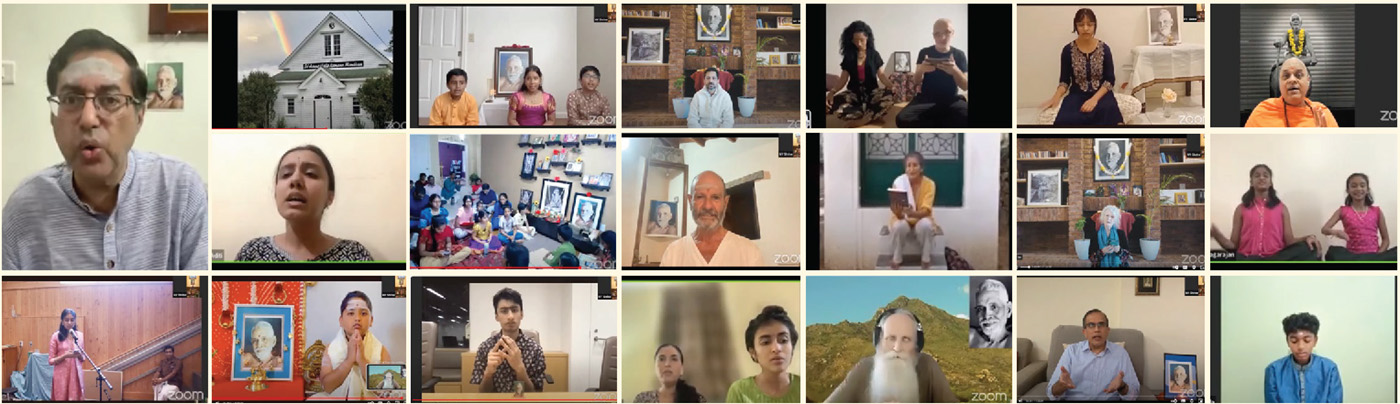
Satsang groups from Australia, United Kingdom, France, and groups from around the US and Canada from NY, Washington DC, Tampa, Ottawa, Ohio, Michigan, the Spanish language satsang, North Carolina, Austin, Houston, Georgia, San Francisco, Los Angeles, Seattle, Tennessee participated. Programming included recitations and discourses and a concluding talk by Dr. Anand Ramanan, President of Sri Ramanasramam, Tiruvannamalai at 8.30pm EST. For the President's address, see: < https://www.youtube.com/watch?v=Q-BYyLAGWXY>. For viewing the entire programme, go to: https://youtube.com/live/X6qlgfnOyYg?
The Iconography of the Mother’s Shrine: Goddess Durga
Goddess Durga

GODDESS DURGA (meaning 'impassable', ' i n v i n c i b l e ' , 'unassailable' is related to the word Durga which means 'fortress, or something difficult to defeat or pass') is worshipped as a principal aspect of the mother
goddess Mahadevi. Associated with protection, strength, motherhood, destruction, and wars, she battles demonic forces that threaten dharma, (such as we observe in the Devi Mahatmya) and represents the power of good
over evil. Durga is believed to unleash her divine wrath against the wicked for the liberation of the oppressed. She is seen as a motherly figure depicted as a beautiful woman, riding a lion or tiger, with many arms, each carrying a
weapon. In some scriptures, Durg is the name of an asura who had become invincible to gods, and Durga is the goddess who slays him (such as Mahishasuramardini who slays the half-buffalo demon Mahishasura).
Other epithets include Vindhyavasini (she who dwells in the Vindhya Mountains), Mahamoha (great delusion), Mahasuri (the great demoness). Reverence for Devi, the feminine nature of God, first appears in the Devi Suktam of the
10th Mandala of the Rig Veda:
I am the Queen, the gatherer-up of treasures, most thoughtful, first of those who merit worship. Thus gods have established me in many places with many homes to enter and abide in. Through me alone, all eat the food that feeds them,
each man who sees, breathes, hears the word outspoken.
—
Sadhu Natanananda’s Upadesa Ratnavali §12
Power and Peace
Those that say that power and peace are different do not know them rightly. What prevails internally as peace is expressed externally as power. — GVK §216
Those who assert that power and peace are mutually opposed to one another are ignorant of reality. Knowers of truth do not see any difference between power and peace. Why? Since Being (sat) is itself Consciousness (chit), sat is known as peace (santhi) while it is contained inside and when externalized appears as power. Put another way, all of Iswara's power is contained inside Him. Peace refers to Iswara's adjunct free, natural state; power is His state when externalized and conditioned. —
What is experienced as peace while [the mind is] inward turned, is experienced as power while [it is] outward turned. Only jnanis who have deeply enquired and realised [the true nature of Self prevailing during both introversion and
extroversion] know that peace and power are one and the same.
— Sri Bhagavan, §6 in GVK
Announcement: Daily Live Streaming
Ramanasramam is live streaming each day, 8-9.30 am and Mon-Sat, 5-6.45 pm IST, which includes the Vedaparayana, puja and Tamil Parayana and. To access Ashram videos, go to: https://youtube.com/@SriRamanasramam/videos
RAMANA REFLECTIONS
Simplicity and Self-Emptying in the Age of Quantity (Postscript)
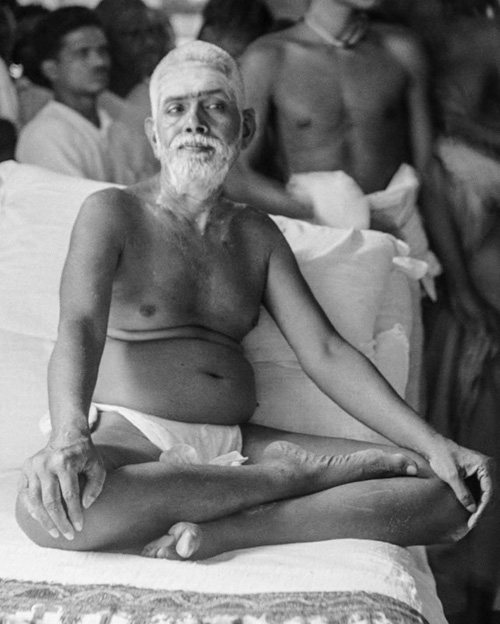
About six weeks before young Venkataraman left Madurai for Tiruvannamalai, he experienced a profound event. While sitting in his uncle's house, he was suddenly gripped by an intense fear of death and thought, "I am going to die." Later recalling this pivotal moment, he said:
The shock of the fear of death drove my mind inwards and I said to myself mentally, without actually framing the words: 'Now death has come; what does it mean? What is it that is dying?'"
This was the turning point in his life, after which nothing would ever be the same.
Without any prior preparation or spiritual training, young Venkataraman had transcended the illusion of the personal self, or ego, which he had never even realized was a trance. But was it merely his own trance? In reality, the entire world is caught up in this same dream of a separate 'I.' When Venkataraman faced the undeniable reality of his own mortality, the illusion of a separate self could no longer be sustained under the intensity of his investigation, which he undertook as if it were his very last moment on earth.
Harvard psychiatrist Dr. Jeff Rediger has documented cases of terminally ill patients who, upon fully accepting the reality of their impending death, were thrust into a state of shock and fear that led them to a profound re-evaluation of their lives.1 These individuals began to scrutinize not just the way they had been living, but more importantly, how they had been defining themselves. This deep introspection resulted in inner transformations so powerful that their physical illnesses healed, even after medical treatments had failed. Spontaneous remissions suggest that self- perception can have a profound impact on physical outcomes, including the very fate of the body.
Bhagavan encouraged his devotees to engage in a similar self-examination, without needing a life-threatening crisis to trigger it. He wanted them to replicate, in a deliberate and controlled way, the process he experienced spontaneously as a boy in his uncle's house.
Although in Bhagavan's case, his realization was catalyzed by an intense fear of death, the practice of self-inquiry has a long tradition in India, dating back over 2,500 years. Ancient texts describe the investigation of states as a method for attaining liberation.2 But what does this mean?
The investigation of states involves observing the mind as the mind and recognizing the mental dispositions that arise at any given moment. This might sound simple but remembering to see one's thoughts and emotions as transient states rather than as the true Self is already a step beyond the limited perspective of the ego. We must remind ourselves that, no matter how real and all-encompassing a particular mental state feels, it is just that—a passing state, and not the Self. This is no small feat, as we habitually identify with these states and call them 'I.' However, when we follow Bhagavan's directive to seek the owner of such states, we find there is no actual owner—no agent or entity that can be called 'I.'
Just as young Venkataraman realized during his intense self-investigation at the age of sixteen, we come to see that the supposed 'owner' of our thoughts and emotions is itself just another transient state—a construct born of delusion and a distorted sense of identity rooted in ignorance. When Bhagavan instructed his followers to "look within," he was pointing to introspective inquiry to dismantle the illusion of the ego as something real and separate.
This recognition can be unsettling at first, as it reveals the mind as a collection of automatic processes rather than a cohesive self. It may feel like looking at a system operating on autopilot—the domain of what neurologists call the autonomic nervous system. We begin to see how past experiences and conditioning shape autonomic responses without any conscious involvement. States of fear, anxiety, or threat are often triggered by the brainstem, bypassing higher cognitive functions that involve personality, reasoning and storytelling. When we mistakenly identify these automatic responses as 'I,' we deceive ourselves into believing we have control over them.
This misidentification, namely, taking the body, the brainstem, and autonomic functions as a separate 'I', is the essence of the egoic trance. Bhagavan's practice of self-inquiry is designed to expose the illusion, helping us reach the first stage of genuine meditation where our spiritual practice can establish a firm footing.
Through self-inquiry, we begin to see that what we habitually call 'I' is nothing more than a collection of ephemeral states. These states have neither an enduring reality nor a true owner. As we delve deeper, we discover that the 'I' itself is a projection, a mental construct born of fear and ignorance. By recognizing this, we gradually break free from the trance of the small self and open ourselves to reality, which is beyond all cognitive constructs and mental representations.
Bhagavan's transformative experience in his uncle's house was not just a personal awakening; it was a demonstration of a universal truth. He showed us that by confronting the fear of death and the illusion of the separate self, we can awaken to what is boundless, timeless, and beyond all suffering. —
Similes from Bhagavan: The Magnet and the Needle
Without desire, resolve, or effort, the sun rises; and in its mere presence, the sun-stone emits fire, the lotus blooms, water evaporates; people perform their various functions and then rest. Just as in the presence of the magnet the needle moves, it is by virtue of the mere presence of God that the souls governed by the three cosmic functions or the fivefold divine activity perform their actions and then rest, in accordance with their respective karmas. — Who Am I? §17
Events in Tiruvannamalai: Aadi Kamakshi Temple Mahakumbhabhishekam
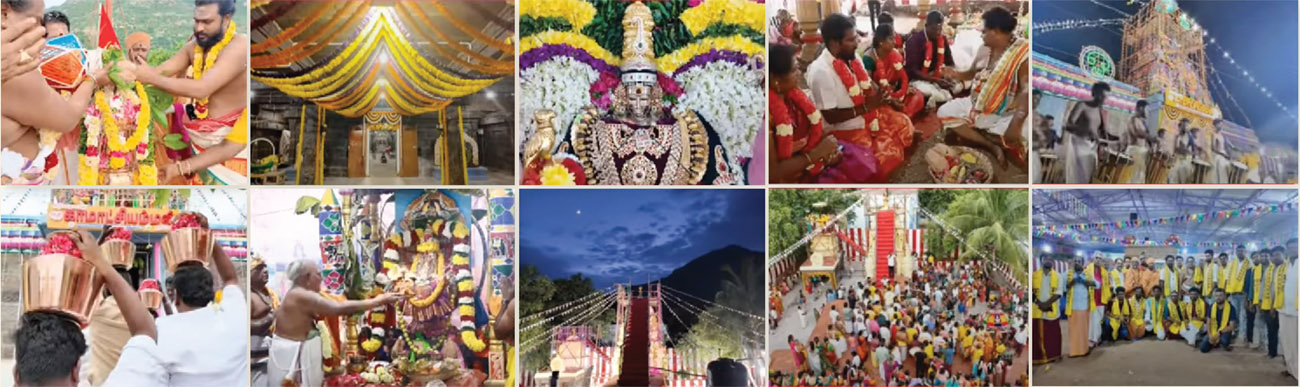
Goddess Kamakshi is one of the ten Mahavidyas embodying the essence of the supreme goddess Mahadevi and is widely praised in the Lalita Sahasranama and Soundarya Lahari where she is referred to as Adi Parashakti. On 8th September 2024, Mahakumbhabhishekam at the Vadaveedhi Kamakshi Amman was performed in full splendour. As part of the renovations, new murals adorn the temple's compound walls depicting the great stories of Goddess Kamakshi. —

Events in Sri Ramanasramam: Muruganar Day
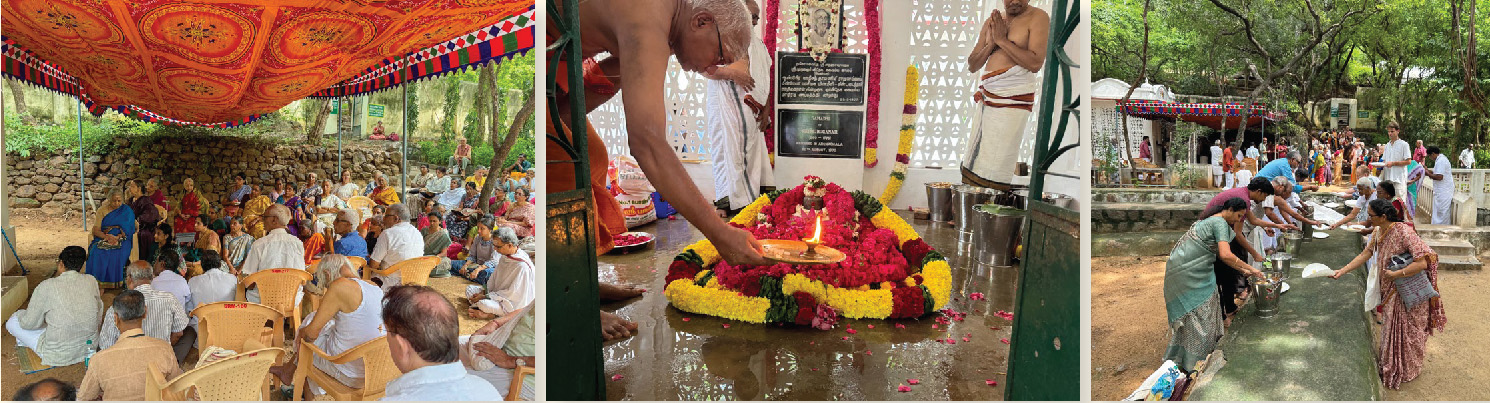
On the morning of 2nd September, devotees gathered at Muruganar’s Samadhi to recite works by the great poet as abhishikam was performed. Recitation of Aksharamanamalai was followed by arati and the distribution of prasad.
In Focus: September Edition
For the September edition of In Focus, copy the following URL into your browser September Infocus
Best Shot: Stillness
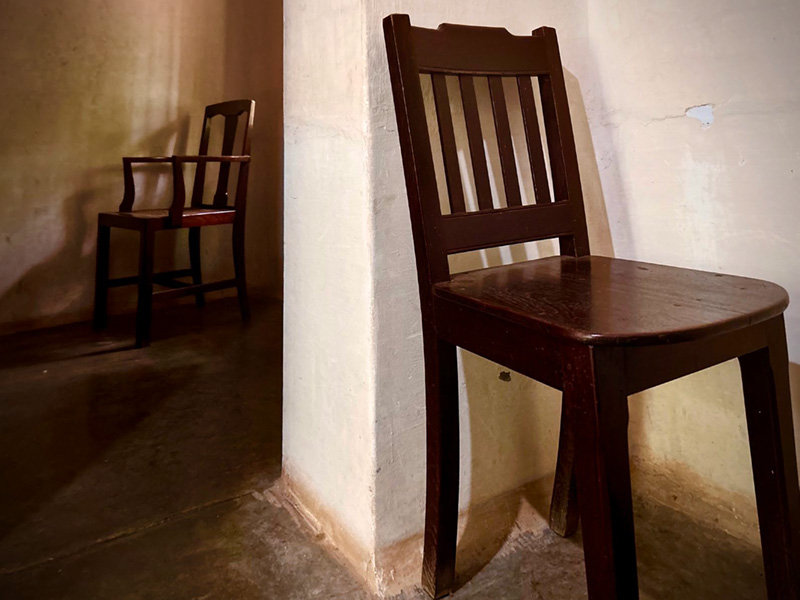
Stillness manifests in various forms, especially in the secluded corners of Bhagavan’s Ashram. Here, stillness is not merely the absence of movement or sound but a living presence, a palpable force, drawing us further into a state of restful inaction. The heart finds space to unfold, unobstructed by the churning of thoughts and the clamour of worldly distractions. If Bhagavan’s presence is everywhere, he is most tangibly and intimately felt when the heart and mind are like the ‘still point of the turning world’. This applies equally to the old Ashram Dispensary on a quiet afternoon. —
Events in Tirukoilur: Kilur Temple Mahakumbhabhishekam
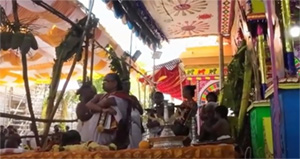
In late August of 1896, the night after his jyoti darshan in Ariyaninallur Temple, Tirukoilur, a pious temple drummer of Kilur Temple offered young Venkataraman prasad. The next day, he was lovingly fed by the
lady of the house of Muthukrishna Bhagavathar, where he pawned his gold earrings for the train fare.
On 15th September 2024, Keezhur Temple, Tirukoilur celebrated Mahakumbhabhishekam. —
Endnotes
- 1 Saranagati, September 2024, pp. 3-6.
- 2 The Gift of God or Andavan Pichhai, Smt. Radha and Dr, Krishna Rao, A Divine Life Publication, 1983, pp. 12-13.
- 3 Ibid. pp. 14-16.
- 4 Ibid. pp. 16-17.
- 5 Apat means danger of death, so apat sannyas is 'urgent' sannyasa diksha is given just before death without customary rituals.
- 6 Ibid. pp. 18-19.
- 7 Talks 129.
- 8 8 Ibid. pp. 25-26.
- 9 9 Ibid. pp. 26-27.
- 10 10 Ibid. pp. 28-29.
- 11 11 Ibid. pp. 29-30.
- 12 12 Ibid. pp. 32-35; the reader may recall the 'shrine' to Pichhai near the kili Gopuram in the Big Temple, commemorating the event.
- 1 Cured: The Life-Changing Science of Spontaneous Healing by Jeffrey Rediger, the Harvard medical doctor and psychiatrist with a theol- ogy degree who spent fifteen years pioneering the use of scientific tools to investigate spontaneous healing. Elaborating the science behind miracles, the professor proves that much of our physical reality is created in our minds and that perception changes our experience, even to the point of changing our physical bodies. He writes: "Illness begins in the soul, and when healing occurs there, the physical body then 'catches up' to the new reality."
- 2The second of the Buddha's 'Seven Factors of Enlightenment' is dhamma vichaya, i.e. 'investigation of states' (or mental phenom- ena). This means scrutinising phenomena operative in the mind at any given moment and disabusing oneself of the idea that such states constitute an 'I'. Instead the practitioner recognises that the 'I' is just one of a myriad of mental states that arise and pass away moment by moment.
Publisher: Dr Venkat S. Ramanan
saranagati@gururamana.org
