
SRI RAMANASRAMAM
VOL. 19, NO. 5
Dear Devotees,
As we near the end of April, the warm summer weather is making itself felt in South India. Meanwhile, renovations are still underway in Ramanasramam in preparation for the upcoming Mahakumbhabhishekam scheduled to take place on the 18th, 19th and 20th of August this year. Anticipating the upcoming rededication of the sacred icons, deities and shrines at the Ashram, we begin this issue with a survey of the history of kumbhabhishekam herein starting in 1949 (see p. 3).
In Ramana Reflections, we take up a discussion of the role of surrender and acceptance in spiritual life (see p. 10).
For videos, photos and other news of events:
https://www.gururamana.org.org or write to us at:
saranagati@gururamana.org. For the web version:
https://www.sriramana.org/saranagati/May_2025/.
In Sri Bhagavan,
Saranagati
Table of Content
- Origins: The History of Ashram Kumbhabhishekam
- Events at Sri Ramanasramam: Sri Bhagavan’s 75th Aradhana
- Events at Ramanasramam: Six Muhurthas for Nataraja Puja
- Iconography of the Mother’s Shrine: The Rasi Chart
- Events at Sri Ramanasramam: Tamil New Year and Panchangam
- The Role of Surrender and Self-Acceptance in Enquiry Practice
- In Focus:April Edition
- Similes from Bhagavan: Rama and the Mirror
- Sadhu Natanananda’s Upadesa Ratnavali §23
- Bhagavan’s Handwriting:“O GodSupreme!” SannidhiMurai,154
- Events at Sri Ramanasramam: Nirvana Room Chanting
- Best Shot: Bhagavan’s Banyans
- Announcement: Sri Chakra Puja Live Streaming
- Events at Sri Ramanasramam: Maj Chadwick Day
Calendar of Ashram Events
3rd May (Sat) Punarvasu |
24th May (Sat) Pradosham |
9th May (Fri) Pradosham |
30th May (Fri) Punarvasu |
11th May (Sun) Full Moon |
8th June (Sun) Pradosham |
12th May (Mon) Full Moon Sri Chakra Puja |
10th June (Tue) Full Moon |
21st May (Wed) Mahapuja |
22nd June (Sun) Cow Lakshmi Puja |
ORIGINS
The History of Sri Ramanasramam Kumbhabhishekam
Kumbhabhishekam
The consecration ceremony known as Mahakumbhabhishekam is believed to homo-genize, synergize and unite the mystic powers of temple deities. Kumbha: 'pot' + abhishekam: 'to sprinkle', 'to pour' = 'pouring water onto (the icon)'.
The yagasala is the site where a litany of prayers from the four Vedas are chanted near the pots containing sanctified water are called kumbha. The crowns (kalasa) of the cone-shaped domes or towers (vimanam) above the lingas and deities are also called pots. Kumbhabhishekam refers specifically to the anointing of the crowns of the vimanam with sanctified water from the yagasala homas. The abhishekam that takes place at the the shrines is called mahabhishekam.
On the appointed day and at an auspicious time, the vimanas are bathed with the charged and sanctified holy waters in the sacrificial pots and these pranic powers are transmitted by a silver wire and enter the deity installed inside the inner sanctum. The deity, which was until then only a granite sculptured stone image or, in some cases, fashioned of the five metals is believed to be transformed into a vibrant and vivid living representation of the deity with sacredness, grace and grandeur, conferring divine blessings on devotees.
Kumbhabhishekam has always marked a pivotal moment in the life of a temple, reinvigorating the temple's spiritual potency and sanctifying it anew as a channel for divine grace. At Sri Ramanasramam, these solemn occasions have not only served to mark milestones of care for its sacred sites but have also been moments of collective renewal, reverence, and remembrance of Bhagavan's divine presence.
First Kumbhabhishekam (1949)
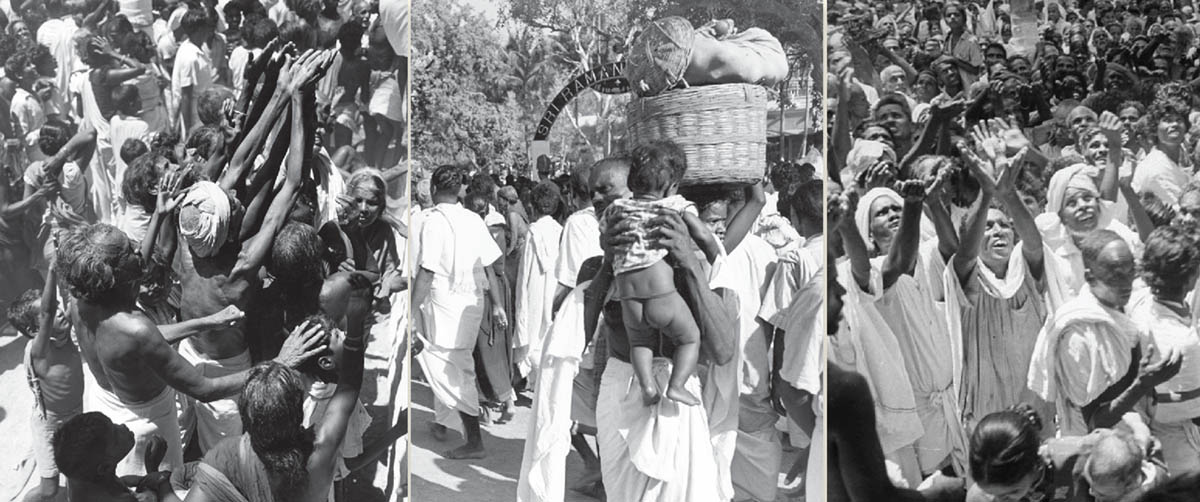
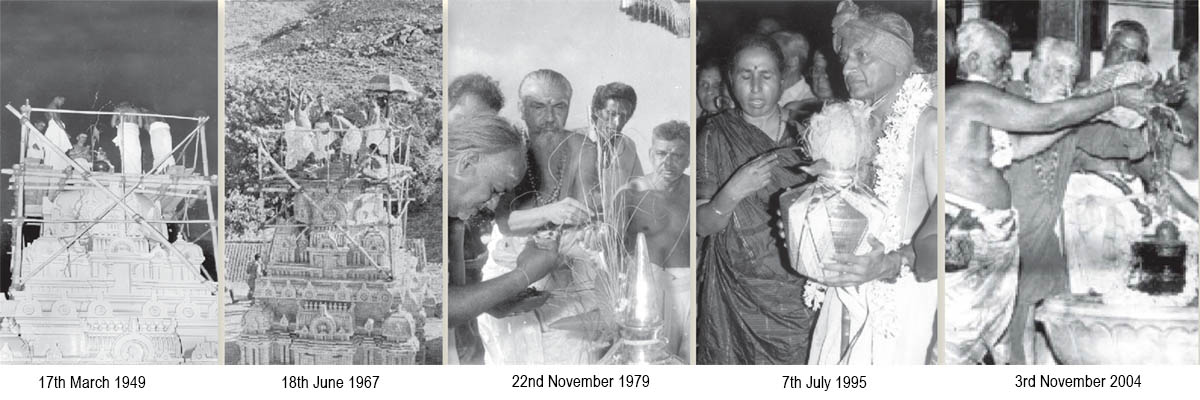
The inaugural kumbhabhishekam at Sri Ramanasramam took place in the sacred presence of Bhagavan on 17th March 1949, for the consecration of the newly completed Matrubhuteswara Temple, dedicated to Bhagavan's mother, Alagammal.
The completion of this temple had been the long-cherished aspiration of Chinnaswami, Bhagavan's younger brother and manager of the Ashram. Despite the chronic shortage of funds—a persistent concern—Chinnaswami and other devotees toiled
for over a decade to bring this vision to fruition.
As the date of the ceremony approached, it appeared that the Rs. 50,000 required for Mahakumbhabhishekam would be difficult to raise. Yet, miraculously, contributions began to pour in from devotees across the country at the very last minute. Massive pandals were erected in the field opposite the Ashram to accommodate the influx of pilgrims, and thousands began arriving from all corners of South India.
In the post-war austerity, it was a time of rationing, and securing sufficient rice to feed the throngs of assembled devotees was a major challenge. Thanks to the untiring efforts of G.V. Subbaramayya and others, lorries filled with rice arrived on the morning of the second day. By then, the crowd had swelled to over 10,000. On the third evening, the number surged to 15,000, transforming the quiet Ashram grounds into a sea of devotional fervour.
The four days of yagasala pujas were presided over by the renowned Sankaracharya of Puri, lending additional sanctity to the proceedings. On the final evening, amidst the chanting of Vedic hymns, Mahakumbhabhishekam was performed, infusing the temple and its deity with divine shakti. Although Bhagavan's health had been declining and he felt too weak to ascend the vimanam platform, he remained a silent witness to the ceremony, viewing the sacred rite from below with characteristic serenity.
Post-Mahasamadhi Turbulence
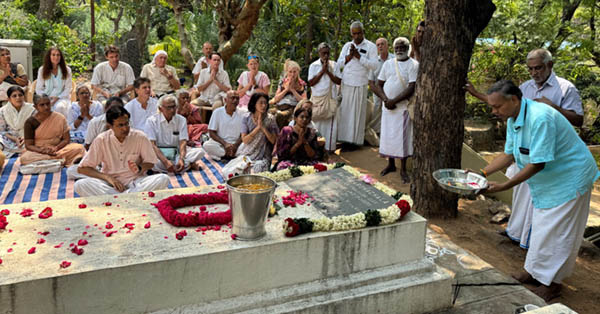
Barely a year later, in April 1950, Sri Bhagavan shed his mortal frame and attained Mahasamadhi. His bodily remains were interred in a sanctified location between the Mother's Shrine and the Old Hall. With Bhagavan's physical
presence no longer guiding the Ashram, the Ashram faced numerous challenges—court cases, financial crises, and exodus of most devotees who, in their despondency over Bhagavan's physical absence, simply left Tiruvannamalai. To make
matters worse, there were barely enough resources to sustain daily operations, let alone undertake the construction of a shrine over Bhagavan's Samadhi.
Still there was a sense of urgency to build a mantapam, both for the prescribed daily Vedic worship as well as for devotees' meditation. The construction of the shrine, mantapam and eventually, the main hall, was to take place in successive stages, but work progressed slowly owing to lack of funds.
The catalysing moment came at 9 am, 5th November 1952 when Anandamayi Ma laid the foundation stone. This event would initiate an eighteen-year project in gradual stages which would become the centre of life at Sri Ramanasramam. Devotees recalled the words and gestures of Anandmayi Ma that morning while she faced Sri Bhagavan's Samadhi:
Here is the sun; we are all stars in daytime.
For Chinnaswami and Venkatoo, Anandmayi Ma had come specially to Sri Ramanasramam to lay this stone and to initiate the great task of establishing a proper mantapam and hall over Bhagavan's Samadhi. At least symbolically, the
construction began with her visit this day. S.S. Cohen describes the moment:
Those present recollect the meticulous and measured way she handed brick after brick to lay the foundation. When the traditional purna kumbha was offered to her at the entrance of the Ashram, Ma graciously remarked: "Why all this? Do you do all these when a daughter comes to her father's house?"
At the conclusion of the ceremony, Anandamayi Ma approached the foundation stone and when the additional stones were in place, she strewed flowers over them as a final blessing.
Stages of the Samadhi Hall
In the years that followed, in which Chinnaswami also left the body, progress was slow due to the ongoing shortage of funds. But by July 1964, the central sanctum with its polished black granite pillars was in place. Two years later, in
August 1966, the crowning vimanam above Bhagavan's Samadhi, along with an outer granite structure surrounding the tomb, were formally inaugurated.
During this lengthy period of construction, the New Hall served as the temporary sanctum for daily Vedaparayana and pujas. However, with the architectural work complete, it was necessary to ritually restore the divine presence to its rightful place. This involved performing the Ashram's second Mahakumbhabhishekam.
Thus, on 18th June 1967, the sacred rite of kumbhabhishekam was performed once again, not only to inaugurate the newly completed mantapam and vimanam but also to rededicate the Mother's Shrine.
Completion of the Samadhi Hall (1970)
The final phase of the original vision—the construction of a large hall over Bhagavan's Samadhi—remained incomplete. But with fresh resolve, a final effort was launched in 1969, just two years after the second
kumbhabhishekam. This time, thanks to the generosity of devotees, construction moved steadily forward. By 3rd May 1970, the hall was ready and was ceremoniously inaugurated. The date was especially auspicious, as it coincided
with the 20th anniversary of Bhagavan's Mahanirvana. Though only minor rites were performed at this time, the architectural vision was nearing its full realization.
Third Kumbhabhishekam (1979)
As the centenary year of Sri Bhagavan's birth approached in 1979, it became apparent that twelve years had again passed since the last kumbhabhishekam. Accordingly, elaborate preparations were made to mark this momentous
occasion. The yagasala rituals commenced on 19th November, and the ceremonial climax was performed on 22nd November 1979.
This third kumbhabhishekam was marked by a special addition: for the first time, the kalasas—the crowns atop the vimanams of Bhagavan and the Mother's Shrine—were plated in gold, an offering of opulence and reverence, signifying the spiritual wealth that Bhagavan had bequeathed to humanity.
Fourth Kumbhabhishekam (1995)
Fifteen years later, in 1995, yet another opportunity for ritual renewal presented itself. This fourth Ashram kumbhabhishekam spanned five days and began on 3rd July 1995. On 7th July, just after 9 am, abhishekam was
performed on both the vimanams, drawing together devotees from all over the world. The event culminated in a unique gesture of devotion—girivalam, the sacred circumambulation of Arunachala, during which a large,
mounted photo of Bhagavan was carried in procession by devotees through the town.
Fifth Kumbhabhishekam (2004)
The fifth kumbhabhishekam took place on 3rd November 2004, and was marked by an extraordinary occurrence. At exactly 11:18 a.m., just as the ritual anointing of the Rajagopuram and the vimanams of Bhagavan's and
the Mother's Shrine was set to begin, a majestic eagle, believed by many to be Garuda— the sacred vehicle of Lord Vishnu—was seen circling above the Ashram. The bird's sudden appearance at this precise and sanctified moment was taken by
all present as a sign of divine approval.
Sixth Kumbhabhishekam (2013)
In the weeks leading up to the 2013 Mahakum- bhabhishekam, the Ashram was abuzz with activity, often continuing late into the night. Originally intended as a minor restoration of the gopuram and vimanam above
Bhagavan's and Mother's shrines, the work revealed extensive cracks in the lime-mortar stucco. While the underlying brick remained intact, the surfaces needed stripping and refurbishing. New cement was used for increased durability, and
all original iconography was carefully preserved.
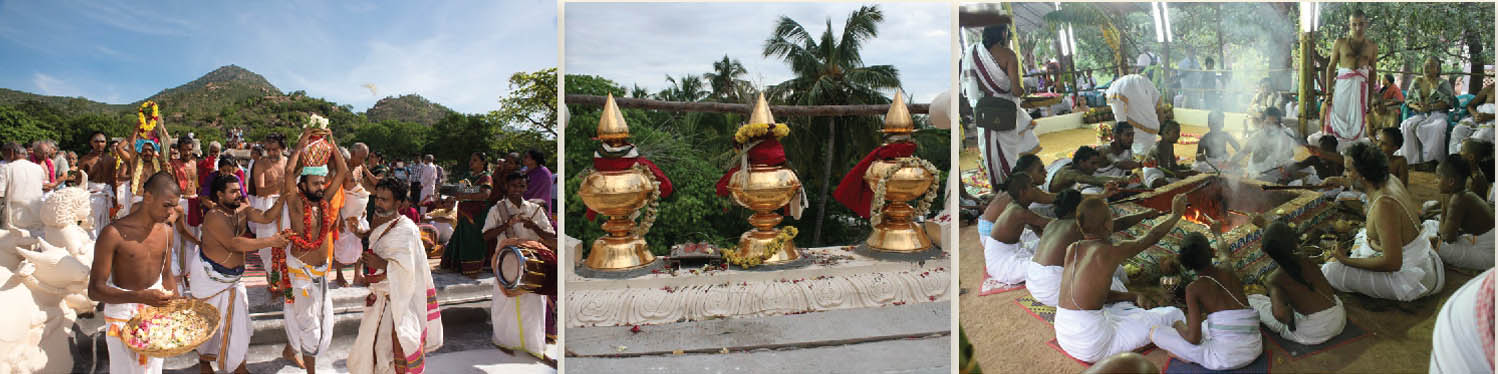
The gold-plated kalasas atop the domes underwent meticulous restoration using electrolysis by experts from Kumbakonam. For the first time, the kalasas atop Rajagopuram were also plated in gold. Sculpted crocodile rain spouts were installed on the eastern and southern roofs of the Samadhi Hall, concealing drainage pipes within their tails and discharging water through open jaws, consonant with South Indian temple aesthetics.
Renovations included replacing woodwork above the New Hall, screen doors, and window fittings in the Old Hall. The Samadhi Hall underwent a complete makeover: its white marble platform was replaced with grey slate, and the panchaloka icon of Bhagavan was polished and coated with polyurethane to preserve its golden hue. The black granite base of the icon was refitted, and the shrine's drainage was repaired.
The traditional ashtabandha sealant, made of eight herbs, was sourced from a mutt in Tiruppanandal to reseal the base of deities in both shrines. Ground- breaking for the yagasala took place on 16th August, using mud and unfired bricks to construct three traditional fire pits northeast of the Samadhi Hall.
Other restorations included repainting the Old Hall, Ashram well, Swamis Niranjanananda and Ramanananda's samadhis, and all rooftop fixtures. Pali Tirtham was dredged and deepened, and its inner stone structures were rebuilt to better protect water reservoirs during dry periods.
At 9 am on 25th August, President V. S. Ramanan and purohits bearing the sacred pots went in procession up to the rooftop of Bhagavan's Shrine, where sanctified waters bathed the golden-bright kalasas of Rajagopuram and Mother's and Bhagavan's vimanas. Immediately following, an unprecedented crowd quietly entered Bhagavan's Shrine at 9.30 am for Mahabhishekam. Later, successive lunch batches in the dining hall and adjoining pandal flowed effortlessly, one after the other, as visitors partook of Bhagavan's prasad.
These six kumbhabhishekams across more than seventy-five years of Sri Ramanasramam history were not merely ceremonial markers but profound affirmations of Bhagavan's living presence. Each drew devotees into a deeper participation with the Ashram's unfolding history, transforming a stone memorial into a centre of living grace and sanctifying the unshakable spirit of surrender that continues to define Sri Ramanasramam to this day. —
[Sri Ramanasramam's seventh Mahakumbhabhishekam is set to take place on 20th August 2025 preceded by three days of yagasala pujas beginning on the morning of 18th August.]
He once told T.V. Subramania Iyer, that there were three lingas in Tiruvannamalai: Arunachala, Maharshi, and himself. Even after Seshadri's demise on 4th January 1929, his presence endured. Bhagavan Ramana had a dream after Seshadri's demise of Seshadri being shaved. Bhagavan approached him and patted him. Seshadri looked up and embraced him.
During Seshadri's interment, Ramana stood silently all the while, honouring a great soul.
In the end, one worshipped, and one remained still. But both led countless beings toward the Self. An epitaph to Seshadri's life reads:
Maharishi Ramana Prarthya Mahaneeya Nijasthitihi "One whose lofty state was praised even by Maharishi Ramana." * (This article is freely adapted from Seshadri Swami of Tiruvannamalai,
S.A. Subramanian, 1998, and from the Ashram literature.)
(series concluded)
Events at Sri Ramanasramam: 75th Anniversary Sri Bhagavan’s Mahanirvana

The 75th anniversary of the Bhagavan's Mahanirvana was observed at his shrine Friday morning 25th April. At 4.30 am, to the resonant sounds of Nadhaswaram by Sri T. R. Pichandi and party, devotees filled Bhagavan's Samadhi Hall, elaborately decorated with natural vettiver (khus) fibres. Tamil parayana began at 5.30 as purohits chanted in the Mother's Shrine for Mahanyasa Japam. Abhishekam started around 8 am and final arati took place at 10.30 am. More than 2,000 devotees joined for Bhagavan's prasad served from five separate buffet stations, two in the special pandal behind the dining hall, two in a tent erected behind the dormitories and a fifth in the usual Narayana Seva location.
Events at Sri Ramanasramam: The Six Muhurtas for Nataraja Puja
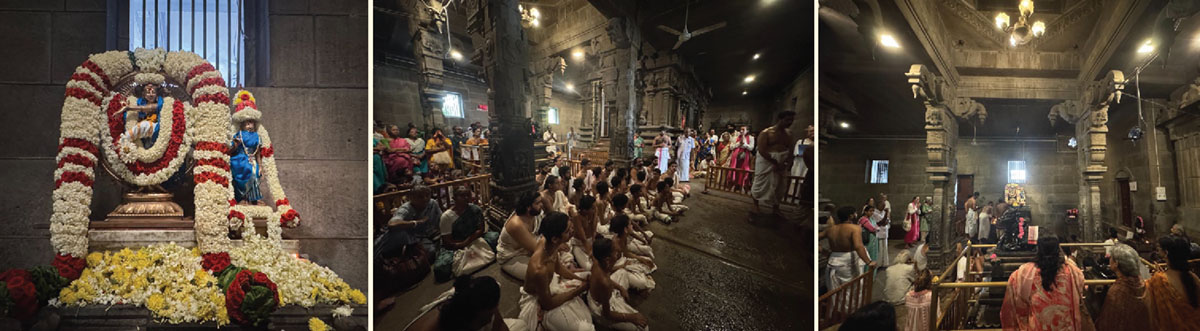
Over the years, devotees have inquired about the muhurtas (sacred timing) for Nataraja Puja at the Ashram. The Nataraja venba in the panchangam is not that easy to translate. Pundits expert in Sanskrit and Tamil have studied the text and come up with simple guidelines according to the tradition recommended for performing Nataraja Puja:
कामिकागमः
नृत्तमुर्त्त्यभिषेकश्चतुर्दिवसक्रमान्तः।
प्रथमान्तिथिरुक्ताऽऽर्द्राचैत्रपौर्णमितेर्दिने ॥
आर्द्राचैत्रयुतपौर्णमास्यैकादशदिनेऽपि ।
चैत्रकृष्णाचतुर्दश्यां चित्रपौर्णमितेर्दिने ॥
सिंहस्थेऽर्कउत्तराषाढयुतेऽनीज्येऽथवैष्णवे ।
एवमेकपकाराभिषेकोऽभिषेक्तुमिष्यते ॥
शुक्लपक्षेऽथवैष्णव्येऽप्युत्तराषाढयुतेऽर्केपरे ।
उत्सवस्यान्तेचैतच्चतुर्थ्यन्तेऽथवाभवेत् ॥
संक्रमेणोपचारेण कर्तव्योऽर्चनकादिकम् ।
kāmikāgamaṃ:
nṛttamūrtyabhiṣekaṃ ca śṛnuṣvaikāmānasaḥ |
pradhānantithiṛṛkṣṣaṃ ca dvidhācapari kīrtitaṃ ||
ārdrācāpi dhanurmāse māghe cāpi caturdaśī |
chatre ca śrāvaṇe caiva mithune cottare tathā ||
siṃhe caturdaśī caiva kanyāyā caiva caturdaśī |
evameva prakāreṇa abhiṣekaṃ ṣaḍaivatu ||
śuvalapakṣe viśeṣeṇa udayavyāptikaṃ paraṃ |
utsavānte ca tīrthe ca nṛttyamūrtyabhiṣecane ||
saṃkrameṇāpi doṣaṃ ca na kartavyaṃ kadācana ||
The translation reveals the six muhurtas (and other suggestions) as follows:
(1) During the month of Dhanu (Margazhi), on the day when the star Tiruvadirai (Ardra) occurs; (2) in the month of Magha—that is, whichever month contains the full-moon fortnight (purva paksa) together with the star Magham
(Magha)—on the Sukla-paksa Caturdasi (the 14th bright-fortnight day); (3) in the month of Chaitra—namely, the month in which the purva coincides with the star Cittirai (Chitra)— on the day ruled by Tiruvonam (Sravana); (4) in
the month of Ani (Jyestha/Asadha), on the day with the star Uttira (Uttara: Phalguni or Asadha, depending on local tradition); (5) in the month of Avani (Sravana), on the Sukla-paksa Chaturdasi; and (6) in the month of Purattasi
(Bhadrapada), on the Sukla-paksa Chaturdasi. These are the days, declares the Kamika-Agama, that are fit for performing abhishekam and related rites to Lord Nataraja.
[Note: the following suggestions are also given: Therefore, on the aforesaid days, one ought to worship Sri Nataraja with proper trikarana suddhi (purity of thought, word, and deed). One who worships Him in this way will assuredly gain the blessing of beholding His Ananda Tandava in body and mind and will earn the privilege of serving His cosmic dance of consciousness (cihidakasa nattana), and will ultimately abide in the eternal state where the mind shines as Chidambaram. Besides these special abhishekams, the Agamas also prescribe conducting abhisheka-utsavas on the final day of each temple's annual Brahmotsavam, during the sacred tirtha festival. Consequently, those days, too, are considered proper occasions for offering abhishekam and other festive rites to the Lord Nataraja. ] —
In Tamil:
|
சித்திரையில் ஓணமுதற் சீரானி யுத்திரமாம் சத்து தனுவாதிரையுஞ் சார்வாரும் பத்திவளர் மாசியரி கன்னி மருவு சதுர்த்தசிமன்று ஈசரபிஷேகத் தினமாம் |
"Chittiraiyil Onam mudal sir Ani Utthiramam / Sathu thanu(r) Athiriyum sarvagu bhakti valar / Masi ari kanni maruvu sathurthasi manru / Isar abhiseka dhinamam." |
Iconography of the Mother’s Shrine: The Rasi Chart Above Nandi
The Rasi Chart
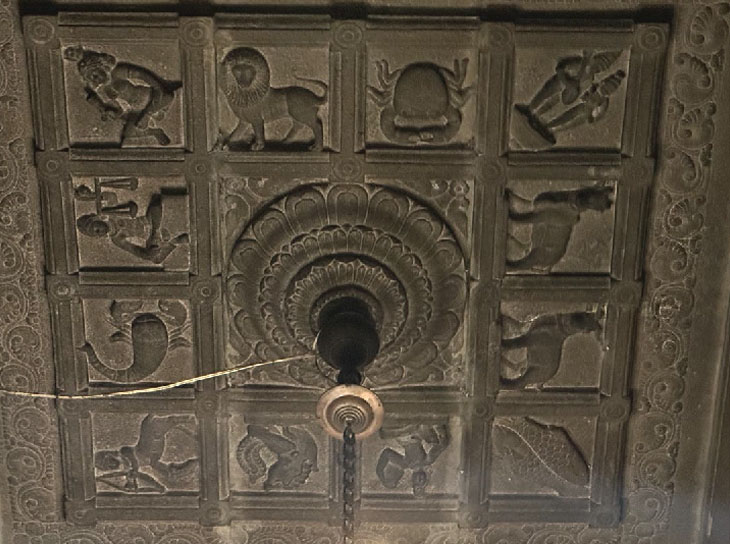
Jyotisha, or Vedic astrology, is an ancient system exploring time, space, and its effects on individuals. Central to jyotisha is the rasi chart, which fixes planets in 30-degree zodiac signs.
Understanding jyotisha requires familiarity with the twelve signs, the twelve houses, and the nine grahas or planetary deities: Sun, Moon, Mercury, Venus, Mars, Jupiter, Saturn, Rahu, and Ketu. The grahas are
sometimes called "seizers" because of their subtle forces that influence human consciousness and direct actions according to prarabdha karma. Each person's horoscope maps individual prarabdha, stored across the five
koshas, as described in the Taittiriya Upanishad. These karmas manifest in life through the grahas' influence. The lagna, or ascendant, is the first house and represents an individual's personality
and self- identity. The moon's position represents emotional nature and how an individual experiences life. The angles or aspects between planets indicate specific interactions and influences on one's life.
Jyotisha divides the zodiac (the celestial band of the heavens) into twelve signs and 27–28 nakshatras (divisions of the position of the moon according to the fixed heavens). It employs two chart styles, the South
Indian (square-shaped) and the North Indian (diamond-shaped). The rasi chart above Nandi in the Mother's Shrine is featured in the South Indian chart style, and symbolises the way the cosmos impacts all the created order,
including the life of the Lord's chief devotee, Rishiba (Nandi). The twelve divisions of the sky depicted on the ceiling of the Mother's Shrine follow counter-clockwise starting second up from the bottom right:
Mesha (Aries), Vrishabha (Taurus), Mithuna (Gemini); Karkata (Cancer); Simha (Leo); Kanya (Virgo); Tula (Libra); Vrishchika (Scorpio); Dhanu (Sagittarius);
Makara (Capricorn); Kumbha (Aquarius); and Meena (Pisces). —
Events at Sri Ramanasramam: Tamil New Year Panchangam Reading
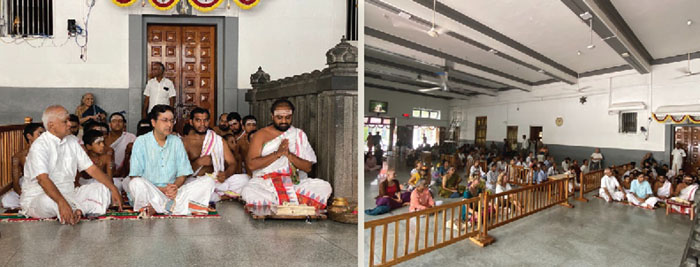
On New Year's Day, 14th April, the panchangam ('liturgical almanac') was read out in Bhagavan's Shrine. The reading serves to confirm key festival dates (muhurtas) for the upcoming year. Panch or 'five' refers to the limbs (anga) or placement of the moon calculated in five ways, namely, according to tithi, nakshatra, rasi, yoga, and karana by which muhurtas are determined and festival dates fixed.
RAMANA REFLECTIONS
The Role of Surrender and Self-Acceptance in Enquiry Practice
RAMANA REFLECTIONS
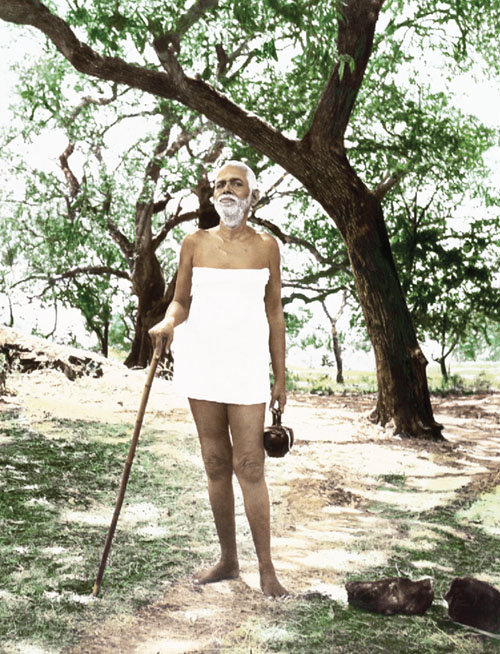
In June 1936, Mr. B. C. Das, a physics lecturer complained to Bhagavan in the Hall about a "vicious circle," namely, that meditation "is only possible with the control of the mind and control of the mind can only be accomplished by [meditation]." He added in frustration: "It is practically impossible to make the mind concentrated."
Bhagavan in a very relaxed tone, responded:
Concentration is impossible so long as there are predispositions. By practice and dispassion (abhyasa vairagyabhyam), it is possible. Vairagya is the absence of diffused thoughts; abhyasa
is concentration on a single thought. The one is the positive and the other the negative aspect of meditation.1
Over the decades, many who have come to Bhagavan have expressed the same frustration, confronted by minds besieged by restless thoughts charged with anxiety, self-doubt, or fear. In our digitally saturated age, overactive minds have become the norm. Yet Bhagavan prescribes a clear remedy: non-attachment—a quiet yet profound strength arising from relinquishing our infatuation with outcomes, possessions, identities, and expectations. Vairagya is not indifference or passivity, but clarity—the capacity to remain grounded even as the world churns.
How do we cultivate this non-attachment or vairagya? Bhagavan points to predispositions (samskaras), emphasizing that the source of our disturbance lies within us. Any effort to bring about improvement by railing against the world is pointless. Attempting to rectify external conditions without the inner work is futile. Vairagya takes place within. Bhagavan succinctly states, awareness is detachment.2 Attachment rooted in non-awareness and the stupor of narcissistic delusion binds us to the notion of a separate self. Freedom lies in surrendering the ego to its source—the Self. Bhagavan explains:
Let us surrender first and await results, then we can discuss it further, if need be. Learn what surrender is. It is to merge in the source of the ego. The ego is surrendered to the Self. Everything is dear to us because of love of the Self. The Self is that to which we surrender our ego, [allowing] the Supreme Power, i.e., the Self, to do what it pleases.3
Surrender and Acceptance
Bhagavan's vairagya (vi+raga=vigataraga, or non-attachment4) begins by loosening our insistence on how things should be and
embracing things as they are. Surrender allows for a new harmony based not on ideal outer conditions but on inner alignment. We harmonize our desires with life's inherent unpredictability. Bhagavan elaborates:
We give up this and that of 'our' possessions. If you give up 'I' and 'Mine' instead, all are given up at a stroke. The very seed of possession is lost. Thus, evil is nipped in the bud. But one's vairagya must be very strong.5
As our enquiry deepens, detached awareness gradually reveals hidden layers of the heart, uncovering not just lightness and joy but grief and vexation as well. When we touch on what lies hidden beneath the mind's surface chatter, we enter a new dimension of the inner work which includes layers of undigested laments and orphaned emotions stored in the body. Here we find that Bhagavan's surrender is there to help us.
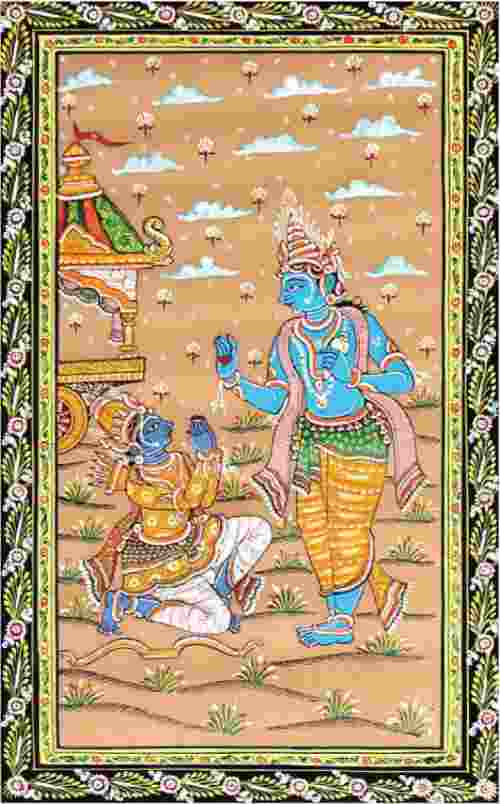
Surrender, Bhagavan reassures, is not passive resignation but an active trust in Divine wisdom beyond human comprehension. We stop reacting and start listening to the clues our immediate environment provides us with as though they were
ordained of God. Lord Krishna advises Arjuna similarly:
Perform your duty with equanimity, abandoning all attachment to success or failure.6
In uncertain times, vairagya and non-attachment empower us to act fearlessly, engaging without becoming obsessed with outcomes. Non-attachment becomes a sacred discipline, fostering stillness amidst turmoil, wisdom amidst confusion, and freedom amidst impermanence.
If we find the thoroughgoing nature of life's changeability challenging, we also begin to see how it can be freeing. We begin to recognise that nothing in the created order endures through time. We begin to relate to the phenomenal world in a more detached way. Non-attachment to created things allows us to walk in harmony with a world that no longer needs to be perfect for us to be at peace. Bhagavan reiterates:
Self-surrender leads to realisation just as enquiry does. Complete self-surrender means that you have no further thought of 'I'. Then all your predispositions (samskaras) are washed away, and you are free. You should not continue as a separate entity at the end of either course.7
Surrender practice, however, can be daunting. Fully experiencing emotional intensity, especially during meditation, may feel unsettling. Yet, by courageously turning toward discomfort without avoidance or analysis, we allow things to be seen through the lens of Bhagavan's enquiry. Here we naturally let go of the impulse to insulate through compulsive thought or conspicuous device use.
Sitting in the fire of inner difficulty helps us see that the murky regions of the heart are not inhabited by enemies to be overcome. Rather, the heart's residual afflictions—whether ancestral, collective, or born of early life
wounding—are resolved simply by being felt and known. We do not need to like what enquiry practice presents us with but rather only see it and allow it to pass through. Bhagavan affirms the usefulness of enquiry:
An examination of the ephemeral nature of external phenomena leads to vairagya. Hence enquiry is the first and foremost step to be taken. When vichara continues automatically, it results in a contempt for wealth, fame, ease, and
pleasure. The 'I' thought becomes clearer for inspection. The source of 'I' is the Heart—the final goal.8
Acceptance transforms the internal landscape. What seemed oppressive becomes liberating, our honesty deepens, and we no longer hide from ourselves.
Japanese philosophy beautifully articulates this concept through wabi-sabi, celebrating imperfection, impermanence, and incompleteness as essential to aesthetic beauty. Cracks in pottery, faded ink on paper, and weathered wood
symbolize life's inherent deficiencies, reflecting inner struggles. Not all flaws in a piece of art need be edited or improved. Instead, they may serve as signs of character, evidence of time, testaments to a life
fully lived, and representations of the essence of earthly existence which is ever fraught with constraints, not least of all, loss, sickness, decline in old age and death.
Most of the time, life's vexations appear as inherent, whereas they are only the signature of our long-standing resistance. Bhagavan's surrender comes to our aid, not that it fundamentally reorders creation, but that it radically alters
our relationship to it. Bhagavan exhorts:
Leave it to Him. Surrender unreservedly. One of two things must be done. Either surrender because you admit your inability and require a Higher Power to help you, or investigate the cause of misery, go into the source, and merge
into the Self. Either way you will be free from misery. God never forsakes one who has surrendered. (Mamekam saranam vraja).9
The courage of surrender brings radical honesty, accepting internal discrepancies as part of a divine pattern. The 14th-century Dominican monk, Meister Eckhart beautifully guides us:
To get at the core of God at His greatest, we must first get to the core of ourselves at our least.
Accepting the histories of our imperfect hearts is faith. This is Bhagavan's surrender. It is laying our imperfections at the feet of God. By contrast, insisting on preferred circumstances separates us from God and Self, divides heaven
from earth, and banishes us to the outer regions of a made-up realm. Instead, we learn to exclude nothing.
Surrendering is among the highest forms of moral freedom, delivering us from the endless task of perfectionism and the compulsion to curate our life by always smoothing its edges and polishing its surfaces.
In shedding pretences and trusting that mistakes are preferable to stagnation, we recall a line from Søren Kierkegaard, to dare is to lose one's footing for a moment; not to dare is to lose one's whole life.
But what is the dare Bhagavan is calling us to?
It is probing the realms of the heart that were previously avoided, neglected or hidden away.
The Way Out
The way out is through, goes a saying. We need not fix our imperfections but simply remain present to them. In so doing, we reflect the kindness Bhagavan showed his devotees in the Hall. The spiritual path involves entering
discomfort consciously to redeem it and be redeemed by it. The poet Rilke encapsulates this beautifully:
Perhaps everything that frightens us is, in its deepest essence, something helpless that wants our help.
The spirit of non-attachment is coming to see that there is nothing so quietly tormenting as the subtle tension of our resistances. The act of wanting things to be other than they are creates friction and separates us from ourselves and
from others. An internal world shot through with restlessness is a drain on our vital energies and keeps us firmly rooted in ignorance.
Bhagavan versified our longing in a prayer to Arunachala:
Let me, Thy prey, surrender unto Thee and be consumed, and so have peace, Oh Arunachala! 10 Acceptance means not pushing against things. When we resist
conditions day in and day out, God's hands are tied, unable to work on our behalf.
Non-attachment helps us train the heart to remain open to what we are called to and simultaneously, to what is beyond our control. Muruganar says it eloquently:
Forsake me not, my friend Detachment, ever let me call you mine, for you destroy the densest darkness, the darkness of desires, kindling the flame of knowledge.11
The Mother Bird
We recall the simile of the mother bird who prays fervently that her eggs would hatch bringing forth healthy babies. She doesn't stop there. She tends her eggs around the clock, turning them at regular intervals to be sure the warmth of
her soft belly permeates every part of each egg. Nearby another mother bird decides to pray and practice surrender with even greater intensity, so much so, that she imagines she does not need to turn her eggs or even sit on them. The
latter's eggs never hatch. Why? Wasn't she sufficiently surrendered?
Actually hers is not surrender at all. Unwilling to listen for the subtle promptings of God—the still small voice within—she is invested in an idea about herself as one totally surrendered. Like many of us, she harbours an unconscious fear that listening to God within would compel her to listen to the haunting cries of the defilements. Like many of us, she avoids God to avoid herself. Like many of us, she has lived her whole life at a distance from her own heart. Outward acts of surrender and devotion do not help her discern the soft whispers of the Divine prompting her to tend her eggs like the first mother bird. She tricks herself into believing that her intense surrender exempts her from action. But true surrender does not mean inaction.
Here we are reminded how Lord Krishna said to Arjuna on the battlefield that there is no such thing as inaction. Every choice is an action. As for the choice not to act, the second mother bird pays a heavy price for it. True surrender means doing all in one's power, then leaving the rest to God.
Acceptance
Non-resistance, non-reactivity, and non-longing form the core of acceptance practice but all are seen in the light of doing what is being called for in the moment.
Acceptance allows for harmony beneath life's surface turbulence. When resistance ends, harmony naturally arises, bringing transformation. When we stop resisting the moment, the moment stops resisting us. Acceptance is not the end of effort, but the beginning of freedom. When we give up everything, God has no choice but to come to our aid.
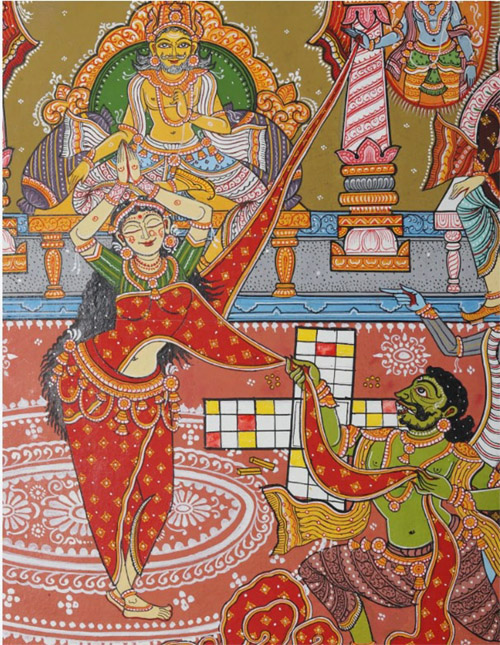
This is illustrated in The Mahabharata through Draupadi's ordeal. We recall the scene where Duryodhana, the leader of the Kauravas, drags Draupadi to the assembly hall and attempts to humiliate her.
When a gentleman from Ambala asked Bhagavan about a rational explanation for Draupadi's vastra (sari) becoming unending, Bhagavan responded:
Spiritual matters cannot be fitted into rational explanations. Spirituality is transcendent. The miracle [comes only] after Draupadi had surrendered herself. The secret lies in surrender.
12
Here we recall Lord Krishna rubbing dust from the feet of the surrendered person on his head. True surrender is sanctity of the highest order.
Self-Acceptance
Non-surrender is often born of a deficit in self- acceptance. Ultimately, freedom begins not with external changes but with internal acceptance. There is no judgment, no ledger of right and wrong—only the silent radiance of Being. The
ceaseless project of self-improvement is rooted in a misunderstanding, namely, the belief that the ego is fundamentally flawed whereas, in fact, there is no ego, Bhagavan tells us. Thus, mistakes—previously seen as failures—do
not belong to anyone. In recovering them, we can then let them go. They then become gateways to a hidden innocence residing further down.
Conclusion
True courage begins by embracing life and sitting with uncertainty, sorrow, or loneliness without trying to fix or flee anything. Beneath every struggle lies God's grace, illuminating our inherent purity untouched by karmic
afflictions. Courage arises when we give up the fight, trusting that even what is difficult has something to teach us. Surrender and self-acceptance are indispensable components of Bhagavan's enquiry. They offer a profound path to
freedom, inviting us to embrace conditions just as they are. What remains is simplicity and the shining truth that we were never unworthy to begin with. Through enquiry, we begin to overcome non-acceptance, allowing us to discover what
is not broken, namely, the Ground of Being— the Self—whole, complete, luminous, and aware. —
In Focus: April Edition

For the April edition of In Focus, copy the following URL into your browser April Infocus
Similes from Bhagavan: Rama and the Mirror
One knows that control of the mind is the final aim, it is thus futile to make an interminable study of the scriptures. What is required for such control is actual enquiry into oneself by self- interrogation, 'Who am I?' How can this enquiry in quest of the Self be made merely by means of a study of the scriptures? One should realize the Self by the Eye of Wisdom. Does Rama need a mirror to recognize himself as Rama? That to which the 'I' refers is within the five sheaths, whereas the scriptures are outside them. Therefore, it is futile to seek by means of the study of scriptures the Self that has to be realized by summarily rejecting even the five sheaths. — Who Am I? §20
Sadhu Natanananda’s Upadesa Ratnavali §23
To determine God’s truth, we must understand our own.
For highly mature souls who seek the supreme Satchitananda to be free of the scorching heat of birth (and death), it is by enquiry into the word ‘Thou’, (as in‘That’, ‘Thou’ and ‘Art’ of Tattvamasi) that the glory of liberation is attainedGVK §506
Jiva understands the term tat ascribed to God, since he is aware of his own existence through the understanding of the term tvam ("thou"). How? Since a plant cannot grow without a seed, jivas (the effects) depend upon God (the cause) and know about themselves only by the light of God and therefore cannot exist if there is no God—independent, self-shining. In reality, the condition of Being transcends the distinction between cause and effect. The meaning of the term tvam is sufficient to comprehend this. As there is no distinction between "pot space" and "universal space," there is also no distinction between tvam and tat, indicating they are identical and always true.
Bhagavan’s Handwriting: “O God Supreme!” Sannidhi Murai, v. 155

|
pattratru nirkum paricanrō pantaivinait tottrattru nirkaccey cūlcci parāparamē. |
Is it not a blessing to be devoid of attachment? Oh Supreme God, is it not a simple trick to be free of past deeds? — |
Events at Sri Ramanasramam: Nirvana Room Chanting

Bhagavan's Aradhana according to the Gregorian calendar falls each year on 14th April. The Tamil New Year Sri Chakra puja was performed a little early in order that all may be ready to gather at 8 pm outside Bhagavan’s Nirvana Room. During Aksharamanamalai chanting, a welcome rain came, blessing the proceedings and cooling the otherwise warm mid-April day. Afterwards, devotees filed one by one past the open door of the Nirvana Room to pay their respects. —
Best Shot: Bhagavan’s Kitchen
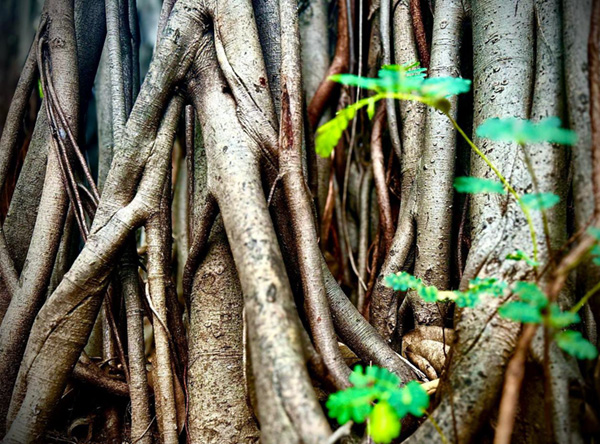
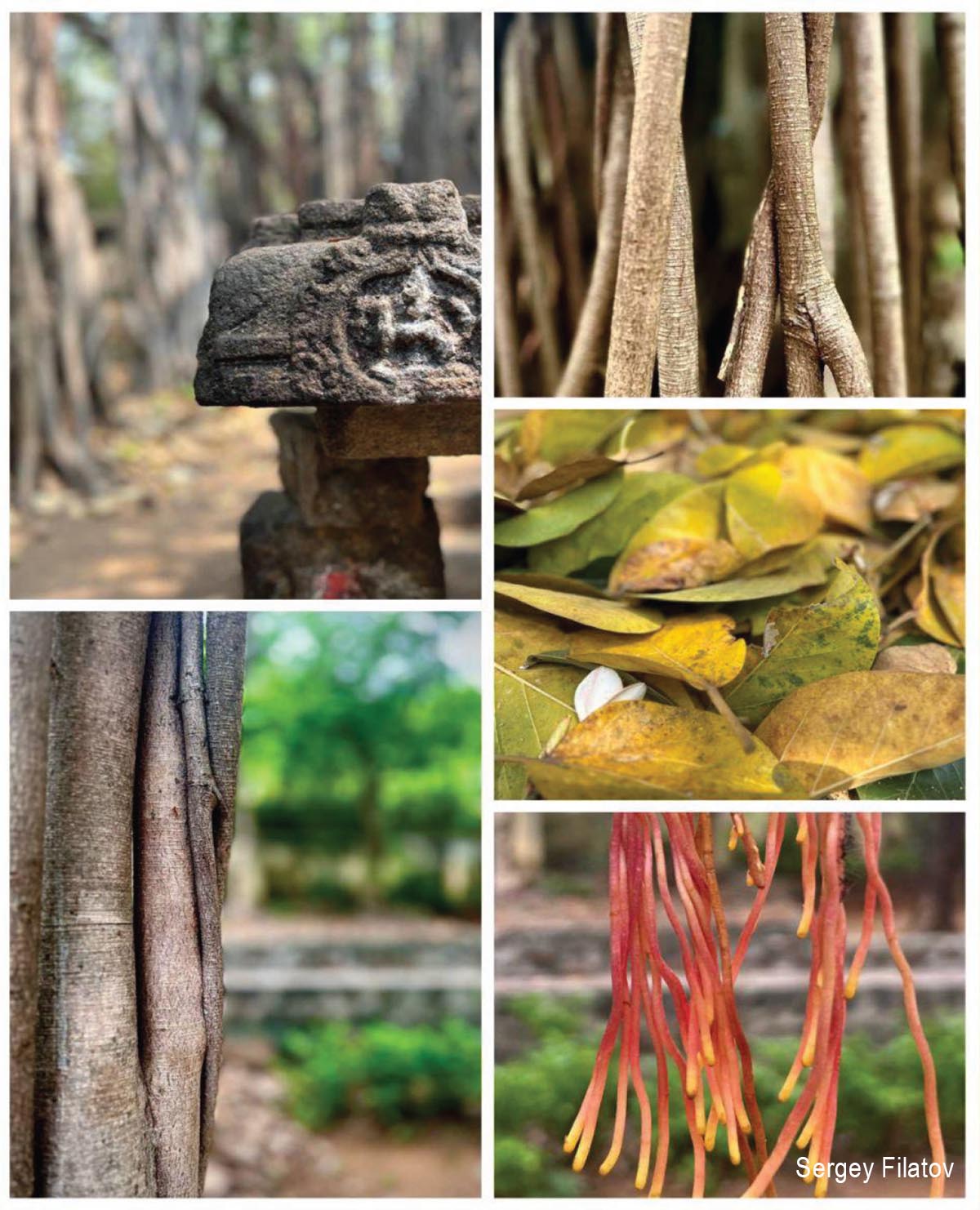
The banyan is one of India’s most sacred trees, symbolizing the diversity of earthly life emerging from a single, hidden source beneath the earth. It stands for immortality, shelter, and wisdom, and is revered as a dwelling place of the divine. In 1930, Manavasi Ramaswami Iyer with help from Sub-register Narayana Iyer planted banyan trees along the path Bhagavan used for his daily walk to Palakotthu. A century later, we get to benefit from their actions. According to the Puranas, Arunagiri Yogi sits on Arunachala beneath a banyan tree. Significantly, the tree pictured left lies at a higher elevation than the Ashram’s front wall and may thus be considered as growing upon the sacred slopes of Arunachala. —
Announcement: Sri Chakra Puja Live Streaming
Sri Ramanasramam is live streaming the Ashram Sri Chakra Puja on the first Friday of each month. Daily live streaming Mon to Sat from 8 to 9.30 am and 5 to 6.45 pm IST continues and includes the Vedaparayana, puja and Tamil Parayana. (No streaming on Sundays) To access videos, go to:https://youtube.com/@SriRamanasramam/videos
Events at Sri Ramanasramam: Major Chadwick Day
The banyan is one of India’s most sacred trees, symbolizing the diversity of earthly life emerging from a single, hidden source beneath the earth. It stands for immortality, shelter, and wisdom, and is revered as a dwelling place of the divine. In 1930, Manavasi Ramaswami Iyer with help from Sub-register Narayana Iyer planted banyan trees along the path Bhagavan used for his daily walk to Palakotthu. A century later, we get to benefit from their actions. According to the Puranas, Arunagiri Yogi sits on Arunachala beneath a banyan tree. Significantly, the tree pictured left lies at a higher elevation than the Ashram’s front wall and may thus be considered as growing upon the sacred slopes of Arunachala. —
Endnotes
- 1 Talks, §287, 27 November 1936.
- 2 Guru Vachaka Kovai, Prof. K. Swaminathan, §243.
- 3 Talks, §201, 14th June 1936.
- 4 Talks, §566, 26th October 1938.
- 5 Talks, §28, 4th February 1935.
- 6 The line continues, Such equanimity is called Yoga or union with the Supreme. Bhagavan Gita, Chap. 2.47-2.53.
- 7 Talks, §31, 4th February 1935.
- 8 Talks, §27, 4th February 1935.
- 9 “Only surrender to Me”, Talks, §363, 20th February 1937
- 10 Aksaramanamalai, v. 28.
- 11 Guru Vachaka Kovai, Prof. K. Swaminathan, §239.
Publisher: Dr Venkat S. Ramanan
saranagati@gururamana.org
