
SRI RAMANASRAMAM
VOL. 19, NO. 6
Dear Devotees,
As we near the end of the month of May, following abundant rains, the warm summer season seems to have passed.
The Ashram is buzzing with repair work and renovations in preparation for Mahakumbh- abhishekam to be conducted in August this year. Among the many projects is a needed expansion of the Ashram’s Free Dispensary.
In this issue we take up the life story of G. V. Subbaramayya. In Ramana Reflections, we consult Bhagavan on the path of jnana and hear just what jnana and vichara should look like in our daily life (see p. 10).
For videos, photos and other news of events:
https://www.gururamana.org.org or write to us at:
saranagati@gururamana.org. For the web version:
https://www.sriramana.org/saranagati/June_2025/.
In Sri Bhagavan,
Saranagati
Table of Content
- In Profile: G.V. Subbaramayya
- Bhagavan’s Handwriting: Ramana Sannidhi Murai, v. 156
- Announcement: Dispensary’s World Environment Day
- Events at Sri Ramanasramam: Mahapuja
- Ramana Reflections: The Mirror of Knowing
- In Focus: May Edition
- Sadhu Natanananda’s Upadesa Ratnavali §24
- Similes from Bhagavan: The Rising Sun
- Announcement: Sri Chakra Puja Live Streaming
- Sri Ramanasramam Centenary Commemorative Coin
- The Ashram Gardens: A Unique Narayana Seva Visitor
- Best Shot: Skandasramam
- Obituary: Sri T. S. Vaidyanathan (1948-2025)
Calendar of Ashram Events
5th June (Thu) Ashram Dispensary Environment Day |
7th July (Mon) Cow Lakshmi Day |
8th June (Sun) Pradosham |
8th July (Tue) Pradosham |
10th June (Tue) Full Moon |
10th July (Thu) Full Moon |
23rd June (Mon) Pradosham |
23rd July (Wed) H.C. Khanna Day |
24th June (Tue) New Moon |
24th July (Thu) Punarvasu |
27th June (Fri) Punarvasu |
25th July (Fri) Ganapathi Muni Day |
IN PROFILE
G.V. Subbaramayya
G.V. Subbaramayya
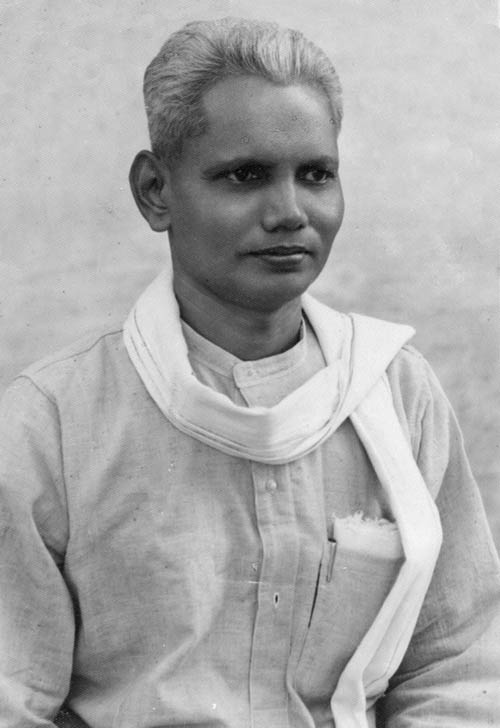
Narrating the life of Prof. G. V. Subbaramayya is no simple task, for his own Sri Ramana Reminiscences stands as a masterwork of prose, storytelling, and devotional biography. To recount his life is, in some sense, to merely reprint that volume—so complete is it as a testament to a life spent in the holy presence of Bhagavan Sri Ramana.
A lecturer and later the principal of P. B. N. College in Nidubrolu, Andra Pradesh, Prof. Subbaramayya was a scholar of refinement, fluent in his native Telugu as well as Sanskrit and English. His literary works included a poetical rendering of Kalidasa's Meghaduta in Telugu and two volumes of English poetry.
Yet, the story we must tell begins in the early 1930s, when Subbaramayya—affectionately known among Ramana devotees as 'GVS'—came across some verses in Telugu that captivated him. Three things struck him: the beauty and poetic genius matched that of the classical Telugu poets; the author was a contemporary; and most astonishing of all, the poet was not a native Telugu speaker but a Tamilian. He recalls:
For over two years I had been reading the works of Sri Bhagavan and other Ashram literature. My interest was mainly literary rather than philosophical. I was struck with wonder at the style of the Telugu Upadesa Saram which, in its simplicity, felicity, and classical finish, could rival the great poet Tikkana. I became convinced that a Tamilian who could compose such Telugu verse must be divinely inspired. I longed to see him.
That moment came under tragic circumstances. In December 1932, GVS's two-year-old son suddenly passed away from a heart attack. No longer moved merely by literary curiosity, GVS now set out for Tiruvannamalai, drawn by an inner intuition that this inspired poet—Bhagavan Sri Ramana—could console his grieving heart.
On 8th June 1933, he arrived at Sri Ramanasramam for the first time:
My immediate quest was for peace and solace. In the morning, I had darshan of Sri Bhagavan in the Old Hall. As our eyes met, there was a miraculous effect upon my mind. I felt as though I had plunged into a pool of peace. With my
eyes closed, I sat in a state of ecstasy for nearly an hour. When I returned to normal consciousness, I noticed someone spraying the Hall to ward off insects, and Sri Bhagavan mildly objecting with a gentle shake of the head.
Hearing Bhagavan speak, I gathered the courage to ask a question: 'The
Bhagavad Gita
says that mortals cast off worn-out bodies and take new ones, just as one discards old clothes and dons new garments. How does this apply to the deaths of infants whose bodies are still fresh?' Bhagavan promptly replied, 'How do you
know that the body of the dead child was not worn out? It may not have been apparent, but unless it is worn out, it will not die. That is the law of Nature.'
Moved by this exchange and changed by his meeting with Sri Bhagavan, GVS made up his mind to return. But it would take three years. Thus, in the spring of 1936, he came again, this time carrying a letter of introduction from Sri G. Sambasiva Rao. But Bhagavan needed no such formality. GVS recalls the moment:
As I handed him the note, even before reading it, Bhagavan gave a knowing nod and smiled graciously. He said, 'Why the introduction? You have come before; you are not new.' To my astonishment, Bhagavan now appeared to me as the very image of my deceased father. The resemblance was uncanny. My cousin, Sri V. V. Narayanappa, who visited later, also remarked, 'Sri Bhagavan looks exactly like my uncle, your father.' That settled it for me. Bhagavan was not just Guru, Maharshi, or Bhagavan— He was my father. My approach to him henceforth was like that of a child to a parent: fearless, familiar, and free.
As is often the case with those first coming into the orbit of the living sage, long-standing spiritual practices and daily observances begin to dissolve without any conscious intention. GVS had been initiated into two mantras, which he was to repeat a certain number of times each day. One day in the presence of Bhagavan, GVS noticed the sankalpa to maintain this practice had begun to dissipate:
After a few days, I was seized with fear that I was incurring a sin by neglecting my initiation. I confessed this to Bhagavan. He smiled and said, 'Precisely owing to having done so much japa, its merit has brought you here. Why fear now, while enjoying the fruit of that japa?'
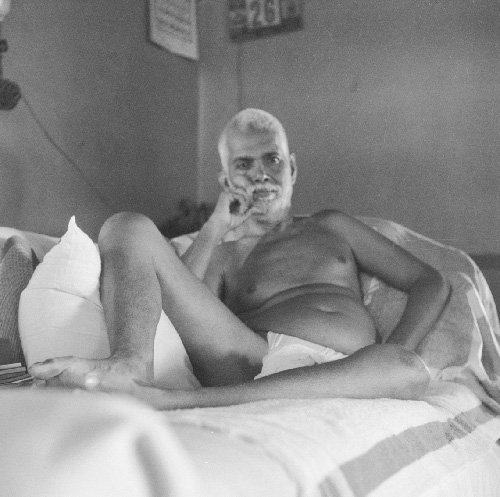
A similar anxiety arose regarding his having discontinued his pranayama practice. Disturbed by worry, he approached Bhagavan in the dead of night when the Hall was quiet. Bhagavan responded with laughter:
'What! Again you are seized with fear? These are common experiences of those who do yogic exercises without the guidance of a living Guru. But having come to me, why should you fear?' Then Bhagavan added in a low voice, 'Next time you feel that sensation, just think of me—and you'll be all right.' From that moment on, I never felt it again. So there has been no need to think of Bhagavan on that account.
One day on this same visit, GVS told how, after the other devotees had left the Hall, an old villager approached Bhagavan complaining of chronic stomach pain. Smiling gently, Bhagavan said, "Am I a doctor?" Then, turning serious, he leaned over and whispered to GVS to give the man vibhuthi prasad from the office. Though GVS had been somewhat sceptical about the power of prasad, this incident changed his thinking on the subject permanently.
Ashram Work
When he returned home after this visit, GVS, aware that translation work was going on in the Ashram, wrote offering his literary services. He proposed that he attempt a Telugu translation of the Sri Ramana Gita, submitting the
first canto.
V. V. Narayanappa informed GVS that, on 21st June 1936, Bhagavan had spoken with appreciation of the clarity and elegance of the translation. Encouraged by this, GVS completed the entire work and went on to translate other texts, including writings by Sri Kavyakanta Ganapati Muni and Sri Daivaratha.
On 6th October of that year, vibhuthi prasad from Bhagavan was sent to the above mentioned Narayanappa, GVS's cousin, who was then bedridden with typhoid. Though the doctors had warned of an impending crisis, the fever broke that very day and normalized by the next—a clear sign for GVS of Bhagavan's grace. Another similar miracle affected him:
I told Bhagavan of my wife's continuing grief over the loss of our son. Bhagavan inquired, "Has she had no male child since?" "No," I replied. Bhagavan sighed and said with compassion, "Alas! What a pity." This exchange took place on 18th October 1936. Remarkably, on 1st August 1937, my wife gave birth to a male child. When we later brought the baby to Bhagavan, his first question was, "What is the child's name?" I answered, "Ramana Prasadam." Bhagavan exclaimed, "Indeed! Is it?" Then, to my astonishment, he fed the child two bananas as if to demonstrate that it truly was his prasad. The offering did not in the least upset the child's digestion.
When departing the Ashram to return home, Chinnaswami handed GVS three packets of prasad. When I asked whom they were for, Bhagavan replied:
"One for your family, one for Narayanappa, and one for your friend." He did not specify who the friend was, nor did I ask. However, the very next day, a letter redirected from the Ashram reached me. It had been written by Mr. R. P. Reddy, a zamindar, who had addressed it to the Ashram, imploring Bhagavan's grace for his aged grandmother. She had not eaten for months and was on the verge of collapse. At once, I realized whom Bhagavan had meant by "your friend." I hastened to Mr. Reddy with the prasad. A few days later, he came to see me and joyfully reported that the prasad had marked a turning point—his grandmother had begun eating again and was steadily recovering.
In February 1937, GVS visited the Ashram to submit his translation of Sri Kavyakanta's Gitamala. He recalls the scene:
As I entered the Hall and prostrated, my five-year-old daughter, Lalita, ran up to Bhagavan and asked innocently, "What's your name, Sir?" Bhagavan responded with a counter-question, "What's your name?" "My name is Lalita," she said. "And what is yours, please?" With a twinkle in his eye, Bhagavan pointed to himself and said, "What! Don't you know me?" She immediately replied, "Oh yes! I just asked for fun." Bhagavan laughed heartily.
GVS tells us that Lalita was lively and unmindful of Ashram decorum. She pulled the punkah, fiddled with the books, and busied herself in the Hall. Three times, Bhagavan asked her, "What are you doing there?" And each time, she replied, "I am remaining quiet." Bhagavan remarked:
This child is so busily active yet claims to be keeping quiet. A little child says this, but elders cannot understand such a thing.
From then on, Lalita became a favourite of Bhagavan, who would coax her to dance and sing Tamil songs she had learned from her Tamil teacher. His grace flowed abundantly on these occasions. GVS recalls the moment of their leave-taking:
As she knelt to take leave, Bhagavan, who had just finished his breakfast and was seated, tapped her on the back with his stick, saying, 'This is to keep you in mind, lest you forget.' Then he lifted her and embraced her, holding
her close to his heart. Turning to those present, he said, 'The special quality of this child is this: she has no sense of strangeness. All beings and all things she accepts as her own.'
During this same period, GVS worked diligently on Sri Ramana Gita and its appendices. One day, Bhagavan playfully asked:
"For your college work, you draw a salary. But what is your payment for this labour?" I replied, in jest, that I was hoping for a far greater reward than money. As it turned out, a reward did come.
Strangely enough, midway through the following month, GVS received a last-minute telegram offering him the position of Chief Examiner, just a day before the commencement of the examinations. Later, he discovered that, due to an
oversight, the authorities had appointed one examiner fewer than required and noticed their mistake only at the eleventh hour. They resorted to the reserve list, where GVS's name stood at the top. So, they wired the offer to him. It was
so unexpected and timely that he could only attribute it to Bhagavan's grace. When he next saw Bhagavan, he said:
So I did receive payment—at Sri Ramana's own hands.
In the summer of 1937, as GVS entered the Hall, Bhagavan and theattendant Madhavaswami exchanged glances and laughed loudly. GVS comments:
As I looked puzzled, Bhagavan asked Madhavaswami to explain. The latter said, "Sri Bhagavan was preparing the 'table of contents' for your Ramana Gita
and remarked that its author might himself come and fix them up. Just as Sri Bhagavan finished writing the last word, lo and behold! you appear on the scene!"
One night in the dining hall, Bhagavan enquired whether there was any bitter orange pickle. The Sarvadhikari was annoyed to find there was none. The next afternoon, the outgoing Ashram mail that was as usual submitted for Sri Bhagavan's
perusal by Sri G. L. Narasimha Rao, contained a letter by the Sarvadhikari to a Madurai devotee asking for a basket of country oranges:
Upon reading it, Bhagavan remarked: "To these people salvation seems to lie in country oranges. Otherwise, why should we write to someone for them? Would they not come of their own accord if they were destined to come?"
So saying he returned the letter to Sri Narasimha Rao. As the latter was withdrawing in trepidation, a Railway contractor entered the Hall with two sealed basket-parcels for which no railway receipt had been received. GVS explains:
In those days it was the invariable practice to first show Bhagavan anything that came to the Ashram before it was taken inside. Now Bhagavan laughingly observed "What! Are these parcels country-oranges? Open them and see." When they were opened, lo! they both were baskets full of country-oranges. At once they were taken into the kitchen for being cut and pickled. Again, Bhagavan said, "Perhaps one basket has sour oranges and the other basket sweet oranges," and sent someone to make sure before mixing them up. It turned out to be exactly as Sri Bhagavan had said. The sweet oranges were peeled first, and their slices were distributed among the devotees then and there. Seized with wonder, I enquired whether we should consider the incident as a miracle or as a mere coincidence. In reply, Bhagavan quoted from Yogavasistha which says: 'This prajna which is treasured up in the heart of the wise is Chintamani. Like Kalpalata it fulfils instantly whatever is thought of.' —
(to be continued)
Bhagavan’s Handwriting: “O God Supreme!” Sannidhi Murai, v. 156

|
unmaip paraveliyā munnitattē mupporulin tinmaip pirivinaiyār ceytār parāparamē. |
In the vast space of your true Being, O God Supreme, who is it that brought about this firm division into the three prime entities? — |
Announcement: World Environment Day at The Ashram’s Free Dispensary
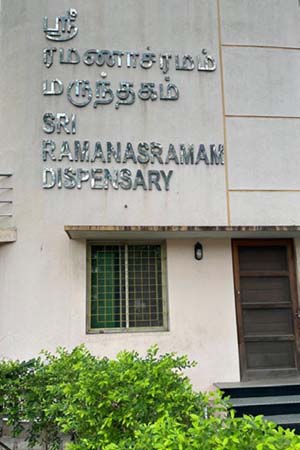
World Environment Day is celebrated every year on 5th June, serving as a global platform to raise awareness and inspire action to protect the environment. Established by the United Nations in 1972 following the Stockholm Conference, it is now observed in over 150 countries and has become a key event for environmental outreach.
The theme for 2025 is "Ending Global Plastic Pollution." Each year, approximately eleven million tonnes of plastic waste enter aquatic ecosystems. In addition, microplastics from sewage and landfills—often stemming from plastics used in agriculture—accumulate in the soil. The social and environmental costs of this pollution are estimated to range between ₹2,500 to ₹5,000 crores annually. This year's observance comes at a pivotal moment, as nations work toward a global treaty to end plastic pollution, including in marine environments. The fifth round of treaty negotiations took place in the Republic of Korea in November 2024, and the second part of the session will be held from 5–14th August 2025, in Geneva. Locally, the Ashram Free Dispensary will mark the occasion from 7 to 9 am on Thursday, June 5th, 2025, with support from local school children. The event aims to raise awareness about the impact of plastic pollution. All are welcome to join. —
Events at Sri Ramanasramam: Mahapuja
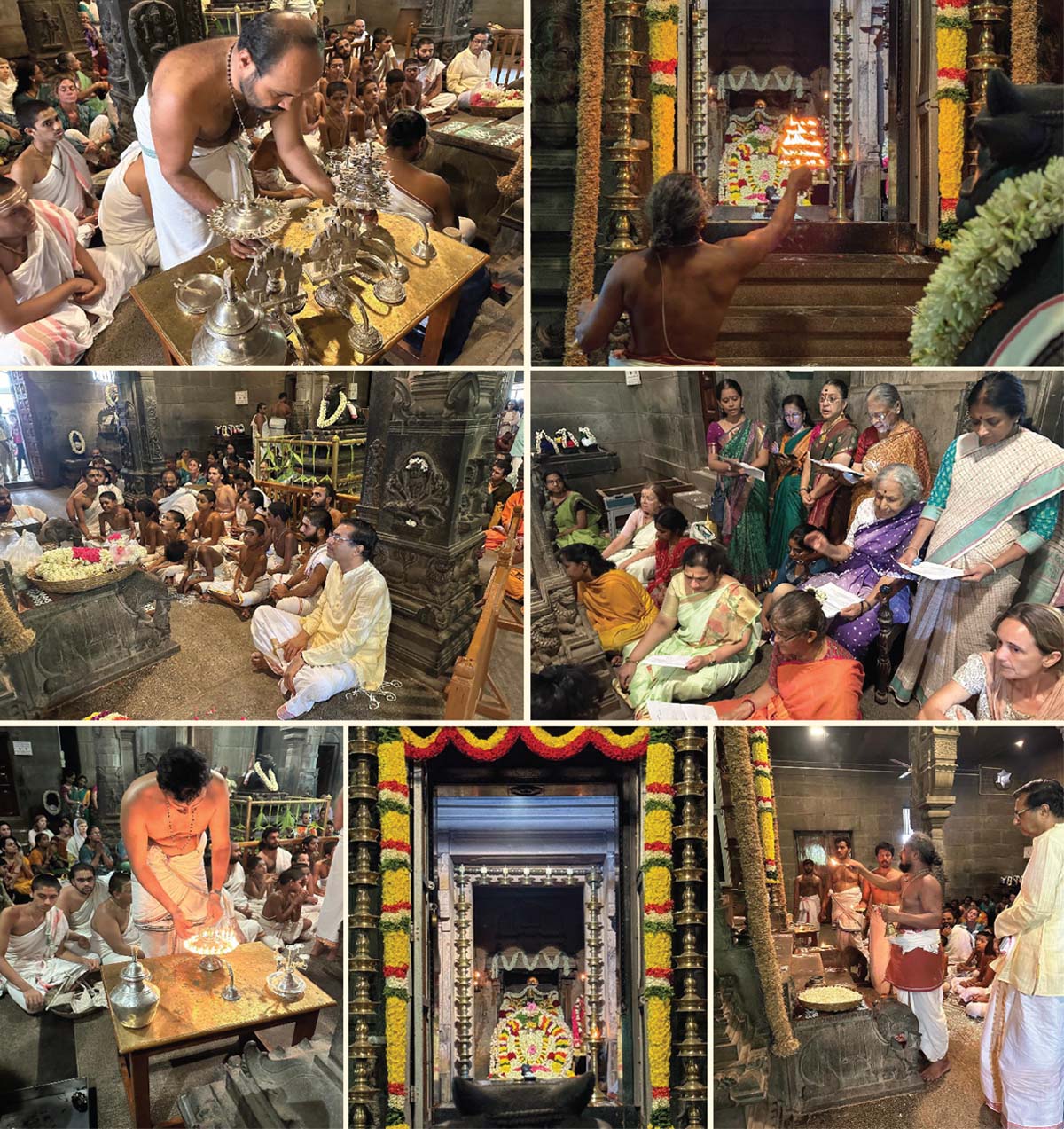
One day in 1916, Mother Alagammal ascended the Hill with no intention of returning home. What began as a longing soon evolved into a spiritual aspiration. Under her son's strict yet compassionate guidance, her spiritual quest culminated in complete liberation on 19th May 1922. The following day marked the first Mahapuja at her samadhi at the base of the Hill—what would later become known as Sri Ramanasramam. Since then, this day has been commemorated annually as Mahapuja. This year's Mahapuja took place on the morning of 21st May with mahanyasa japa followed by Deeparadhana at 10:30 am. Devotees worldwide participated virtually through live online streaming. —
RAMANA REFLECTIONS
The Role of Surrender and Self-Acceptance in Enquiry Practice
RAMANA REFLECTIONS

Followers of Bhagavan Sri Ramana naturally align themselves with jnana marga—the path of knowledge. Yet many remain uncertain about the true nature of knowledge. Bhagavan clarifies the distinction between bhakti marga and jnana marga by stating that bhakti "concentrates on God," while jnana "seeks the Self."1 Bhagavan further explains that the "path of knowledge tries to find out how viyoga (separation) came about." This has relevance for Bhagavan's vichara.
True knowing, according to Bhagavan, depends on resolving the fundamental illusion of separation. Merely accumulating information, even if accurate, holds little value in the spiritual life.
Modern seekers will do well to guard against idle curiosity and excessive information that may obscure genuine insight. They understand the difference between reading books to know things and reading the text of the Heart to know the way forward on the spiritual path. In fact, Bhagavan once said that books are outside; the Self is within.2
While practical knowledge has a place, it remains secondary for Bhagavan's devotees. Speculative knowledge distracts from what truly matters.
Once, when asked about the importance of understanding the ultimate nature of the world, Bhagavan simply replied:
Find out who you are and there will be an end of all your doubts.3
True knowing is not a theory to memorize but a path to follow. Identifying which kind of knowledge really matters and discarding the rest is the core of jnana marga. Instead of merely gathering facts, the seeker aims to refine the instruments of perception, sharpen true insight, and purify the heart cluttered with unnecessary distractions.4 These constitute the foundational principles of jnana marga.
The biblical saying know the truth, and the truth will set you free, is often misunderstood. Real knowing is qualitative, focusing on essential understanding— knowing oneself and one's place in the cosmos. We do not need to know many things, but rather, the one thing that will be decisive in freeing the knowing faculty from its encumbrances. As Bhagavan eloquently remarks:
One can know oneself only with one's own eye of knowledge, not with someone else's. Does Rama require a mirror to know he is Rama? 5
Bhagavan tells us that penetrating illusion is itself illusory.6 What can he mean? Each clarifying moment in the enquiry process leads us to a deeper state of knowing, but this deeper knowing is very often grounded in ignorance. Until the illusion of the small self is fully resolved, every breakthrough remains grounded in the original misunderstanding.
Knowing often remains tethered to the mistaken notion I-am-the-body, leading to myriad views, opinions and narratives. The drive to know things often masks deeper existential insecurities, granting the illusion of control over life's uncertainties.
What then is the mind's true function? Bhagavan advises that the mind is a tool only to be made use of when needed, and not a constant distraction akin to a radio stuck between stations at full volume.
Bhagavan's cinema metaphor vividly illustrates true knowing. Initially, we understand that the figures on the cinema screen are mere shadows and light. This is the first order of clarification. Yet a deeper realization emerges: everything we perceive, including the walls and seats of the cinema hall, are sense objects arising on the Screen of Awareness. Bhagavan elucidates this subtlety:
The instruments for knowing—the sense organs—are external and thus called outer senses. The mind, internal, is the inner sense. But the distinction between inner and outer is only with reference to the body. In truth, there is neither inner nor outer.7
Further clarifying, Bhagavan states:
A figure on the screen in the cinema hall seems to watch the world. Yet both the observer and the observed are illusory. Similarly, the ego and the world perceived by it hold no more reality than cinema images.
8
In the meditation traditions there's a teaching, "Everything points to It." This seems to emphasize that all phenomena ultimately reflect the One Ground of Being. Bhagavan describes the ego as a distorted reflection of the Self. The error lies in mistaking the reflection for its Source. Rumi beautifully echoes this idea:
The truth was a mirror in the hands of God. When it shattered, everybody took a piece and thought they possessed the truth and had it all to themselves.9
This metaphor reveals a common fallacy—believing the truth we encounter is exclusively ours. The mirror was in God's hands and reflected God's face. But each person looking into their mirror fragment only sees themselves—not as they are but as they imagine themselves to be. Bhagavan expands this point further:
This world arose like a dream from thoughts born of ignorance of the Self. The essence of the Vedas rests in revealing Brahman's true nature after exposing the world's illusory appearance. Realization reveals the illusory nature of the world and one's innate bliss.10
It's not that the mirror fragments are not pure. They reflect exactly what is put before them. It is the seer that is not yet pure. His or her distorted perception obscures truth. In not seeing clearly, he or she misses seeing the true face of God—misses seeing his or her own true face. Bhagavan elaborates:
Since purity is the nature of mind undefiled like ether, what is called mind is, in truth, of the nature of knowledge. Only mistaken perceptions create 'mind'—originally pure sattva—identifying falsely as the body and deeming the world real. But the mind free of defilements meditates to gain the natural state of the Self.11

GVS recalls Bhagavan's answer in the hall regarding the ultimate status of the world:
The world seen as the world through ignorance is false, but the same world seen as Brahman through knowledge is real.12
A parallel from the Sufi tradition echoes this point:
From atoms, He fashioned countless mirrors, each reflecting His Face. To awakened eyes, beauty everywhere reveals that Face.13
Viewed from the ego, the reflections are distorted; viewed from the liberated state, they are pristine clarity.
Another common distortion involves making the world our mirror, following collective delusion rooted in consumerism, and looking to its ways as our guide. Society's tendency is to seek security and freedom through transient sensory experiences. The logic of following the mirror of the world is simple: if everyone else is doing it, it must be correct.
The Well of Madness
There's a story of a Maharaja who ruled from a palace perched atop a hill overlooking the villages below. He was fair-minded, deeply loved by the people and adored by his wife, the Maharani. Under his rule, all lived in peace and
harmony.
The villagers relied on a central well for their water supply. One day, a vengeful wizard poisoned the well and anyone who drank its water quickly became mad. Within days, every villager had drunk the poisoned water, and the harmonious kingdom was plunged into chaos. Only the king and queen remained unaffected, as they drew water from a separate source. Deeply concerned, the Maharaja descended to the people below, determined to restore order. But the villagers, now crazed, saw their once-beloved king as strange and threatening. They united against him, convinced he had gone mad. The mob chased him back to the palace, demanding he surrender the crown.
Heartbroken, the king considered stepping down for the people's sake. However, the queen proposed another solution: "What if we drink from their well and become like them?" Desperate to maintain unity, the king reluctantly agreed. Together, they went to the poisoned well and drank. Instantly, they too succumbed to madness. The king's subjects, seeing the king and queen now behaving just like them, rejoiced. The rebellion ceased, and peace was restored. Yet, neighbouring towns avoided the kingdom entirely, cautioning "The people there are completely crazy." 14
This story illustrates our inclination to conform, even if everyone around us is on the wrong path. Bhagavan neither drank from the collective well of madness nor fixated on a reflection in the mirror. The world gone mad with egoism did not exist for him. As Reality Itself, he had no need for a fragment of glass merely reflecting Reality.
Cognition and the Consumer Age
Our pursuit of knowledge carries inherent limitations. When we come to understand that the knowledge we possess is insufficient, come to see that thought cannot take us there, it becomes clear that the longed-for moment when
ego becomes whole can never arrive. Since ego is a fantasy, Bhagavan tells us, it can never be complete. The project of ever trying to gain something new gives way to giving up all we cling to. Understanding this with the mind is one
thing; accomplishing it with a turn-around in the Heart is another.
In the consumer era, we have put the thinking mind at the centre of our lives and are at a loss to imagine how things could be otherwise. If our happiness is tied to what can be consumed, obsessive thinking is not different from any other sense indulgence: it grants momentary relief but must ever be renewed.
Knowledge often becomes acquisitive—we seek to know things to fill the gap within and overcome our sense of insufficiency. We imagine we are improving ourselves by accumulating things known whereas very often we are only congesting the psyche. Discriminating between what needs knowing and what needs letting go of is one of life's great secrets.
The thinking mind is the be all and end all in a cognition-centred age. Cognition's high profile is alluring, after all, it governs language. But as concerns the spiritual path, cognition is a mixed bag. It is not that deep nor very still.15
An ancient Indian sage taught that true knowing— achieved only by ripe souls—transcends cognition:
The adept directly knows the cognized as the cognized, does not conceive the cognized as 'mine,' does not delight in the cognized. Why? Because with the ending of delusion, he is completely devoid of all delusions.
16
The Yoga Vashishta concurs:
A sage directly knows the cognized as cognized, yet remains unattached, free from delusion.
Most of us idolize cognition and the thinking mind, mistaking mental constructions for reality.17 Knowing, conceiving and cognising are the ego's creations, therefore regarded as precious. We delight in them because they give an air of solidity to what is otherwise insubstantial. Knowing is riddled with the root ignorance: the assumption that we are an ego in a body in a world. This is what Bhagavan meant when he said, knowledge is ignorance.18 The urge to know is often driven by the impulse to confirm— rather than dispense with—the egoic project. This is the ambivalent nature of knowing. At best, knowing is an expedient means, a temporary shelter where we take refuge, but it can never become our true home. Bhagavan elucidates:
The mind's light which reveals the false phenomenal world is but reflected as in a mirror. The true, bright Self-luminous light is Being-Awareness, the Heart from which the mind arises…. Seekers hold in their hands the mirror and study with care the scripture which declares, "The Self Alone is to be known", but only a few, alas, [put down their books to] seek the Self and gain true life.19
Cognition helps us draw maps, but the map alone, unapplied, holds no value. Bhagavan emphasized three stages—sravana (learning), manana (reflection), and nididhyasana (deep meditation and self-inquiry). While true learning and true reflection are cognitive processes, they can point beyond cognition to nididhyasana—the intuitive wisdom revealed through enquiry. Just as a raft is useful for crossing the flood but discarded upon reaching the other shore, explicit knowledge is beneficial yet ultimately provisional—a means, not an end.
The Path of Not Knowing
Self-enquiry does not aim at acquiring something new, but rather, discarding what is untrue. 'Who am I' cannot be successfully practised by the thinking mind alone. By its nature, enquiry is designed to wear down the compulsion to use
cognition to address the Heart's concerns.
A few years ago, in Saranagati,20 we considered the account of a pilgrim-monk in Tang dynasty China at a pivotal stage in his spiritual training. His encounter with a meditation master proved decisive. The master greeted him by asking, "Where have you come from?" The monk replied, "I am on pilgrimage". The master then asked, "What is the purpose of your pilgrimage?" With gentleness in his eyes born of long years of silence, the monk replied in all sincerity, "I don't know." The master looked upon the monk with great affection and said, "Ah…not knowing is most intimate." At that, the monk was enlightened.
To know by grasping at objects external to the heart is the province of the thinking mind. In contrast, not- knowing draws us nearer to the Self, rendering the mind pliable and receptive. Precisely because of our lack of concrete answers, a space emerges, free from the incessant grasping of the ruminative mind. Within this space arises an intuitive, felt sense of truth. The aphorism, those who speak, do not know; those who know, do not speak, points to a reality beyond words and conceptual representations.
The most troubling feature of explicit knowledge is its knack for thinking it knows more when in fact it knows less. Self-encapsulation is what makes ego so delusional: the explicit nature of its content knowledge hampers its access to a broader field of awareness, e.g. intuition, and yet, it imagines that its reach is all- encompassing. In other words, the ego does not know that it does not know. Rooted in words, images, thoughts, and stories, the ego remains confined within self-created boundaries, limited to its own representations. 21
By contrast, not-knowing (or spiritual knowledge) is implicit and indistinct. While it lacks the certitude of egoic knowledge, its open-endedness—pregnant with the boundless potential to see and be transformed— leads to realms of unforeseen possibility.22
Here the dynamic functioning of Bhagavan's vichara manifests itself. Each new enquiry takes us to the next level down, which is then enquired into and found not to be a true refuge. Each new knowing, if treated as a resting place, becomes a trap. Recognizing that the urge to seek refuge arises from an egoic longing, we reject each new truth which is corrupted by the same delusion. Only then does our enquiry become potent, vigorous, and energetic. When we leave behind the misleading aspect of explicit knowing, we come to see that it is not absolute nor inherently liberating. We understand that not-knowing is cultivated through Bhagavan's enquiry— is itself Bhagavan's enquiry—and that true knowing is not a place we come to, but a process centred on letting go of all we habitually cling to, including the desire to know more.
The compulsion to seek deeper understanding has an innocent quality—aspiring to replace false knowledge with truer insight. While it is admirable in many ways, Bhagavan directs us toward a higher knowing—an unknowing—through vichara which promises to change the internal landscape forever. Bhagavan guides our enquiry with the following penetrating questions:
Are there two 'I's? How does this question arise? Do I remain to ask it or not? Can I find my Self as in a mirror? Because our outlook has been outwardly bent, it has lost sight of the Self, and our vision has become external. The Self is not found in external objects. Turn your look inward and plunge downward.23
If man is a dwarf of himself, to quote Emerson, it is because he overestimates his knowledge, fails to fully appreciate the dual aspect of knowing—its capacity to lead and to mislead.
To be sure, knowing is our diamond-sharp digging tool, and yet, confusing the tool for the destination— taking the reflection in the mirror for the Self—leads us perilously astray. Knowing is capable of veiling and revealing, capable of ignorance and wisdom, bondage and liberation. Bhagavan illuminates the needed distinction:
The Self reflected in the mind's distorting mirror may appear to move. Know that it is only the image moving; the true Self never moves or changes. 24
Conclusion
Over the centuries, many have mistakenly believed they could reach the Self by knowing things about the Self. Bhagavan assures us, however, that only direct experience of the Self will win our freedom.
Conceptual understanding reflects truth dimly; silent intuition reveals it clearly. Although the light is from the same source, the mirror is not the Self. Nevertheless, the mirror can point us away from darkness toward the eternal reality. As our enquiry deepens and matures, seeker and mirror alike disappear, Bhagavan tells us, leaving the Self to shine on its own—changeless, pure, and everlasting.
The Mundaka Upanishad beautifully concludes:
In Him are woven heaven, earth, and sky, and the mind with all its senses. Know Him—the Self alone—and leave all else aside. —
In Focus: May Edition

For the May edition of In Focus, copy the following URL into your browser May Infocus
Sadhu Natanananda’s Upadesa Ratnavali §24
The myriad worlds find their grounding in the Self.
While Consciousness—Reality itself—is you, instead of knowing that you are Consciousness and remaining as That, you see the world arising out of you, and suffer because of it. Alas, what can I say about this! The world is seen as outside, whereas it is only an appearance arising withinGVK §429
The Self is the reason everything—moving or unmoving—exists. Objects of the world can be described as non-existent, inert, divided, and non-eternal. Without the light of the Self, they cannot be created, sustained, or destroyed. Accepting the existence of a substratum, their guiding principle, is therefore essential. Atman is that principle. Another way of looking at it is that the world and each layer of existence is non-dual by nature, bound inexorably to the substratum. This singular reality not only sustains the world but sustains divine realms as well, including Vaikuntha (the abode of Lord Vishnu) and Kailasa (the abode of Lord Siva), upholding them and radiating their inner effulgence. —
Similes from Bhagavan: The Rising Sun
Not from any desire, resolve or effort on the part of the rising sun, but merely due to the presence of his rays, the lotus blossoms, water evaporates, and people attend to their various duties in life. In the proximity of the magnet the needle moves. Similarly, the jiva, subjected to the threefold activity—creation, preservation, and destruction—of the Supreme Lord, performs acts in accordance with its karma. But the Lord Himself has no resolve. No act or event touches even the fringe of His Being. This state of immaculate aloofness can be likened to that of the sun, which is untouched by the activities of life, or to that of the all-pervasive ether, which is not affected by the interaction of the complex qualities of the other four elements — Who Am I? §20
Announcement: Sri Chakra Puja Live Streaming
Sri Ramanasramam is live streaming the Ashram Sri Chakra Puja on the first Friday of each month. Daily live streaming Mon to Sat from 8 to 9.30 am and 5 to 6.45 pm IST continues and includes the Vedaparayana, puja and Tamil Parayana. (No streaming on Sundays) To access videos, go to:https://youtube.com/@SriRamanasramam/videos
Sri Ramanasramam Centenary Commemorative Coin
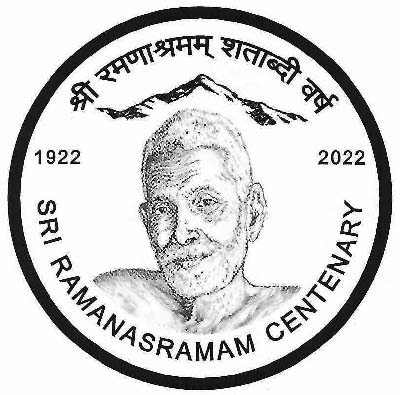
On 15th May 2025, the Government of India officially announced the issuance of a special ₹100 commemorative coin to mark the Centenary of Sri Ramanasramam. The coin celebrates 100 years since the Ashram's establishment in May of 1922. The commemorative ₹100 coin will be minted in silver (99.9% purity). It will weigh 40 grams, with a diameter of 44 mm, and feature 200 serrations along its edge.
The coin will prominently feature Bhagavan's image taken from the Wellings Bust with the sketch of Arunachala above it, an artistic representation dedicated to Sri Ramanasramam, commemorating its rich spiritual heritage and century-long service to devotees and spiritual seekers worldwide. On the obverse side will appear the Lion Capital of the Ashoka Pillar at the centre. Beneath this emblem, the coin will bear the inscription of India's national motto, Satyameva Jayate in Devanagri. On the left periphery, the word "भारत" (Bharat) will appear while the word "INDIA" will be inscribed in English along the right periphery. Additionally, it will display the Rupee symbol "₹" and the denominational value "100" written in international numerals.
This commemorative coin is classified as numismatic, distinguishing it from everyday currency. Numismatic coins typically hold historical significance or unique design elements, making them especially appealing to collectors, historians, and those devoted to preserving cultural heritage.
The Ashram Gardens: A Unique Narayana Seva Visitor
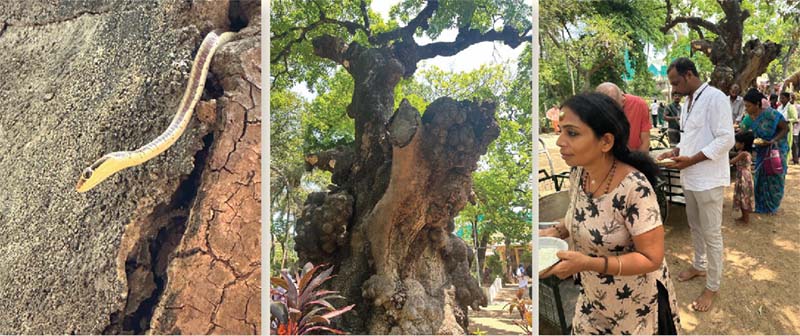
During COVID, participation in the Ashram's Narayana Seva significantly increased, drawing a more diverse group of beneficiaries.
On Tuesday, 13th May, the Narayana Seva volunteers were witness to a truly unusual and memorable visitor. Perched high in the Ashram's famed iluppai tree (soap-nut tree or Madhuca longifolia), a tree snake observed the entire distribution of Bhagavan's prasad for over an hour, quietly surveying the scene below. This silent observer was identified as a Common Bronzeback Tree Snake (Dendrelaphis tristis), a non-venomous and generally shy species known for its agility and arboreal lifestyle.
With much of its body camouflaged within the tree's bark, the slender bronze-backed snake remained still and unobtrusive, adding an air of mystery and reverence to the sacred offering. Native to the subcontinent, these snakes pose no harm to humans and are considered beneficial in controlling insect and small rodent populations. Such occurrences often serve as quiet reminders of the Ashram's harmonious relationship with the natural world, where even wildlife participates—silently and reverently—in the presence of Bhagavan's grace. —
Best Shot: Skandasramam
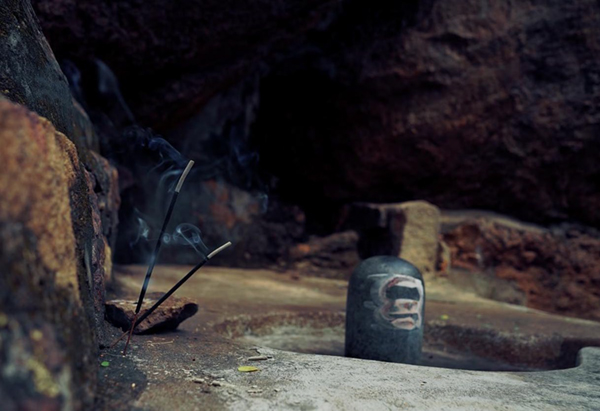
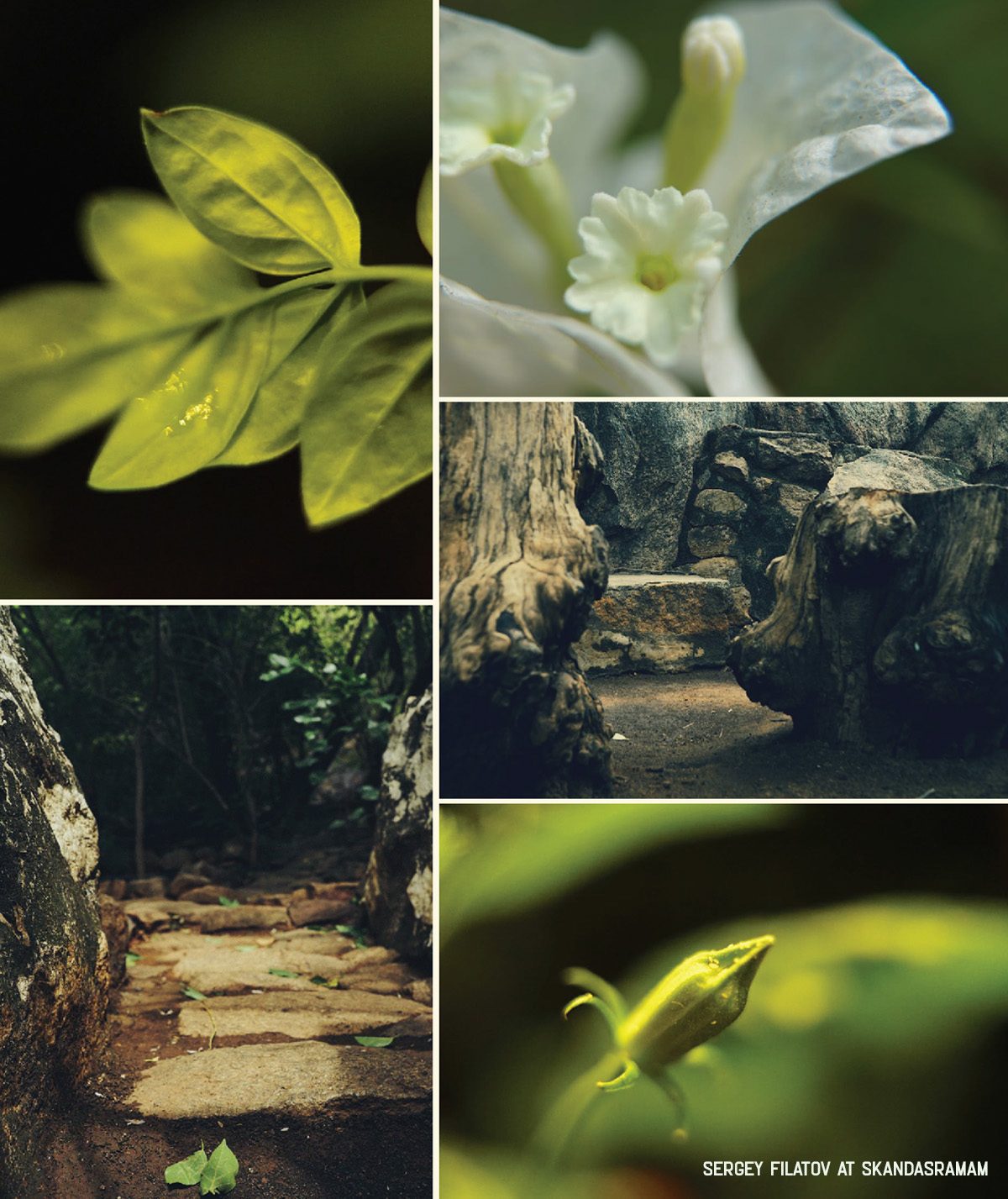
In 1906, just when Virupaksha Cave faced water shortages, Bhagavan discovered a spring nearby. Kandaswami who was living with Bhagavn on the Hill, saw Bhagavan’s daily struggle to fetch water, and took it upon himself to build Skandasramam by hand—levelling rock, planting trees, and creating gardens. Completed in 1915, Bhagavan named the new Ashram after Kandaswami. Devotees enjoyed intimate meditations and daily recitation of Aksharamanamalai in Bhagavan’s presence. Today, the site, shaded by newly planted trees, remains a revered pilgrimage destination, a living memorial to the Sage’s years on the Holy Hill. —
Obituary: Dr. T. S. Vaidyanathan (1948-2025)
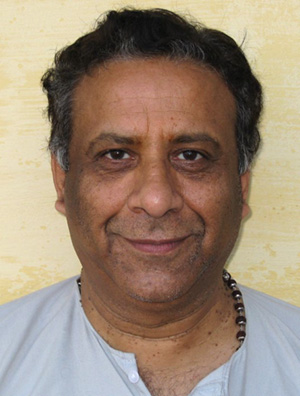
Dr. Thinnium Subramanian Vaidyanathan, a long-time devotee of Bhagavan, passed away peacefully at his Tiruvannamalai residence on 14th May 2025 at 11:30 am, following a prolonged struggle with liver disease. He was 76.
Vaidyanathan first encountered the teachings of Bhagavan more than forty years ago while residing in the US. From that point onward, Bhagavan's presence and grace became the guiding force of his life. While living alternately in Seattle and New York, he became an active and dedicated member of Arunachala Ashrama, New York, selflessly serving in a variety of roles. Devotees fondly recall his heartfelt hospitality—meeting them at the airport, driving them to the Ashrama, and offering thoughtful assistance throughout their stay.
Born 18th December 1948, Vaidyanathan graduated from the prestigious Indian Institute of Technology (IIT), Kharagpur, after which he moved to the United States and went on to earn a PhD from the University of Washington. He built a successful career in aerospace engineering and raised a family. Despite the demands of work and family, he made frequent pilgrimages to Ramanasramam, deepening his devotion to Bhagavan. Upon retirement in 2012, he returned to Tamil Nadu, serving in Ramanasramam by taking responsibility for the Ashram's publications department. Beyond his formal responsibilities, he became widely known for his quiet acts of compassion. He generously supported the education of underprivileged children and often provided financial assistance for those in need of urgent medical care. Affectionately referred to by fellow Ashram residents as the "ATM of the poor", Vaidyanathan never turned away anyone who sought his help. More impressive still is the way he maintained this commitment to generosity, even after his retirement. He always gave whatever he had, even to strangers, earning him deep affection.
Vaidyanathan is survived by his son, two daughters, and six grandchildren. His loss is deeply felt by family, friends, and the global community of Ramana devotees. His life stands as a testament to the transformative power of devotion, service, and a heart of good will. May his soul rest at the feet of Sri Ramana-Arunachala, whom he so faithfully served. —
Endnotes
- 1 Talks, §91, 6th November 1935.
- 2 Self-Enquiry, §23.
- 3 Talks, §197
- 4 Bhagavad Gita, 12.12 affirms: Better indeed is knowledge than mechanical practice. Better than knowledge is meditation. But better still is the renunciation of the fruits of action. For peace immediately follows renunciation.
- 5 Who Am I? §20, in The Collected Works, p. 44.
- 6 Talks §446, 24th January 1938.
- 7 Self-Enquiry, §8 in The Collected Works, p. 9.
- 8 Talks, §443, 8th January 1938.
- 9 From Wisdom of the East: The Persian Mystics.
- 10 Self- Enquiry, §10 in The Collected Works, p. 11.
- 11 Ibid, §11 in The Collected Works, p. 11.
- 12 G.V. Subbaramayya, Ramana Reminiscences, p. 10. The Yoga Vash- ishta similarly declares: The world is nothing but Brahman itself; see the world as Brahman and attain bliss.
- 13 The Sufi mystic Jami.
- 14 Freely adapted from a story by the Brazilian writer, Paulo Coelho.
- 15 Evolutionary biologists point out that the feeling part of us is situated in the body and belongs to a much more ancient (neural) system. Therefore, it is not surprising that wisdom would originate there and not in the evolutionarily more recent cortical regions of the brain which gives rise to higher cognitive functioning.
- 16 Gautama Buddha, Majjima Nikaya, sutta 1.
- 17 The English words 'idea' and 'idol' are etymologically derived from the Greek eidolon, meaning 'form'.
- 18 GVK, §536: Knowing aright the nature of the Self and abandoning the non- self as unreal, is wisdom true. All other knowledge is ignorance, and not wisdom.
- 19 GVK, §1004, §1157.
- 20 Jan 2022 issue, citing case 20 of the Shoyuroku (The Book of Serenity).
- 21 It is worth mentioning that from a neurological point of view, chronic obsessive thinking can be seen as a low-grade form of anxiety, or more specifically, chronic hyperactivation of the sympathetic nervous system in a perpetual state of fight or flight. If so, this would caution against trusting any broader, spiritually relevant conclusions born of compulsive thinking—not only because they would be fear-based—but because true creativity, wisdom, and insight, according to neurophysiologists, can only take place in a calm nervous system (Porges, Bonano).
- 22 Oxford neuropsychologist Iain McGilchrist distinguishes knowledge as 'representation' (left hemisphere) from knowledge as 'presence' (right hemisphere), the former having little to no awareness of the latter, while the latter is cognisant of the former by virtue of its 'global' awareness (see his ground-breaking work, The Master and His Emissary, 2009).
- 23 Talks, §238, 20th July 1936.
- 24 GVK, §98.
Publisher: Dr Venkat S. Ramanan
saranagati@gururamana.org
