In this issue, we take up the life story of Venuammal, the younger sister of the devoted Echammal. Venuammal came to Bhagavan a few years after her sister and like her sister, would suffer loss and be consoled by Sri Bhagavan (see p. 3).
In Ramana Reflections: Cultivating the Doubt Sensation (Part IV), we see the inner workings of vichara and its capacity to dissect the solidification of dehatma buddhi. The density of the egoic assumption is relatd to the panchakoshas and vichara is there to help us move fromt he gross to the subtle (see p. 7).
Unable to play audio. Please check if the file exists.
Venuammal, the younger sister of the devoted Echammal, was herself a deeply committed devotee of Bhagavan. Like her sister, she endured great sorrow early in life.
Married at the age of fifteen, she soon gave birth to a daughter but was widowed not long afterward and left to raise the child alone.
Echammal had come to Bhagavan as a widow in 1906, and Venuammal followed a few years later. At Skandasramam she assisted Bhagavan’s mother, Alagammal, in the kitchen, and a close bond grew between them. Alagammal is said to have regarded Venuammal as her own daughter. When Bhagavan’s Mother fell ill, it was Venuammal who nursed her with tender care until her final hours in May 1922.
Though Venuammal was poor, she managed to get her daughter married at the age of seventeen. On 20th October 1920, her daughter, Balakuchambal gave birth to a baby girl who was named Rajalakshmi. Venuammal was overjoyed.
But like Echammal, Venuammal’s happiness would not endure. Tragedy struck with the sudden death of her daughter in 1923. Inconsolable, Venuammal came from town late in the night and poured out her sorrow before Bhagavan. Bhagavan shared her grief and consoled her by telling her that the purpose for which her daughter had been born in this world was over and of necessity she had to leave it. Moreover, he said, the body dies whereas the atman is deathless. Consoled by his words, she returned home.
Venuammal’s granddaughter was now displaced as the girl’s father was employed and could not look after her. So, it was decided that the motherless child, not yet three years old, should come and live with Venuammal. Thus in 1923, Venuammal took the responsibility of mothering her young granddaughter.
By this time, Bhagavan had already come down from the Hill and was settled near his mother’s samadhi on the plot of ground that would come to be called Sri Ramanasramam.
Venuammal served at the Ashram, but her house was in town. So, each morning, she took her granddaughter along with her to the Ashram.
Her granddaughter and Bhagavan got along famously. She called Bhagavan Thatha or ‘grandpa’ and Bhagavan happily played the part.
In the first months at her new home, the youngster often cried for her mother who was no more. Bhagavan used to tell her that both he and she were in the same boat since he too had just a year earlier lost his mother.
Sri Bhagavan with Mother Alagammal and Venuammal near Skandasramam, ca. 1919
The Cooking Game
In those years, Bhagavan would sometimes sit near Pali Tirtham on a raised platform under a tree and the girl would come and play near him. Once, when she was playing the ‘cooking game’, she offered small stones as cooked rice to Bhagavan and asked him to eat them. Bhagavan readily complied and put the stones into his mouth, pretending to eat them. On seeing this, Venuammal asked Bhagavan why he was putting stones in his mouth. Bhagavan replied that he and Rajalakshmi were playing the ‘cooking game’ and the stones she happily offered to him as food should be put in his mouth, otherwise the game would be spoiled.
On another occasion, the girl was seated next to Bhagavan in the dining hall when Venuammal was serving. When she served her granddaughter some brinjal, the girl asked for more. Venuammal recited a Sanskrit proverb, Aasaa aasaa parama dukham, Niraasa parama sukham (‘Desire is the supreme suffering, and contentment is the supreme happiness’) and refused to give her more. Just as she was about to serve more brinjal to Bhagavan, Bhagavan repeated the same proverb and refused to accept a second helping.
Venuammal told Bhagavan that the proverb was meant for the child, not for him. Bhagavan replied that what was applicable to the child was also applicable to him; if the young child could not be served more, then neither should he.
Venuammal’s Sri Chakra
Her own devotion was marked by simplicity and inwardness. During the Skandasramam days, the women were in the habit of chanting the Lalita Sahasranama and had on the altars in their homes the Sri Chakra,1 forged in the five-metals, that they used during their recitation. The Sri Chakra is the sacred geometric diagram of the Sri Vidya tradition, formed by nine interlocking triangles around a central bindu, symbolizing the union of Shiva and Shakti and the non-dual cosmos. Venuammal had no such image and felt that her devotion during her Lalita Sahasranama chanting suffered because of it. Seeing this, Bhagavan sat and drew her a Sri Chakra by hand, colouring in at the appropriate places and bringing life to Venuammal’s life of devotion—a sacred gift that became the centre of worship in her family for generations.2
In 1950, when Venuammal prepared to undertake a pilgrimage to Kashi, Bhagavan asked her to bathe in the Ganges on his behalf. One night, while immersed in the holy river and meditating on the name “Ramana,” she beheld a brilliant shooting star streaking across the sky. The following morning, she learned that, at that very moment, Bhagavan had shed the mortal body. For devotees, the coincidence bore the quiet mark of grace linking the sacred river, the Guru’s passing, and the heart of a faithful servant. Venuammal’s life, like that of her sister Echammal, was woven of suffering, endurance, and unwavering devotion. —
1 Encircled by lotus rings and a temple-like square, it represents creation, consciousness, and bliss, and in three dimensions appears as Mount Meru. ↩
2 Adapted from articles by Rajalakshmi’s son, A. Viswanathan for The Mountain Path, 2008, Aradhana pp. 38-39 and Advent pp. 28-33. ↩
Around Town: Ferrying Fares To and Fro
Photo: Dev Gogoi
They also serve who sleep and wait,
A well-earned rest,
Between ferrying fares to and fro,
Wherever, whenever they wish to go,
Under a benevolent gaze, blessed fate.
And that’s it. All it takes is the visage of Bhagavan to lift a mundane ricksha into a carriage fit for royalty. A local print shop is given a reference image, which is beautifully rendered stylistically on sticker media and nicely fitted on to the vehicle. There are three such autos in the area. Would you not rather be transported by one adorned with Bhagavan’s image? —
Events at Sri Ramanasramam: Maha Puja
After Bhagavan’s mother attained liberation on the 19th May, 1922, devotees felt that her body should be buried rather than cremated since she was a jnani. Bhagavan concurred. But as to why his mother could not be buried on the Hill itself, Bhagavan later explained: “There is an ancient tradition that this Hill is lingaswarupa; that is to say, this Hill itself is God. That is the cause and glory of this place.”
Temple authorities had always made similar declarations to any party wanting to construct shrines on the Hill. According to the sastras no other form of worship should take place on Arunachala as Arunachala is the Lord Himself. Even if mother had been interred quietly at Skandasramam, no shrine or memorial at the gravesite would have been permitted. It was thus decided that the body should be interred at the foot of the Hill on the southern side, a traditional site for the burial of sadhus.
The burial party left Skandasramam just before dawn on 20th May and chose a site close to the road. But Ramakrishna Iyer suggested that it be nearer the hill, away from the road, and thus more conveniently situated if ever a temple over it were to be constructed. When he pointed out another location further in, all were in agreement.
Maha Puja is the day of the liberation of Bhagavan’s Mother, who merged with Arunachala on Krishna Paksha Navami of Vaikasi in 1922. This year’s observance took place on 9th June and began with Mahanasya rites, followed by abhishekam and culminating in pujas at the shrines of Sri Bhagavan and Mother, after which hundreds of devotees gathered for the mid-day meal. For Mahapuja video footage, see: https://youtube.com/@SriRamanasramam. —
The Ashram Gardens: Birds of Sri Ramanasramam
Photos: Dr. Nitya Ramanan
The Ashram gardens are replete with life. Devotees absorbed in Bhagavan may sometimes forget to notice the natural beauty surrounding his samadhi. All the photos above, as well as those on page one, were taken at Sri Ramanasramam. Above, from left, are the Ashy Drongo, Indian Pond Heron, Indian Cormorant, Little Egret, and White-throated Kingfisher. On page one appear the Yellow-billed Babbler, Common Myna, Rufous Treepie, Great Egret, Black Drongo, Indian Pond Heron, Rose-ringed Parakeet, and the blue and white peafowls. —
Ramana Reflections
Cultivating the Doubt Sensation (Part IV)
Audio: RAMANA REFLECTIONS
0:00 / 0:00
Unable to play audio. Please check if the file exists.
In earlier segments, we saw how vichara becomes fruitful when the question “Who am I” is animated by uncertainty and a felt sense of urgency. The mind prefers outwardness and often turns spiritual teaching into an object of study rather than a practice of direct engagement.
We also noted two common errors: first, trying to destroy unwanted thoughts by force; and second, mistaking conceptual clarity for the path itself. In the latter case, Bhagavan’s teaching is reduced to a doctrine or philosophy to be mentally ruminated over, rather than a path to be followed with one’s whole being.
In the story of Chandi Devi and Rakthabij, we saw how resistance can multiply and entrench what needs to be left behind. Inner darkness must be met openly—not hated or resisted. Samskaras and vasanas lose their hold when brought into awareness, for ego thrives in concealment, avoidance, denial, and non-acceptance. True inquiry redirects attention from mental objects to the hidden source. Bhagavan’s vichara is a raft for crossing the flood, not a possession to perfect endlessly.
As devotees, we must abandon the dry dock of ideas and enter the sea of practice—daunting though it may appear. Vichara leads us back to the Heart—to the lost centre of our own being. It is the path of direct experience.
The greatest faith is faith born of direct experience. Received faith, or blind faith, is provisional, useful only insofar as it goads us to take the next step. But there is no faith so solid, so reliable, so dependable as faith born of direct seeing. The greatest devotion we can show Bhagavan is to follow in his footsteps and, little by little, experience directly the truth of the path he laid out for us.
The Egoic Interface
So far in this series, we have been speaking of vichara in a general way. Let us now look more closely at its subtle workings and see how it has the power to dissolve the illusion of separateness, what Bhagavan called dehatma buddhi, the identification of the Self with the body.
The singular purpose of vichara is to break up the solidification of the conceptual mind. Once we understand that the egoic mind is an interface that helps us negotiate life—an instrument panel for navigating the complexities of daily living—it becomes a matter of adjusting the algorithm. Vichara is the means for doing this.
The ego is made up of convenient fictions, short-cuts designed to make the interface more efficient and user-friendly. The objects that appear on a computer desktop do not reveal the binary code underlying the computer’s operations. Instead, the desktop gives us icons we can click, sparing us the need to type lines of code.1
The centrepiece of our personal interface is the ego. It is the name we give to a vast array of mental functions in an effort to make sense of them in a cohesive way. While useful in practical life, the ego has serious limitations. Therefore, adjustments are needed.
Unpacking Solidification
But what is the cause of the firm belief in ego? Classical texts tell us that the wave imagines itself as a wave, separate from the ocean. But in truth there is no wave apart from the ocean. The wave is only a form the ocean takes.
Meditation traditions tell us that this mistake is born of “reification”2 or “solidification.” What does this mean? It is the process of treating an abstract idea, concept, or relation as if it were a concrete, independent object. Solidification gives names to observable forms and phenomena, thereby engendering the belief that something exists separately from everything else. Vichara is intended to free us from this illusion and reveal that our wave-identity is a phantom.
Solidification influences every aspect of our lives. We imagine that if we have a name for something, it must be a thing in itself, apart from other things. Language binds us this way. Discerning the reification born of naming is part of the work of vichara. It means looking closely at what has been named and resolving it into its component parts.
In ancient Greece the Ship of Theseus posed a philosophical puzzle about identity and change. If every plank of a ship is gradually replaced, is it still the same ship? And if the discarded planks are reassembled, which ship is truly Theseus’s?
The paradox questions whether identity lies in matter, form, continuity, or memory. Similarly, in Indo-Bactrian India, the monk Nāgasena used the example of a chariot to instruct King Milinda. A chariot is not found in its wheels, axle, frame, or reins, nor apart from them. “Chariot” is only a convenient designation for assembled parts, born of conceptual imputation. So too with the separate self.
The meditation setting is a good place to begin examining reification, since some stability of surroundings is needed to isolate the process and observe it closely. Some may say that meditation is not required for vichara. Yet it is not easy to dismantle and rewire the algorithm called ego while it is actively in use, just as we would not take apart the dashboard of a jetliner while the plane is in flight.
What does solidification look like in meditation?
As we sit, we may hear the heart beating, badum, badum, badum…. This sound and vibration constitute an experience but not a static thing. The heart is not saying “heart” or “your heart” rather it just goes, badum, badum, badum. It is not even a thing. “Beating heart” is the name we give to a set of conditions. If we carry a conceptual imprint of anatomy and the organs of the body, one of which we call “heart,” then from the point of view of direct experience, such names are part of a conceptual overlay created by the mind. Reality has no need of our labels. The heart can beat perfectly well without our names for it.
This is why stillness is useful. The mind itself is an interface born of solidification. To see it clearly in its assumed role as an entity, we need, as far as possible, to allow everything to settle.
Despite all this, it is no easy matter to loosen solidification and overcome the deeply ingrained notion of ego. The egoic assumption is universal. The mental inertia that sustains it has been with us for as long as we can remember. Indeed, the ego is such a firm assumption that we hardly dream of questioning it. And even when we do, how easily we fall back into the default position of being an “I” in a body, moving through a world.
When we take the diverse phenomena of experience as a single whole and call it “world,” this seems perfectly normal. After all, everyone does it. Likewise, when features of experience are grouped together under the heading “I,” the assumption of the I’s existence is taken for granted. But Bhagavan tells us that both are tricks of the mind. The composite parts of ego are merely conceptually conjoined features of reality. The same applies to “world.” The parts themselves do not call themselves “I” or “world,” nor do they know themselves as constituting an “I” or a “world.” They simply are what they are.
The work of vichara is to get beneath this constitutive illusion and see its parts. Nature does not need our names and labels. Neither does the spiritual Heart. The Heart simply IS.
To deconstruct the nominal realm is to see that names are not fundamental or ontically independent. It means disassembling conceptually formed agglomerations and seeing them as manifestations of the Self passing through the prism of ego, much as the wave is only a manifestation of the ocean.
Viewed spatially, the ego is an agglomeration of functions operating together: the thinker, the planner, the rememberer, the doer, the sufferer, the defender, the seeker. These appear to be bound together by a single “I,” but on closer inspection each is itself an agglomeration, and no solitary entity called “I” can be found.
Viewed temporally, the ego is a succession of events arising one after another. We imagine these events are linked by a continuing separate self, but in fact they unfold as a causal chain, each conditioned by what came before, without requiring any separate entity to bind them together.
In this sense, vichara functions as an inward dissection. It does not merely analyse the personality intellectually; it exposes the hidden assumption of a separate self standing behind experience. As this assumption weakens, the ego is less and less taken as the owner, controller, or centre of life.
The Self, however, is not another organising principle behind the ego. It is not a subtle manager, witness-person, or metaphysical entity holding the parts together. It is beyond all such categories: the Ground of Being, prior to thought, untouched by personality, and silently present as the Truth of all experience.
The Panchakoshas
The panchakoshas, or the five sheaths,3 as stated in the Taittiriya Upanishad, offer a profound framework for understanding solidification, reification and the layered nature of human identity. Associated with the gross, subtle, and causal bodies, the five sheaths represent successive veils obscuring the Self, like concentric coverings concealing a flame. But what are these veils if not varying degrees of solidification and reification?
As we move from the outer to the inner, we move from the gross to the subtle. Vichara is the means by which subtle awareness develops; ego is the mechanism that keeps us rooted in the gross. Bhagavan comments:
Ask yourself: “Who am I?” The body and its functions are not “I”; nor are the mind and its movements. Thoughts arise spontaneously, superficially, or analytically, but who is aware of them? Their presence and sequence are known to the individual perceiver, commonly called the ego or “I.” Yet the intellect is only a sheath of this “I,” not the Self itself.4
From a lived perspective, the koshas may be seen not merely as metaphysical constructs but as distinct modes of awareness that range from gross to increasingly subtle. As one’s vichara deepens, the finer sheaths become more salient. Long-term vichara practice reveals their transitory nature and the underlying stillness beneath them. Bhagavan continues:
Enquire further: “Who is this ‘I’? From where does it arise?” In deep sleep, the ego is absent, appearing only with waking or dream. Therefore, the true “I” cannot be the ignorant, intermittent ego. It must be that which remains through waking, dream, and sleep—the unqualified substratum underlying all three states. Thus, by discarding body, mind, intellect, and even the bliss-sheath as not-Self, what remains is the true Self, beyond the five sheaths, ever-present as Sat-Chit-Ananda.5
It is only by attending inner conditions with careful inquiry that we begin to probe beyond the apparent solidity of the ego and move toward a subtler awareness. What appears as a single, unified entity is in fact a conceptual construct, concealed by habit, memory, identification, and repeated acts of self-reference. By crossing the barriers of the koshas through vichara practice, conceptually formed entities begin to become less dense. Bhagavan comments:
Vivekachudamani makes it clear that the artificial ‘I’ of the vijnanamaya kosa is a projection and through it one must look to the significance (vachya) of ‘I’—the true principle.6
The absence of the artificial I, the ego, becomes apparent gradually, as the seeming solidity of the personality is seen through. This dissection of the solidified personality is one phase of vichara. What had appeared to be a single mass—“me,” “my life,” “my story,” “my character”—is discovered to be composed of thoughts, sensations, memories, desires, fears, roles, reactions, and bodily identification.
At the subtler end, a refined state of awareness may arise in meditation, especially in an intensive retreat setting, when the mind becomes still and the usual patterns of compulsive thought have subsided. Here deeply embedded defilements—unconscious regrets, fears, and unresolved karmas—may come before the light of awareness. When met in stillness, they begin to dissolve. How? By the purifying power of awareness. Bhagavan adds:
There is no difference between matter and spirit. Modern science admits that all matter is energy. Energy is power or force (sakti). Therefore, all are resolved in Siva and Sakti i.e., the Self and the Mind. The koshas are mere appearances. There is no reality in them as such.7
As has been said, enlightenment is not about creating light but exposing what is hidden in the darkness of the unconscious.8
The same applies to wounding, trauma, and unresolved grief. They only need to be seen, known, accepted and felt fully for their healing to begin. In time, the heart discovers that its suffering is born of injury but that it contains all that is needed to turn around a lifetime of discomfort rooted in anxiety, self-loathing, disappointment, despair, hopelessness, resentment, bitterness, regret, remorse, and loneliness. The bliss of the innermost kosha is born of proximity with the natural state, free of neurotic entanglements. Bhagavan adds:
The pleasure of such states comes when one thought excludes all others and then itself merges into the Self. This bliss belongs only to the anandamaya kosha. In waking, the vijnanamaya kosha predominates; in deep sleep, thoughts disappear and bliss is obscured. Yet these are sheaths, not the core, which lies beyond all three.9
Tradition tells us that bliss must be let go, for it is only a response to leaving behind what has been endured over a lifetime—or countless lifetimes—and is not the final resting place. The experience of stillness, or the bliss of deep interior silence in meditation, is not something to long for; nor are the defilements it displaces something to resist. Resistance and longing are both conditioned states, and clinging to preferred outcomes risks generating fresh samskaras.
Conclusion
The great sages tell us that when the inner work reaches its penultimate stage, no more seeds remain: no samskaras, no latent tendencies, defilements, veils, or impurities of any kind. There is only abidance in the Self, untouched by the fluctuations of the mind and the veiling power of the sheaths. At that point, there is no further need for cultivating doubt or inquiry, for there can be no return to ignorance, nor any re-identification with the gross body.
This does not mean that the sage cannot think, converse, or perform daily tasks. We know how Sri Bhagavan rose each morning at three o’clock, went to the kitchen, lit the fire, and cut vegetables. We know how he interacted with devotees with utmost care and attention. But for Bhagavan, the thinking mind had become a voluntary instrument at his disposal. The compulsion to think, and identification with thought and action, had disappeared once and for all.
The Self, Bhagavan tells us, is that which is present before bliss and stillness arise and remains after they subside. Through earnestness, honesty, and silent vigilance, one may pass beyond even this final veil. Bhagavan assures us that these higher states are available to all, and that none are excluded, provided one’s vichara is sincere and unrelenting. —
2 Or “thingification”. Reification is derived from the Latin res (meaning “thing”), taking names and metaphors literally. ↩
3 Tradition describes the annamaya kosha as the physical body, sustained by food and subject to decay. Pranamaya kosha is the life-force sheath governing bodily functions. Manomaya kosha includes the sensory mind, thought, emotion, and egoic identity. Vijnanamaya kosha is the intellect, enabling discrimination yet remaining within ignorance. Anandamaya kosha, linked to deep sleep and meditative bliss, is closest to the Self but still conditioned. ↩
The Ashram is live streaming the Sri Chakra Puja on the first and last Friday of each month. Daily live streaming Mon to Sat from 8 to 10.45 am and 5 to 5.45 pm IST continues and includes the Vedaparayana, puja and Tamil Parayana. (No streaming on Sundays) To access live streams, go to: https://youtube.com/@SriRamanasramam/live
Similes from Bhagavan: A Necklet of Gems
As the string in a necklet of gems, it is Thou in Thy unity who penetrate all the diversity of beings and religions. If like a gem when it is cut and polished, the impure mind is worked against the wheel of the pure heart to free it of its flaws, it will take on the light of Thy Grace and shine like a ruby whose fire is unaffected by any outward object. When once a photographic plate has been exposed to the sun, can it receive impressions afterwards? O benign and dazzling Aruna Hill! Is there anything apart from Thee? — Sri Arunachala Ashtakam §5
Best Shot: The Axis Around Which the World Spins
Photo: Dev Gogoi
What is that axis ‘round which the world spins,
so subtle, silent, past the reach of sense,
unmanifest, beyond our mortal grasp?
Which map reveals the road that leads us there—
its hidden geography of the soul?
Without us, or within our heart’s own depth?
Does distance fill the breast with longing’s pull,
or closeness loose a joy no cause can claim,
unearned, unfounded, flooding every gate?
Why strive at all to crack this wordless koan?
Is it enough to stand in adoration,
or lie prostrate in full submission’s peace?
The passer-by, when unknowingly filled
with quiet calm he cannot name or trace,
and never need to wonder whence it came?
We wave the flame, join our palms, praying to
Sri Ramana Linga! Sri Arunachala! —
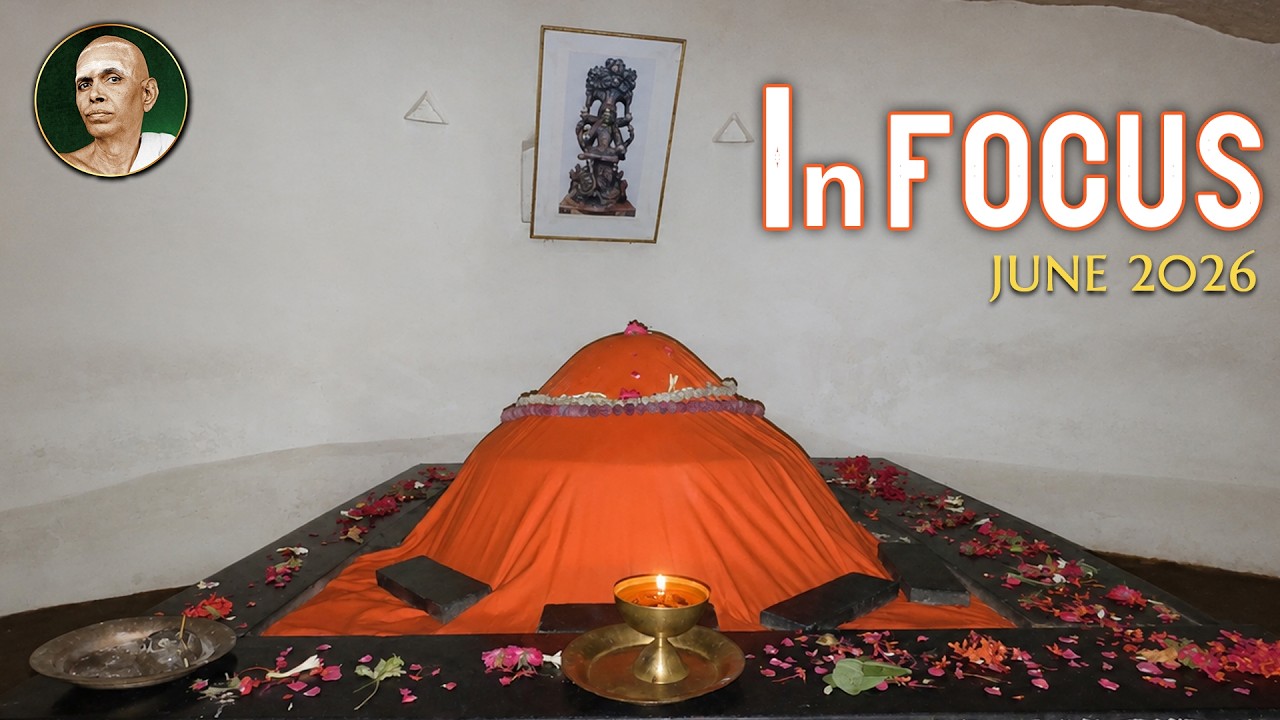
Ashram Video: In Focus - June 2026
Catch up on the latest events, daily life, and special moments at Sri Ramanasramam. Watch our newest "In Focus" monthly wrap-up video below.
Devotees will remember Smt. G. Muniamah as a quiet, soft-spoken presence who sat each evening at 6 pm in Bhagavan’s Old Hall. For many years she also came for the morning sittings, though in recent years she was no longer able to do so.
Born in Malaysia in January 1949, Muniamah moved to Tiruvannamalai following her marriage in 2000. She lived with her husband on Post Office Road, near the local post office. A sanctioned meditation teacher in the Vipassana tradition, she spent more than a decade guiding and supporting groups of young women—sometimes numbering over fifty at a time—in meditation practice in Chennai. During visits to Malaysia, meditators gathered around her for group sittings, while family members drew strength from the quiet courage and steadiness she embodied in times of difficulty. Those who meditated in Bhagavan’s Old Hall know how valuable her stillness was to the collective effort.
In March, Muniamah fell ill, suffering swelling in her feet, and in time became confined to bed. Those present during her final hours said that she remained conscious, peaceful, and inwardly focused on Arunachala until the very end. Her many years of meditation practice in Bhagavan’s Old Hall came to her aid, enabling her to transcend physical pain and remain anchored in silence and stillness.
Muniamah passed away quietly at home on 21st April, merging at the Feet of the Holy Hill. She is survived by her husband, V. Kumarasamy, and will be missed by the meditators in Bhagavan’s Old Hall. —
Around the Ashram: The Deep Well Inside of Me
There is a really deep well inside me.
And in it dwells God.
Sometimes I’m there too.
But more often stones and grit block it
And God is buried beneath.
— Etty Hillesum, 20th century.
The Ashram priest, Giridhar operates a wooden pulley to draw water in a brass container (kalasam). This is an essential part of liturgical life of Ashram puja, purification rituals, and abhishekam using spring-fed water without modern contaminants.
When Ramana Maharshi’s mother was interred at the foot of Arunachala, earth was scooped out for a platform around her samadhi. When water in the crevice did not dry up, Bhagavan Ramana asked them to dig a pit three feet wide and three feet deep. Once done, water began flowing and the excavated site revealed itself to be a perennial spring which never dried up, eventually becoming a full-service well. —
Among the devotees of Bhagavan who experienced the bliss of his presence, Lakshmi the Cow is noteworthy. While it is believed that in the presence of Bhagavan liberation can be bestowed on any devotee, the case of Cow Lakshmi is the most outstanding for according to Bhagavan it is Lakshmi and Bhagavan’s mother, Alagammal, who attained liberation.
Cow Lakshmi came to Bhagavan as a young calf in 1926. Initially tended to by a caretaker in town, she used to walk from town each day and spend the day with Bhagavan. Upon her arrival, she would enter the hall and seeing Bhagavan, prance about with demonstrable joy. When she became pregnant with her first calf, Bhagavan asked that a shed be constructed for her in the Ashram. During the course of the next twenty-two years as an Ashram resident, Lakshmi gave birth to nine calves, three of which, remarkably, were born on Bhagavan’s Jayanthi Day. Lakshmi left the body on 18th June,1948.
This year on Friday, 26th June devotees gathered for Cow Lakshmi’s annual Aradhana Day puja. Devotees sang songs dedicated to Cow Lakshmi, among them songs by Ashram’s K.V. Subramonyan. —
Announcement: Saranagati Goes Online
On 1st September 2026, Saranagati e-magazine begins its 20th year. Marking this milestone, the publication is launching a website in response to requests to make Saranagati articles and content more accessible. The site includes a complete pdf archive of Saranagati issues published thus far for free downloading. Over time, this archive is hoped to become Google searchable, once traffic to the site begins and the uploaded files are indexed. It is hoped that all two hundred plus Saranagati issues will be available for a general Google search in about 4-5 months. The website hopes to go public in the coming weeks. —