
SRI RAMANASRAMAM
VOL. 19, NO. 7

Ashram Butterflies (from top, left to right): Lime Butterfly(Papilio Demoleus), Common Banded Peacock(Papilio Crino),Common Baron(Euthalia aconthea),Plain Cupid Butterfly(Luthrodes pandava),Common Leopard(Phalanta phalantha)Blue Mormon(Papilio polymnestor), Common Crow Butterfly(Euploea core)
Dear Devotees,
As we near the end of the month of June, Ashram
renovation, painting and repair work is ramping up in light of the fast approaching days of yaga sala pujas and the eventual rededication of the Mother’s Shrine, Bhagavan’s Samadhi, the vimana and gopuram above,
which will take place with Mahakumbhabhishekam, starting the 18th August and concluding with the main rites on morning of the 20th.
In this issue we continue the gripping story of G.V. Subbaramayya in the hall with Bhagavan (see p. 3).
In Ramana Reflections, we begin a series on Bhagavan’s teaching as it relates to the dream of the small self (see p. 9).
For videos, photos and other news of events:
https://www.gururamana.org.org or write to us at:
saranagati@gururamana.org. For the web version:
https://www.sriramana.org/saranagati/July_2025/.
In Sri Bhagavan,
Saranagati
Table of Content
- In Profile: G.V. Subbaramayya (part two)
- Bhagavan’s Handwriting: Sannidhi Murai, v. 157
- Mahakumbhabhishekam Renovations: Update
- Similes from Bhagavan: The Futility of Examining the Rubbish
- Events at the Ashram: World Environment Day and the Holy Hill
- Ramana Reflections: The Dream of Self
- In Focus: June Edition
- Sadhu Natanananda’s Upadesa Ratnavali §25
- Obituary: Smt. V. Lakshmi (1941-2025)
- Obituary: Smt. Meenakshi Panchu (1933-2025)
- Obituary: Kumari Atuko Ogawa (1944-2025)
- Best Shot: The Dream of the Water Lily
Calendar of Ashram Events
2nd July (Wed) Natarajar Abhishekam |
25th July (Fri) Ganapathi Muni Day |
7th July (Mon) Cow Lakshmi Day |
6th Aug (Wed) Pradesham |
8th July (Tue) Pradesham |
7th Aug (Thu) Kunjuswami |
10th July (Thu) Guru Poomima |
8th Aug (Fri) Full Moon |
23rd July (Wed) H.C. Khanna Day |
18th - 20th Aug (M - W) Kumbhabhishekam |
24th July (Thu) Punarvasu |
20th Aug (Wed) Punarvasu |
IN PROFILE
G.V. Subbaramayya
G.V. Subbaramayya
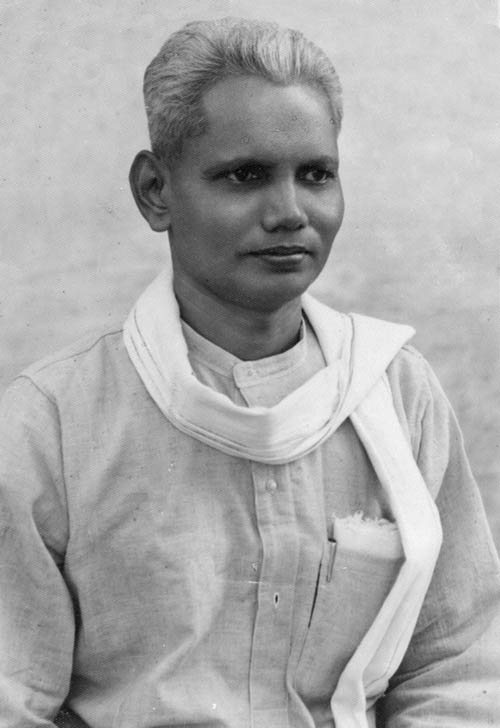
In the first instalment, we saw how Prof. G. V. Subbaramayya (GVS), a respected lecturer and college principal in Andhra Pradesh, was already a refined scholar in Telugu, Sanskrit, and English, with several literary works to his name. His spiritual biography, Sri Ramana Reminiscences, vividly narrated his spiritual journey with Bhagavan.
In the early 1930s, GVS discovered the Telugu Upadesa Saram and was astonished that a Tamilian could compose such refined classical Telugu verse. Initially drawn by literary admiration, the tragic loss of his two-year-old son in December 1932 led him to seek solace at Tiruvannamalai.
In June 1933, his first darshan of Bhagavan brought a profound peace. When he asked about the untimely death of children, Bhagavan explained that nature's law applies regardless of age.
Through his translations—particularly Sri Ramana Gita—GVS earned Bhagavan's appreciation. Many signs of grace followed: healing through vibhuti prasad, the birth of a male child after bereavement, unexpected career blessings, and quiet miracles—such as the sudden arrival of bitter oranges just when Bhagavan mentioned them.
GVS's daughters, especially Lalita, also endeared themselves to Bhagavan through their innocent charm. Lalita's unfiltered, playful presence in the Hall led Bhagavan to say, "The special quality of this child is that she has no sense of strangeness. All beings and all things she accepts as her own."
These are a sample of the themes we covered in the first segment. Now we pick up our story, beginning on 31st October 1937, when GVS's two-year-old daughter, Indira, suffered severe convulsions and fell unconscious. Allopathic remedies failed. Branding with a heated pipe slightly revived her, but she remained near death. Desperate, GVS prostrated and prayed before Bhagavan's photo: "Bhagavan, only you can save her." And then he sent a telegram to the Ashram. He describes the moment:
At exactly 7 pm—the time the telegraph was scheduled to reach the Ashram—two Ayurvedic physicians arrived, and Sri V.V. Narayanappa handed me an envelope, saying, "Here is Bhagavan's prasad for the child." To my astonishment, it was the same prasad I had once given him during his own illness, which he had preserved. He felt moved to offer it for my ailing daughter. The doctors treated her and assured me she was out of danger. That night, as I slept beside her, I had a vivid dream: I was in Bhagavan's Hall, where he lay reclined. A fierce, towering figure appeared. Bhagavan motioned to him three times to leave, and the figure departed. Then Bhagavan turned to me and asked, "How is your child?" I replied, "By your grace, she is better." He smiled, saying, "She will be all right, don't fear," and gently touched my back. I awoke thrilled.
During Christmas, GVS visited the Ashram and asked Bhagavan about the telegram:
"Yes, I read your message and also noted that the clock was then striking seven." When I pressed further—"Did you not think to do something to save the child?"—He replied, "Even the thought to save the child is a sankalpa (intention), and one who has any sankalpa is no Jnani. The moment the Jnani's eye falls upon a thing, there starts a divine, automatic action which itself leads to the highest good." That phrase—'divine, automatic action'— Bhagavan himself uttered in English.
On another morning, GVS saw a senior official tell Bhagavan, "I have everything, but not peace." Bhagavan asked, "Why do you want peace?" When the man replied he was unhappy without it, Bhagavan said:
Just as a man with a headache seeks relief, so too do we seek peace, for it is our nature. But forgetting that, we search outside. Withdraw the mind within, and real peace will be known.
Ammani Ammal, Waking, and Dream
One day, Bhagavan praised the learning and devotion of Ammani Ammal, sister of Dr. T. M. Nair. She had wired him for a peaceful end during her final illness. As Bhagavan read her letter, she passed away. Bhagavan, deeply moved, shed
tears. He explained how we glimpse the real Self daily in the brief twilight between sleep and waking—just before the 'I'-thought arises. This split-second of undifferentiated awareness is pure Self-awareness, accessible to those who
remain alert and inwardly watchful. Bhagavan elaborated:
In waking, I exist in this world with this physical body. In dream, I manifest out of myself a world of forms and identify myself with one. In deep sleep, I am unconscious of any world or form and yet I do exist. For, if I did not exist, I could not return to waking-consciousness. Then what is the common source of the three states? It is nothing but 'I' or 'I am'. God said unto Moses 'I AM THAT I AM'; and he said: 'Thus shalt thou say unto the children of Israel: "I AM hath sent me unto you.'"
Daily Encounters
A Vaishnava devotee brought his deities to the Ashram and offered them to Bhagavan for sanctification. When he lamented being mocked as an idolator, Bhagavan said:
Why not retort? They are worse idolators—don't they wash, dress, feed, and adorn their body daily? Is not the body the biggest idol?
When GVS learned that Sri Rajendra Prasad and Sri Jamnalal Bajaj were coming for Bhagavan's darshan, GVS sent two verses in Telugu saying that their visit to Ramanasramam was in keeping with the ancient Indian tradition of rulers being entertained in the Rishi Ashramas. Ramanasramam in their reply dated 16th August 1938, reported:
Sri Rajendra Babu was entering the Hall when Bhagavan was reading your letter. How happy it would have been if the whole country had but one language! The two stanzas are much appreciated, and they have gone into the record.
Exchanges in the Hall
During his 1938 Christmas retreat, GVS recounted the recent passing of Chivukula Venkateswara Sastri, who, after taking sannyasa, passed away seated in the lotus posture, chanting OM. Bhagavan acknowledged such a passing as a
mark of inner maturity. GVS gives further details, saying:
Bhagavan observed that such was the usual manner of a Yogi's demise and indicated the ripeness of the departing soul. "But," added Sri Bhagavan, "a jnani is indifferent to death as to life. Even if his physical consideration should be most wretched, even if he should be stricken with the foulest disease, and die rolling on the ground and shrieking with pain, he remains unaffected; he is still a Jnani." Now as we recall what happened to Bhagavan himself toward the close of his life, the above words acquire a poignant, prophetic significance.
On the same visit, Bhagavan quoted:
Where psychology ends, philosophy begins; where philosophy ends, spirituality begins.
In the summer of 1939, GVS showed Bhagavan a Telugu rendering of Bhagavan's Vasishtopadesam. After glancing at it, Bhagavan exclaimed:
You've simply copied my original draft!
GVS replied:
How can I alter Bhagavan's words, which are like the Veda? I copied it only for my parayana.
Bhagavan then smiled saying:
You are a clever man!
The next day, Bhagavan caused GVS wonder with the following words:
Even in the beginning I realised that I am not the body. After I came to Arunachala all sorts of questions cropped up whether I am one with the All-pervading Reality or different, whether that Reality is non-dualism, dualism or qualified non-dualism, etc. Even the idea 'I am Brahman' is only a thought and is not atma-nishtha (Self- abidance). That one should give up all thought and abide in the Self is the conclusion of all religions. Even nirvikalpa samadhi is only a stage in sadhana. It implies going into samadhi and rising from samadhi. For me there was no necessity at all to do any sadhana.
That year, the Ashram authorities introduced a rule that women devotees must leave by sunset. Previously, they could stay until 8 pm. This change upset many, including GVS's wife, as it meant missing the evening Tamil parayana and Bhagavan's company at dinner. They knew better than to appeal to Bhagavan—he strictly followed the rules set by the Ashram management. Thus, the women accepted the rule, though unwillingly. GVS's spirited daughter Lalita, however, made jokes with the Chinnaswami, the Sarvadhikari, putting him on the spot:
Swami, if the concern is men and women together at night, why not let the women stay here with Bhagavan and send the men elsewhere? That would be chivalry.
Chinnaswami laughed and replied:
You're a dangerous child. Pray, keep quiet!
One day in the hall, someone asked, "What is this 'I'? Where does it arise?" Bhagavan replied, "Ask the 'I' itself. Saying 'I am in all things' is like saying the mirror is in the image. The truth is that all things are within the Real I."
GVS noted how Bhagavan recalled a request from Somasundaram Swami to write one aksharam (letter) in a notebook. GVS commented:
Since aksharam also means the Indestructible Self, Bhagavan wrote: "One aksharam shines always in the Heart. How can it be written?" This line later appeared in Guru Vachaka Kovai and was translated by Bhagavan into Sanskrit and Telugu.
Explaining another verse from Guru Vachaka Kovai, Bhagavan said:
A Jnani is always in fullness, sporting in Chidakasha. Attributing siddhis to him is like judging the sun's glory by the dust motes in its beam.
One morning, Bhagavan noted a coincidence: as he wrote the word kartha in the Guru Vachaka Kovai proof, a boy recited karthurajnayaa from Upadesa Saram. In the evening Bhagavan recalled a marvellous occurrence:
Some time ago, a paralytic was brought in a conveyance and carried into the Hall and placed before me. I was looking at him as usual. After about half an hour, the man with some effort got up by himself, prostrated, and rising came forward and handed me a notebook. I found it to be his horoscope wherein it was stated that he would be stricken with paralysis and just at this time he would have darshan of a Mahatma by whose Grace he would be cured miraculously. The man after expressing his fervent gratitude walked by himself to his conveyance outside the Hall. All the people present were struck with wonder, which I also shared, because I had not consciously done anything for him.
Bhagavan again repeated that a Jnani could not have any sankalpa (will) of his own. The next day, Bhagavan spoke on the Guru's role:
As one enquires, 'For whom is this Realisation?' the sense of individuality dissolves. The guru's grace lies in removing the delusion that Realisation is yet to come. Even God cannot give Self-Realisation, as it's already the Self. To ask for Realisation is like saying, 'Give myself to me.'
Saab Jaan
One day Bhagavan spoke of Abdul Wahab, known as Saab Jaan, his old classmate and friend from Madurai. Recognizing Bhagavan in a photograph, Saab Jaan visited the Ashram. GVS narrates:
On Maha Puja Day (June 11, 1939), Saab Jaan shared a tale from Villupuram Junction: three Burmese assailants tried to stab him, but a Hindu stranger took a stab wound on his arm and vanished. He saw it as Bhagavan's early grace.
Saab Jaan recalled school memories—how the young Venkataraman had once injured his foot in a football match and developed a high fever. "We were chums," Saab Jaan said, "always visiting each other's homes."
That afternoon, when Saab Jaan came to take leave, Bhagavan was feeding a row of monkeys in Palakotthu. After feeding, the monkeys cried out as if in thanks. Bhagavan returned with Saab Jaan, who struggled barefoot on the hot sand, while Bhagavan strolled with ease. Later, I shared Saab Jaan's stories with Bhagavan, who observed, "He must have started his journey just as we were speaking of him yesterday."
The Purpose of Creation
That evening, someone asked Bhagavan about the purpose of creation. Bhagavan replied:
To know the enquirer is the purpose. The various theories of creation reflect the different stages of the minds that conceived them.
Dr. Syed then asked for a positive method to know the Self after eliminating the non-self. Bhagavan said:
When the non-self is eliminated, what remains is Reality. It is not outside of you and cannot be described. It is for the ripe soul, after total self-surrender to the Guru, to realise. The realised one lives without care, like a monarch or a child, smiling at those who try to grasp Reality with the mind—like a gnat trying to swallow the ether.
King Janaka and the Power of Surrender
To illustrate self-surrender, Bhagavan dramatically narrated the story of King Janaka and Sage Ashtavakra:
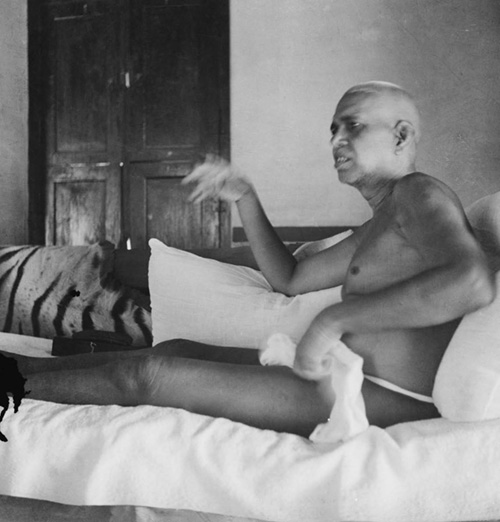
Janaka, having read that Self-realisation can occur at the moment of placing one foot in the stirrup to mount the horse, demanded his scholars prove or disprove it. Failing to do so, they were imprisoned. Sage Ashtavakra agreed to prove the claim—if Janaka obeyed him fully, released the scholars, and surrendered all possessions. Janaka agreed. Outside the city, Ashtavakra asked him to put one foot in the stirrup and prepare to mount. Then came the final condition: "Surrender yourself." Janaka agreed and stood transfixed, one foot in the air. When concerned subjects begged for his release, the sage said, "Janaka, ride home." Janaka obeyed like a servant. Ashtavakra then commanded him to resume rule—in the sage's name. Janaka consented.
Musical Ecstasies and Divine Innocence
The next day, Srimathi Lalita Venkataraman performed on the veena. The final piece, Saranagati, brought the Hall to silent ecstasy. As it ended, Bhagavan remarked:
So, we've returned to earth. We were in Gandharva Loka! Bhagavan praised Lalita's seamless blending of song and instrument. GVS continues:
Later, a young girl danced in the Hall. Bhagavan, delighted, said, "We are now in Deva Loka. Where children play, there is the world of the gods." He appreciated her acting, though she could not understand the deeper meaning.
On Condemnation and Praise
While walking up the Hill, Bhagavan mentioned a dispute between two devotees and asked GVS to deliver a message:
Whoever condemns us is our friend, for he condemns our body, which is our enemy. The enemy's enemy is our friend. Beware those who praise us.
Bhagavan then narrated a story to show how even slander can be a blessing:
A pariah woman criticized a Brahmin based on a scandal. Her husband said, "You are the hundredth to repeat this. Now his curse is lifted." The backstory: a leech had died in food prepared by the Brahmin's wife, which was then served to servants. This earned him a karmic punishment. Being a devotee of Chitragupta, the divine record-keeper, he was warned in a dream of the karmic consequences. Chitragupta advised him to provoke scandal about himself and his daughter. When a hundred people repeated the slander, the sin would be distributed and nullified.
Bhagavan concluded:
Act in such a way as to incur blame rather than praise. Resist the urge to justify yourself—even when right.
Jnani and Prarabdha
That evening, Bhagavan discussed whether a Jnani must experience prarabdha:
Their actions are like fried seeds—useful to eat but incapable of sprouting. Their merits go to those who praise them, and their sins to those who blame them.
When someone noted that the scriptures say the Self reveals itself only to whom it chooses, Bhagavan replied:
The Self draws the aspirant to itself only when he turns inward. So long as one is extroverted, Self-realisation is impossible. Many try to define the Self instead of knowing and abiding in it.
Quoting the Kaivalya Navanitam, he said:
To say 'I have attained the Self ' is like digging a pit and claiming that space has entered into it. Is it not space that gave room for the pit? A child trying to grab its shadow's head is stilled when the mother makes it touch its own head. Similarly, the guru's grace.
To illustrate the role of faith in the Guru and scripture, Bhagavan used this analogy:
In a dream, a king bitten by a dog can only be cured by a dream doctor with dream medicine. Similarly, dream hunger requires dream food. Faith in the guru is essential within the dream of individuality.
Mira Bai and the True Purusha
The next day Bhagavan narrated the story of Mira Bai's visit to her guru:
The disciples refused permission for darshan on the ground that their guru would not see the face of a woman. Mira Bai expressing surprise observed: "I thought that there is only one Purusha (man) and all the rest of us are women." When these words were communicated by the disciples to their guru, he at once realised that Mira Bai was a Jnani and he himself came out and saluted her.
Shashti-Purti and a Prophetic Gesture
On Bhagavan's shashti-purti (sixtieth birthday), GVS anonymously submitted six Telugu verses. Bhagavan smiled knowingly and recognized who the author was. GVS writes:
When my fourth verse prayed that Bhagavan live long for our sake, Bhagavan shook his head and snapped his fingers, as if rejecting the idea—a gesture that, in hindsight, seemed prophetic.
In the Kitchen with Bhagavan
In 1940, GVS was asked to assist with a new Telugu edition of Unnadi Nalubadi ("Reality in Forty Verses") and joined Bhagavan in the kitchen, privileged to enjoy his presence in the intimacy of the early morning hours between
2:30 am and 4 am:
Bhagavan would arrive punctually and help cut vegetables, then prepare sambar or chutney. I once tried to fan him but was stopped—he disliked special treatment. Later, as I tried again stealthily, Bhagavan turned to me, laughed and said, "You want to do it on the sly. But you do not even know how to fan properly. Let me show you." He held my hand and demonstrated the right way. My whole being thrilled at the touch, grateful for my ignorance.
One morning, women and children from Nayudupet arrived early for Bhagavan's darshan before their giri-pradakshina. GVS recalls:
I dismissed them, saying it was not possible. Bhagavan asked what had happened. Hearing it, he said, "Poor people! Why should they go away disappointed? Ask them to come to the back door." When they came, they fell at his feet, kissed them, wept, and received his grace. He stood quietly, radiating compassion. I envied their fortune and truly saw why he is called karunapurnasudhabdhe—the nectar Ocean of Grace.
Bhagavan and the Fate of Nations
On June 10, 1940, the fall of Paris and Italy's entry into the war were announced on the radio:
Around 3 am, Bhagavan, Narayana Iyer, and I were working in the grinding room amid the escalating war in Europe and Narayana Iyer remarked, "France has fallen in three days. Can Britain hold out more than three weeks?" At this, Bhagavan said, "Um! — but Russia," then abruptly fell silent. Neither of us dared ask what he meant, especially since Russia was then friendly with Germany. Remarkably, a year later, Germany attacked Russia—an event that decisively shifted the war. It seemed as if Bhagavan, though outwardly aloof from worldly matters, had glimpsed this coming turn of events. This episode offered a rare insight into the omniscience of the sage who was believed to be untouched by worldly affairs, yet whose words hinted at a profound, intuitive knowledge beyond ordinary understanding. 1* —
(to be continued)
* From Sri Ramana Reminiscences, G.V. Subbaramayya, 4th ed. 2014.
Bhagavan’s Handwriting: “O God Supreme!” Sannidhi Murai, v. 157

|
nānen pavananrō nāttinān meyññāna vānin rirattav valakkup parāparamē. |
Oh Supreme God, Is it not the Ego, the “I” who emerged and initiated the trial against the heavenly true consciousness?- |
Mahakumbhabhishekam Renovations: Update

In preparation for the upcoming Mahakumbhabhishekam, the Ashram has been abuzz with activity. Devotees and workers alike have been engaged in a range of renovation and restoration efforts. Repairs to the gopuram and vimanam above Mother's and Bhagavan's Shrines became necessary due to cracks in the lime-mortar stucco, though the underlying brickwork remains sound. The iconic crocodile sculptures on the eastern and southern sides of the Samadhi Hall-New Hall complex have been restored and repainted. The wooden door frame of the old bookstall has been completely replaced, and painting work is now in progress at Bhagavan's Samadhi Hall. Construction is ongoing at the Ashram Free Dispensary expansion site, while painting and carpentry work have been largely completed in the Korungu Thottam area—the Ashram's 'K' section. Similar work is currently underway in the Ashram's 'A'-section rooms. The Ashram community continues to prepare with great care and devotion for the upcoming event set to take place 18-20th August. —
Similes from Bhagavan: The Futility of Examining the Rubbish
Just as it is futile to examine the rubbish that has to be swept up only to be thrown away, so it is futile for him who seeks the Self to enumerate the tattvas that envelop the Self, carefully examining them instead of just throwing them away. He should consider the phenomenal world with reference to himself as merely a dream. — Who Am I? §21
Events at the Ashram: World Environment Day and Cleaning up the Holy Hill

Word Environment Day was observed at the Ashram to raise awareness about plastic waste. Initiated by the Ashram Free Dispensary, the event was joined by devotees. Meanwhile, clean-up efforts on the Hill behind the Ashram were underway. Local Councilor Mr. Prakash brought a group of ten boys from a local NGO, along with Municipal Officer Mr. Gangadharan and Mr. Karthik. The team cleaned several large disposal areas and raised awareness among local residents about protecting the Hill. The municipality is planning to install collection bins. In the meantime, Ramana devotees have hung sacks all the way up to Skandasramam which are emptied each day. Despite increased litter, awareness is growing, thanks to posted signs and steady community efforts. We are reminded to avoid the use of plastic bottles, to bring cloth bags to vendors (avoiding plastic ones), and to ease up on the use of 'temple socks' which contain microplastics. —
RAMANA REFLECTIONS
The Role of Surrender and Self-Acceptance in Enquiry Practice
RAMANA REFLECTIONS
Over decades in the hall, Bhagavan regularly employed the dream metaphor to reveal how our mistaken self-view causes suffering—and how right seeing can liberate us.
Devotees came from near and far complaining about their lives. Bhagavan urged them to see that the solution isn't changing outer conditions, but seeing the same life through new, wiser eyes. Their distress, he insisted, was not from external events but from the false self-image they clung to.
In April 1935, a devotee lamented, "There is no perceptible progress." Bhagavan replied, "Progress can be spoken of in things to be obtained afresh, whereas here it is the removal of ignorance and not the acquisition of new knowledge."1 When asked how to remove ignorance, Bhagavan offered a vivid thought experiment:
While lying asleep in Tiruvannamalai, you dream of another town. The dream is vividly real, but your body has not moved. Can a town enter your room? Could you have gone elsewhere, leaving your body here? Both are clearly impossible. The dream and the dreamer are revealed as illusory. The 'I' in the dream vanishes upon waking, replaced by another 'I' that says, "I dreamt." But this new 'I' was not part of the dream. Both are mental projections. The only constant is the substratum—the background awareness out of which all these 'I's arise and into which they dissolve. Many 'I's are born and die every moment. The subsisting mind is the thief according to Janaka. Find him out and you will be happy. 2
To the dreamer, the dream-world is vividly real. The mind constructs space, populates it with people, assigns an 'I' to navigate it—and all within the frame of sleep. The body, however, has not moved at all. This reveals that what seems real to the perceiving subject is not necessarily so.
The waking state appears to restore reality, but this too is questioned. Bhagavan affirms, "Both 'I's are unreal." The waking 'I' judges the dream 'I' as false yet assumes its own truth. The true Self lies beneath both—the silent, changeless witness of states. The 'I' in waking and the 'I' in dreaming are part of the same illusion. What persists through both waking and dreaming is not any particular 'I', but the substratum—the underlying field of awareness from which I-thoughts arise. The apparent continuity of ego is only a succession of I-thoughts tied to different cognitive states.
The "real trouble", Bhagavan says, is that every time a thought arises—whether it is about the body, desires, fears, status, suffering or misfortune—it is accompanied by a subtle sense of 'I' As Bhagavan puts it, "An 'I' arises with each thought and with its disappearance that 'I' disappears too."
This mirrors modern psychological insights: the small self is not fixed except in a most fleeting manner, moment-to-moment. The illusion of continuity is created by our ability to switch seamlessly between transient I-thoughts. The mind suppresses awareness of discontinuity by dissociating contradictory impressions. But when deeply examined, this continuity is found to be an illusion.
The Thief
Bhagavan refers to the story of King Janaka in describing the mind as the true thief.3 Why a thief? Because the mind, through its succession of 'I'-thoughts, tries to steal
the Self 's identity. It impersonates the substratum, claiming "I am this body," "I am this thinker," "I am this sufferer," when in reality, these are mere overlays upon the silent, witnessing awareness.
The foundation of the thinking mind is not pure consciousness, but the deepest layer of mental conditioning where vasanas and samskaras reside. It is from here the waking and dream states are projected. It is what filters perception, tailoring experience for survival rather than for truth. It sustains the illusion of individual experience—the ego's simulation of separateness—in a strategy to make its world consistent. Bhagavan offers self-enquiry to uncover the ego's efforts at concealment.
The Dream of Self and the Salience Network
In our meaning-deprived modern world, dominated by stimulation, the dream of the small self becomes the temple we all inhabit. Its deity is thought. Thought shapes identity, narrative, and the illusion of a coherent world. As
long as we compulsively think, compare, evaluate, and remember, we continue to believe the dream is real.
Yet this process is riddled with inconsistencies. The self appears stable only because experience is filtered through assumptions born of the dream itself. In the waking dream of self, perception is coloured by cultural conditioning, memory, and language. All of these reinforce dream logic. The small self appears central because our experience is organized around it. We remain in the dream because it is familiar.
The Biological Origins of Ego
Our tendency to interpret the world through a self-centred lens is not merely a psychological habit but a deeply biological one. Neuroscientists have shown that the brain relies on the salience network to determine what to
attend to. Each moment we are bombarded by more sensory data than we can process. The salience network selects what appears most significant—usually stimuli tied to survival, threat, reward, or novelty.
In this context, entropy refers to the unpredictability or overload in our environment.4 Crowded streets, intense emotions, or information deluge create high entropy—more input than the brain can manage. To cope, the brain simplifies reality, filtering out what it deems unimportant.
But this filtering is not neutral. It prioritizes usefulness over truth, often distorting perception to keep us oriented and alert. For our ancestors, being attuned to danger meant survival. In the modern world, this can translate into heightened sensitivity to status, or anything that reinforces the ego. This is often anxiety provoking.
Moreover, deeper understanding, creativity, and spiritual receptivity are pushed aside—buried beneath a simplified survival-based simulation of reality.
The same entropy-reducing function underlies dissociative boundaries—psychological partitions that protect us from emotional and existential overwhelm. These boundaries keep certain experiences out of awareness, creating zones of "not-me" or "not-now" in order to maintain a sense of continuity. But over time, they become self-perpetuating filters. They shape identity and memory, constricting what we allow ourselves to feel and know.
The result is a fragmented self—a managed identity shaped more by control and certainty than truth. These boundaries, while useful for survival, hinder inner integration and spiritual openness.
If we see only what we know, as Goethe pointed out, the dream of self seems plausible. It functions like a well-coded program. It has internal logic and cause-and-effect sequences. But this consistency is artificial—compressed by the brain's survival mechanisms, buttressed by dissociative barriers, and reinforced through language and culture.
The dream is undeniably functional. It enables humans to manage a complex world. But it is also a prison. We lose sight of who we truly are, mistaking the egoic dream for the Real. Bhagavan points out that so long as we identify with shifting 'I'-thoughts (generated and sustained by salience-based filtering) freedom remains inaccessible.
Unravelling the Dream
Bhagavan's dream analogy offers a precise diagnosis and a clear remedy: find the thief. He invites us to trace every rising thought back to its root—the 'I' that claims ownership. In the meditation setting, one asks,
"To whom has this thought arisen?" Such questioning redirects awareness from thought content to the one who perceives it.
By turning attention inward, we move beyond the surface level of thought and expose the illusory ego. We see that the 'I' has no stable source, is merely a shadow projected by attention bending toward thought.
Importantly, healing does not require us to destroy our biological filters but to soften them. Self-enquiry helps us tolerate ambiguity, contradiction, and uncertainty—qualities the salience network is designed to suppress in the name of efficiency.
Taking things to the next level in our spiritual work involves inviting new criteria into the salience network. We learn to allow thoughts and experiences previously deemed risky or irrelevant. While our ancestors evolved for survival—not spiritual freedom—our development as humans has now brought us face to face with truths too vast for the ego to hold. We have become self-aware. This is our unique gift. But self-awareness includes the awareness of death—a truth at odds with the biological imperative to survive. The fear this generates, Bhagavan argues, is based on the mistaken identity with the body and the ego. But Bhagavan adds, that which dies was never real. We must transcend this illusion if we are to resolve the deep conflict at the heart of human life.
Awakening Our Biology
The illusion of the separate self is not merely psychological. Dissociative boundaries work for our good—to filter perception, manage the overwhelm of unceasing sensory input, and prioritize survival. But in doing so, they invariably
reinforce the dream of ego. To awaken is not to reject our biology but to see through its limitations—expanding awareness beyond survival-based filtering, and embrace a broader, more fluid consciousness in which the rigid self is seen
as a useful—but ultimately illusory—construct.
Bhagavan's vichara is here to help us modify our filters and avoid the habit of grasping at transient 'I's. Bhagavan tells us, the body lies in bed, the dream arises and passes, dream worlds come and go—but you, the real you, remains untouched. The mind, like a shadow cast by a flame, appears solid. But the real light—the witnessing Self—is undimmed.
That which knows the coming and going of dreams is not itself a dream. That which sees the rising and falling of countless 'I's is not itself an 'I'. To realize this is to awaken—not just from a dream, but from the illusion of being the dreamer. We recall a line from the Katha Upanishad:
There the sun shines not, nor the moon, nor the stars... All the lights of the world cannot light up that Self. It shines, and everything is lit by it.
The Cosmic Dream
Once upon a time, children everywhere sang nursery rhymes, among them:
Row, row, row your boat gently down the stream. Merrily, merrily, merrily, merrily, life is but a dream.
As adults, we imagine that children wouldn't really understand the words they are singing. But in reality, they probably understand these lines better than adults, lost as we are in the waking dream.
Here we may recall the archetypal image of Lord Vishnu reclining on the serpent Ananta in the infinite ocean of causal waters. Entering a deep sleep, a lotus springs up from his navel. Within it sits Brahma, the Creator, who begins the act of creation, forming worlds, beings, time, and the laws of nature. Yet all this arises and dissolves within Lord Vishnu's slumbering consciousness. When Lord Vishnu exhales, the universe manifests; when he inhales, it returns into him.5

This cosmic breath cycles endlessly, signifying that the entire universe is but a projection within divine awareness and not any act Brahma imagines he is performing. Just as a dreamer creates a vivid world in sleep, Lord Vishnu dreams all existence into being. Hence the world we see as real is but a play of divine consciousness—impermanent, dependent, and ultimately unreal before the Self.
Now we recall how Brahma became proud of his role in manifesting the universe, believing himself supreme. He forgot that he arose from Vishnu's navel and that his power came from a deeper source. This is analogous to the dream character who imagines he is the be all and end all of all the actions in his dream, whether a sleeping or waking dream. The Mahabharata reminds us, "Even Brahma, the creator, is created anew with every cycle." 6
Dis-Integrating the Ego
If we are such stuff as dreams are made of and our little life is rounded with a sleep,7 Bhagavan is calling us to enquire deeply in order to rouse us from our
slumber.
Etymologically, vichara means "to separate out," "to discern," or "to investigate." It is not mere speculation, but an experiential process. To enquire "Who am I?" is to begin dismantling the illusion of a continuous, stable self, a process akin to alchemy—not transmuting lead to gold, but illusion to reality. One uncovers the dream's constituent parts—memories, sensations, thoughts, fears, images—all of which rise and fall, and none of which are the Self.
The ego persists only when left unscrutinized. But the moment it is seen clearly, its apparent solidity dissolves. Bhagavan affirms, the ego is like a ghost—it vanishes when looked at. Thus, the spiritual path is not about dissolving the false separateness of the small self by integrating what was split off—making conscious what had been unconscious.
The dream of self almost works. It almost explains things. But the misalignment—between what we deeply are and what the dream assumes—keeps resurfacing. Because the bug is everywhere, we assume it must be part of the design. We search for solutions within the illusion rather than questioning the illusion itself.
If we are preoccupied with rowing our boats, having forgotten that life is truly but a dream, if we are unmindful that with each cosmic inhalation, Brahma, the created order and we ourselves return to the Divine Source, then we will also have failed to fully internalise Bhagavan's vision: All the worlds and universes, heavens and hells, are but dream objects on the screen of Pure Awareness—called the Self.
In Summary
Our narcissism is not a flaw; it is a survival algorithm. It is the mind's response to the fear of fragmentation. But true wholeness lies on the other side of that fear. The path to freedom begins when we dare to witness what the
salience network conceals.
As Bhagavan tells us, when we awake from a nightmare, the villain is no longer a threat to us. The same holds for the ego-dream. In deep enquiry, seeming threats are seen as dream characters. They were never real to the Self. The final fear—death itself—becomes transparent. Death is frightening to the ego-structure, but meaningless to what is not born.
Waking from the dream of self is not the loss of Reality—it is its recovery. We see that nothing external can truly threaten us because the "external" itself is part of the dream. Bhagavan clarifies:
Just as the witnessing consciousness which is the basis of the dream is itself the seer of the dream, you are yourself the seer of the world.8
We resist awakening because silence feels like death to the ego. But the ego dies into Reality, not away from It. If we remain self-centred, it is because we are afraid to be self-empty. As long as thought remains our deity, we fear the stillness that enquiry leads us to. But when we sincerely observe, enquire, and surrender, the compulsive mind grows quiet. In that silence, the true temple is revealed—not a physical structure made of stone, but spacious awareness built of silence. The deity within is not thought—but Presence. Bhagavan adds:
A dreamer dreams a dream. He sees the dream world with pleasures and pains. But he wakes up and then loses all interest in the dream world. So it is with the waking world. Just as the dream-world, being only a part of yourself and not different from you, ceases to interest you, so also the present world will cease to interest you if you awake from this waking dream—samsara— and realise that it is a part of your Self, and not an objective reality. Because you think that you are apart from the objects around you, you desire things. But if you understand that things are only thought forms you will no longer desire them. All things are like bubbles on water. You are the water, and the objects are the bubbles. They cannot exist apart from the water. 9
(to be continued)
In Focus: June Edition

For the May edition of In Focus, copy the following URL into your browser June Infocus
Sadhu Natanananda’s Upadesa Ratnavali §25
There is no world in the absence of a mind.
The world does not exist apart from the body; the body does not exist apart from the mind; the mind does not exist apart from Consciousness; and Consciousness does not exist apart from Self, which is Existence. — GVK §99
A world cannot exist without a body, and neither can a body exist without a mind, a mind without consciousness, or a consciousness without Reality. So it is said that the only one that exists is Reality. How so? Because there is no world other than objects, no objects without senses that perceive them, no senses without the body, no body without the insentient mind that believes it is this body, no insentient mind without sentient consciousness, and no sentient consciousness without the Reality of Being in the form of Existence. —
Announcement: Sri Chakra Puja Live Streaming
Sri Ramanasramam is live streaming the Ashram Sri Chakra Puja on the first Friday of each month. Daily live streaming Mon to Sat from 8 to 9.30 am and 5 to 6.45 pm IST continues and includes the Vedaparayana, puja and Tamil Parayana. (No streaming on Sundays) To access videos, go to:https://youtube.com/@SriRamanasramam/videos
Obituary: Smt. V. Lakshmi (1941-2025)
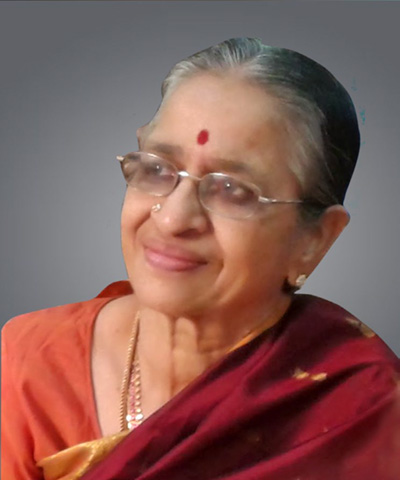
Smt. V. Lakshmi was born on 17th January 1941, the fourth child— and first daughter—of Sri T. N. Venkataraman, nephew of Bhagavan Ramana. She married Sri M. Venkataraman on 7th February 1960, and they
had two sons: Suresh (Mumbai) and Ganesh (New Jersey, USA). After her marriage, she lived briefly in Madurai before settling in Teynampet, Chennai, from 1966. There, she and her husband warmly welcomed devotees of Bhagavan into
their home. Though her visits to Tiruvannamalai became infrequent, her devotion to Arunachala never waned. With Aksharamanamalai, Upadesa Saram, and Arunachala Stuti Panchakam always on her lips, she led a life of
karma yoga grounded in remembrance.
In 2018, due to health concerns, she moved to Mumbai to live with her elder son. Her husband of nearly sixty years passed away in 2019. On 13th June 2025, she peacefully merged in Arunachala. Remarkably, it rained heavily in both Mumbai
and Tiruvannamalai at the hour of her passing—a sign to many of her final union with the Holy Hill. She is survived by two sons.
A touching memory from 5th March 1946, recorded by Devaraja Mudaliar in his Day by Day, recalls a conversation with Bhagavan about Lakshmi when she was just five years old. When a proposal was made to move her to Erukoor,
Devaraja objected, saying, "When even children from Poland and elsewhere grow up here, how can our Lakshmi born here be raised elsewhere?" Bhagavan gently replied, "If her grandfather, Pichu Aiyar stays there, only then would our
Lakshmi go." The conversation evoked verses from Kalidasa's epic Shakuntala, when the girl leaves for her husband's home—echoing Lakshmi's lifelong connection to the sacred atmosphere of the Ashram. —
Obituary: Smt. Meenakshi Panchu (1933-2025)
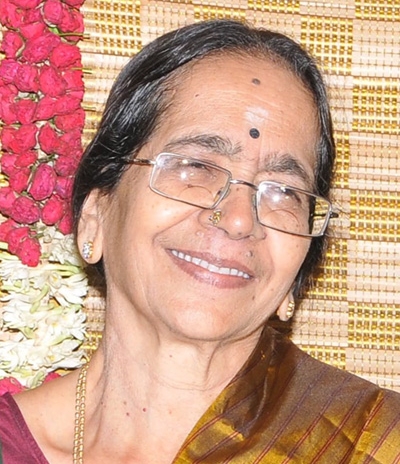
Smt. Meenakshi Panchu was born on 17th March 1933 and at the age of 18, married Sri R. Panchu on 9th May 1951. The couple raised two sons—Sri Sriram Panchu and Sri Gautam Panchu—nurturing a close-knit and spiritually inclined family. The famil spent many years in Mumbai.
In 1998, Meenakshi moved to Tiruvannamalai and found her way into Ashram life as if Bhagavan had readied things for her in advance. Threading flower garlands in the morning and sitting for Tamil Parayana in the evening, her vibrant and affectionate nature quickly endeared her to the local community of devotees. When family members commented about the ease with which she performed her regular 4am 14km pradakshinas as compared with the difficulty she experienced in walking half the distance along the Kodai Lake, she said, “Its a matter of faith”.
Her devotion to Bhagavan deepened over the years, and by 2010 she increased the frequency of her hill roundings, testimony to her inner discipline and unwavering love for the Hill. By the age of 82, her health began to decline, and she was no longer able to maintain regular pradakshina. In 2015, she moved to Chennai to live with her
Obituary: Smt. Atuko Ogawa (1944-2025)

Atuko Ogawa was born on 19th May 1944 in Kyushu's Kobayashi city, Miyazaki prefecture. She worked as an editor at Gakken Publishing in Tokyo before becoming a disciple of Master Takao Yamada, a renowned mystic and meditation teacher. Through him, she was introduced to the teachings of Bhagavan Ramana, which deeply transformed her life.
Known for her intuitive healing gifts, Ogawa-san helped many, never charging for her services. Later, she inherited an apartment building in Takadanobaba, Tokyo. Following an inner command from Bhagavan, she opened a meditation space named (by the former Ramanasramam President, V.S. Ramanan as) Ramana Arul, dedicated to Bhagavan's devotees. A library of spiritual books, especially Bhagavan's works, accompanied the space. Ogawa-san often said, "Bhagavan is telling me to do this," and lived with unwavering faith in Bhagavan's inner guidance.
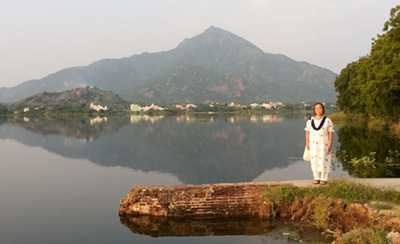 In March 2025, her health declined. After hospitalizations for aspiration pneumonia and an immune disorder, she chose to return home, saying she had work to complete. Despite physical suffering, she remained warm, playful, and gracious. She often said, "Everything is perfect—because Bhagavan has decided it."
A devoted supporter of the Ashram, she sponsored translations of Bhagavan's works into Japanese. Whenever she came to the Ashram, she brought gifts for everyone she knew, including a lot of joy during her visits. Smt.. Atuko Ogawa merged at the Feet of Arunachala Ramana on 27th May. Her presence will be deeply missed by all those who had the honour of knowing her.—
Best Shot: The Dream of the Water Lily

In the Upanishadsh, the cave of the heart—Hridaya guha—is said to be the sacred seat of the Self, untouched by time, thought, or decay. From this stillness, a lotus mysteriously arises—unborn yet ever-present. In the cosmic vision of ancient Bharat, a lotus springs from the navel of Lord Vishnu as he lies in yogic slumber on the cosmic ocean. Upon that lotus sits Brahma, the Creator, who brings forth the universe from the formless void. The lotus thus symbolizes creation arising from silence, purity, and the Unmanifest. It emerges from still waters unstained, just as wisdom blossoms from the depths of the heart. In this image, shot not far from the giri valam road, we see a water lily (alli)—first cousin of the lotus (thaamarai)—rising from pure water. How is it possible? It is the mystery of life springing forth from the unfathomable depths of Being. —
Endnotes
- 1 Talks, §49, 24th April 1935.
- 2 Ibid, 24th April 1935; Bhagavan gives a similar example about a dream of London in response to a question from Major Chadwick (see Talks, §177, 10th March 1936).
- 3 King Janaka famously remarks: Now I have awakened from the long dream of many births (from the Astavraka Gita).
- 4 Entropic filtering refers to the brain's ability to sift through overwhelming sensory input, highlighting what is most important for attention and action. The salience network plays a key role, detecting both internal and external stimuli that stand out. By focusing on what matters and discarding what doesn't, the brain efficiently manages its limited processing capacity. (Adapted from Wikipedia.)
- 5 This ancient image anticipates Einstein's relativity theory which predicts a cycle of an expanding and contracting universe.
- 6 Brahma's pride grew and he acted as though he were the ultimate deity. When Brahma refused to remember his origins, Siva chastened him. Even cosmic creation, when claimed by ego, becomes illusion.
- 7 Shakespeare, The Tempest.
- 8 Vichara Mani Mala, from the Collected Works, p. 279.
- 9 Talks, §625, 7th February 1939.
Publisher: Dr Venkat S. Ramanan
saranagati@gururamana.org
