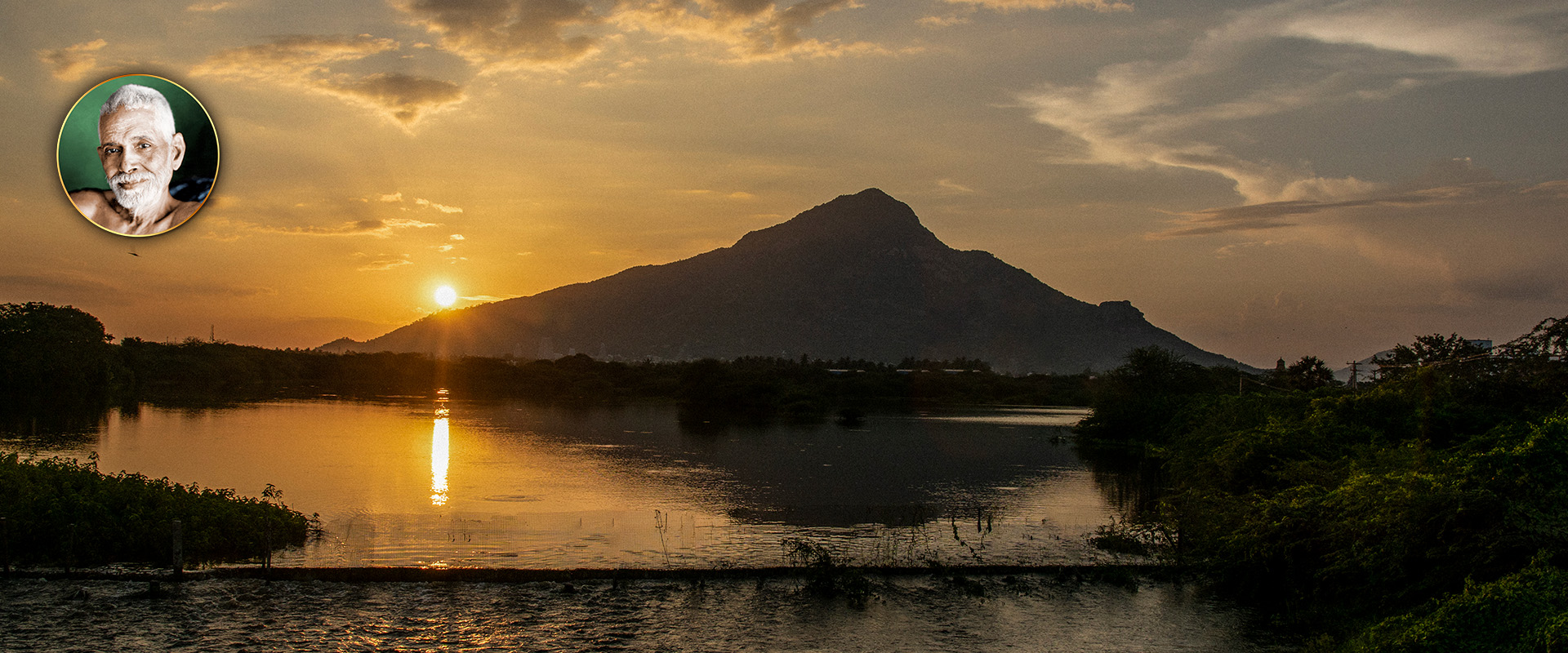
Sri Ramanasramam · Quarterly Journal
The Mountain Path
October 2026 · Vol. 63, No. 4
A journal devoted to the life, teachings, and presence of Bhagavan Sri Ramana Maharshi. Published since 1964 at the foot of sacred Arunachala.
You may now listen to these articles in English at your preferred speed using the embedded audio players. To read the journal in major Indian or international languages, please use the "Translate" pull-down menu to select your language of choice.
In This Issue
Contents
- From the Editor’s desk
- Divine Names of Arunachala — S. Lazar
- Ramana Satguru — Part Two — R. Vaidya
- The Jnani’s Action, The Self’s Stillness — The Editors
- The Healing Grace of Pancharatnam — B. K. Croissant
- Bhagavan: A Personal Rediscovery — Siddhartha
- Essence of Śrī Ramaṇa Paravidyopaniṣad — Part 11 – “I-AM” is the Whole Truth — Annotated by V. Krithivasan
- Mantra Japa as an Aid to Ātma Vichāra — Sneha Choudhury
- POEM: A Flood of Prayer — Niharika Sanyal
- Difficulty in ‘Realising’ the Self — Hari Haran
- Unknown Unfolds by Grace — Vijayalakshmi Ramsai
- Tirukkuṛaḷ: The Wisdom of Sage Tiruvaḷḷuvar — M.R. Kodhandram
- POEM: Guru Purnima — Suresh Kailaash
- Ramana Darshan: I Beheld His Holy Feet — D. Thiyagarajan
- POEM: Still and Silent — Saranagati
- Muruganar in His Own Words — Part Eleven — Hari Moorthy
- KEYWORD: Hṛdaya: The True State — Part Seven — Ramesh Iyer
- Aksharamaṇamālai: ‘A’ for Arunachala and Aham — Sharada Bhanu
- Question & Answer — The Editors
- Nondi’s Corner and Youth Corner
- ASHRAM BULLETIN
FROM THE EDITOR’S DESKThe Importance of Being a Dhira
Venkat S. Ramanan
The word dhira is a rich and profound spiritual term in Indian philosophy and literature. It is difficult to translate into a single English word because it denotes an individual who possesses the attributes of wisdom, steadiness, courage, composure, and spiritual maturity.
Etymologically, the word comes from dhī (intelligence, insight, or higher understanding) combined with a suffix implying possession; it is also traditionally linked to the root dhṛ, meaning firmness or steadfastness. Thus, a dhira is not merely “brave” in a physical sense, but someone who is firmly established in clarity and inner stillness. Tamil spiritual literature similarly refers to a diran as a courageous or steadfast person, and diram as core courage or fortitude. We see this term used purposefully throughout Bhagavan’s own compositions to illuminate the very essence of spiritual strength.
What It Truly Means to Be a Dhira
What does it mean to possess this spiritual valour? In Talks with Sri Ramana Maharshi (Talk 352), Bhagavan provides the following explanation:
“The Self being always the Self, why should only a dhira be illumined? Does it mean a man of courage? No; dhih = intellect; rah = watch; protection. So dhira is the one who always keeps the mind inward bent without letting it loose.”
Bhagavan instructs that the “valour” required on the spiritual path is not physical heroism, but the internal focus necessary to restrain the wandering tendencies of the mind and direct it persistently toward the Self. It requires immense courage to resist the allure of fleeting sense pleasures and to seek ultimate union with the Divine. Such a one is the true hero — the true dhira.
Bhagavan: The Supreme Dhira
Bhagavan himself was the supreme embodiment of the dhira, conquering death through a single, monumental act of intense self-attention, thereby becoming permanently established as the Self. Describing his historic death experience, he recalled:
“From that moment onwards the ‘I’ or Self focused attention on itself by a powerful fascination. Fear of death had vanished once and for all. Absorption in the Self continued unbroken from that time on. Other thoughts might come and go like the various notes of music, but the ‘I’ continued like the fundamental sruti note that underlies and blends with all the other notes. Whether the body was engaged in talking, reading, or anything else, I was still centered on ‘I’.”
These words serve as a foundational teaching, showing us that we too can keep our attention focused on the Self, even while actively conducting ourselves in the world.
Applying the Teaching to Daily Life
For ordinary seekers who have not experienced the sudden, overwhelming illumination that Bhagavan did, maintaining this level of awareness can feel entirely out of reach. Yet, we all understand what courage and single-pointed focus look like in a worldly context. These exact qualities are critical for success in any earthly endeavour. Whether a serious student, an entrepreneur, an athlete, or a civil servant — excellence for all lies in the capacity to remain fixed on a goal while ignoring external distractions.
In worldly pursuits, besides familiar distractions like social media or entertainment, we must also contend with discouraging voices — family members who counsel the paramount importance of financial security or a prospective investor who is dismissive of a visionary idea.
When we turn to the spiritual quest, however, the obstacles become far more numerous and infinitely more subtle. The seeker turns away from the world, trusting the testimony of the scriptures that lasting joy cannot be found outside, but only within.
Such a radical shift frequently invites misunderstanding, scorn, and ridicule from friends, family, and society. This has been true since time immemorial; our scriptures are filled with stories illustrating just how lonely this path can be. Bhagavan himself was ridiculed by his elder brother for meditating instead of focusing on his school grammar lessons before he left home for Tiruvannamalai. Sri Ramakrishna Paramahamsa was thought to be insane for remaining absorbed in divine contemplation instead of properly discharging his duties as a temple priest. Mirabai faced intense persecution, even surviving poisoning attempts by her family, simply for her unswerving devotion to Krishna.
If this was the plight of such great souls, it is no wonder the path feels arduous for everyday seekers who are still far from the exalted state of samadhi. Armed only with sincerity, faith, dedication, and a longing to cross the ocean of samsara, one will almost inevitably encounter obstacles and stumble. Every time we slip, worldly naysayers are quick to point out our failings, declaring that our sadhana is a fool’s errand — claiming we will succeed neither in the world nor in spirituality.
However, the seeker can encounter even subtler obstacles on the spiritual path. Having seen the truth expressed in words, one may continue to cling to the words themselves — reading and discussing — rather than plunging within. This is the mind’s self-imposed hurdle: clinging to the known for fear of losing itself in the unknown. It is here that the need for dhiram is greatest.
The Way Forward: Steps to Becoming a Dhira
What then are we to do? We must return to Bhagavan’s words and cultivate the traits of a dhira. Because this path is an interior journey between the individual and the inner Self, it can feel deeply solitary. While the ultimate support is the Self within, spiritual seekers can benefit immensely from satsang, especially in the initial stages.
Like-minded devotees are often indispensable for providing the encouragement and support needed to sustain the inward turn. Alongside satsang, we must learn to disregard the continually shifting opinions of the world. Once our goal is fixed, we can quietly ignore criticism and step firmly onto the practical path of the dhira through four steps. Each scriptural verse below explicitly references the dhira:
1. Discern the Good from the Pleasant
The first step is choosing what is truly beneficial over what is merely pleasurable. We must gradually identify objects and activities that trigger our latent tendencies (vasanas) but offer no lasting peace.
As the Katha Upanishad (1.2.2) states:
śreyaśca preyaśca manuṣyametastau saṃparītya vivinakti dhīraḥ |
śreyo hi dhīro’bhipreyaso vṛṇīte preyo mando yogakśemādvṛṇīte ||
Both the good and the pleasant approach the mortal; the intelligent man examines and distinguishes them; for, the intelligent man prefers the good to the pleasant; the ignorant man chooses the pleasant for the sake of his body.
2. Remain Undeluded by the Transient
The second step is refusing to be deceived by changing, temporal phenomena. In Verse 13 of Chapter 2 of the Bhagavad Gita, Lord Krishna asserts:
dehino ’smin yathā dehe kaumāraṁ yauvanaṁ jarā
tathā dehāntara-prāptir dhīras tatra na muhyati
Just as the embodied soul continuously passes from childhood to youth to old age, similarly, at the time of death, the soul passes into another body. The wise are not deluded by this.
3. Cultivate Equanimity
Third, we must practice emotional balance amidst life’s inevitable dualities. The dhira remains steady in pleasure and pain.
As Lord Krishna states in Verse 15 of Chapter 2 of the Bhagavad Gita:
yaṁ hi na vyathayantyete puruṣhaṁ puruṣharṣhabha sama-duḥkha-sukhaṁ dhīraṁ so ’mṛitatvāya kalpate
O Arjun, noblest amongst men, that person who is not affected by happiness and distress, and remains steady in both, becomes eligible for liberation.
4. Gently Dive Within
Once the practice is steadied by the first three steps, the fourth step is to dive within. In Verse 27 of Bhagavad Gita Saram (corresponding to Verse 25 of Chapter 6 of the original Bhagavad Gita), Bhagavan summarises:
Dīram-sēr buddi-yinār chittattai mella-mella
Nērac cheya-vēņdu nicchalana - mā-radanē
Chittattai ānmāvil sērt-tiduga mattreduvum
Itta-naiyum ennidādē mandi ottē
One should gradually attain quietude by firmly controlling the intellect and immersing the mind in the Self, allowing no thoughts to arise.
This is the practice of vichara. I outlined the steps to practice Bhagavan’s technique of Atma Vichara in a prior editorial. The method boils down to isolating the “I”-thought and tracing it to its source.
The operative word here is “gradually.” Bhagavan always cautioned seekers to lead the mind inward gently, rather than through force. In Talk 563, he uses a beautiful, practical analogy:
Bhagavan: A refractory bull is lured to the stall by means of grass. Similarly the mind must be lured by good thoughts.
Devotee: But it does not remain steady.
Bhagavan: The bull accustomed to stray takes delight in going astray. However he must be lured with luscious grass to the stall. Even so he will continue to trespass into the neighbour’s fields. He must gradually be made to realise that the same kind of good grass can be had in his own place. After a time he will remain in the stall without straying. Later a time will come when, even if driven out of the stall, he will return to the stall without going into the neighbouring fields. So also the mind must be trained to take to right ways. It will gradually grow accustomed to good ways and will not return to wrong ways.
Devotee: What are the good ways to be shown to the mind?
Bhagavan: Thought of God.
The Power of Devotion and Divine Assurance
As Bhagavan reveals above, the greatest aid in plunging inward as dhiras is deep devotion. His hymns to Arunachala provide the ultimate guidebook on how love of God can help achieve this inner victory.
If we find ourselves lacking stamina, we can echo Bhagavan’s own prayer from Verse 45 of Aksharamanamalai:
Dīramil ahattiļ tēdi-yun tanai-yān
Tirum-bavut trên-arul Arunachalā
“Seeking Thee within but weakly (without diram), I came back unrewarded. Aid me, O Arunachala!”
By invoking his Grace, we develop the spiritual fortitude to withstand and overcome external distractions. Once this inner courage (dhiram) arises, Bhagavan encourages us to approach the Divine with a beautiful, loving boldness, as expressed in Verse 6 of Arunachala Navamanimalai:
Kāmāri yendrunī anbarāl endrumē gadit-tidap padu-gind-rãi
Āmāme unak-kidu vāmāven drai-yurum aruņā chales-waranē
Āmāyin enga-naņ dīranē sūranē yāyi-num valla-nangan
Kāmāri yāgumun kālaran saran pugu karut-tinuț puga-valanē.
“‘Killer of Kama,’ Thou art always called by Thy votaries. Yes, that is true. But Lord of Arunachala, I doubt whether this name fits Thee. If it is fitting, how can the mighty Invisible One (Kama), brave and valiant though he be, dare to creep into a mind sheltering under Thy Feet, who art his killer?”
This reflects the sublime intimacy between the devotee and God—an unwavering confidence to demand that the Lord hold the mind captive within the heart.
Ultimately, Bhagavan assures us that for the soul who perseveres, victory is certain. In his very early days in Virupaksha cave, he translated Devikalottara into Tamil; verse 12 of this work says:
Vishaya jñānampōi virinish kaļa-māi
Vishayamin jñāna-paran vīdum - adaiya
Avā-vilanē nun-dīran akshayamā mōksham
Tavā duttridu-vanē tānē – Sivaiyē
“Being rid of worldly knowledge and having acquired pure wisdom, formless and all-pervading, in which there are no sense objects, the great hero is sure to achieve everlasting moksha, even if he does not consciously seek it.”
The spiritual path is not for the faint of heart. It demands discrimination, endurance, faith, and an uncompromising inward focus. To walk Bhagavan’s path is to step into our true nature as a dhira—refusing to let the mind wander outward and remaining forever anchored in the quest for the Self.
In humility and devotion,
Venkat S. Ramanan
Divine Names of Arunachala
S. Lazar
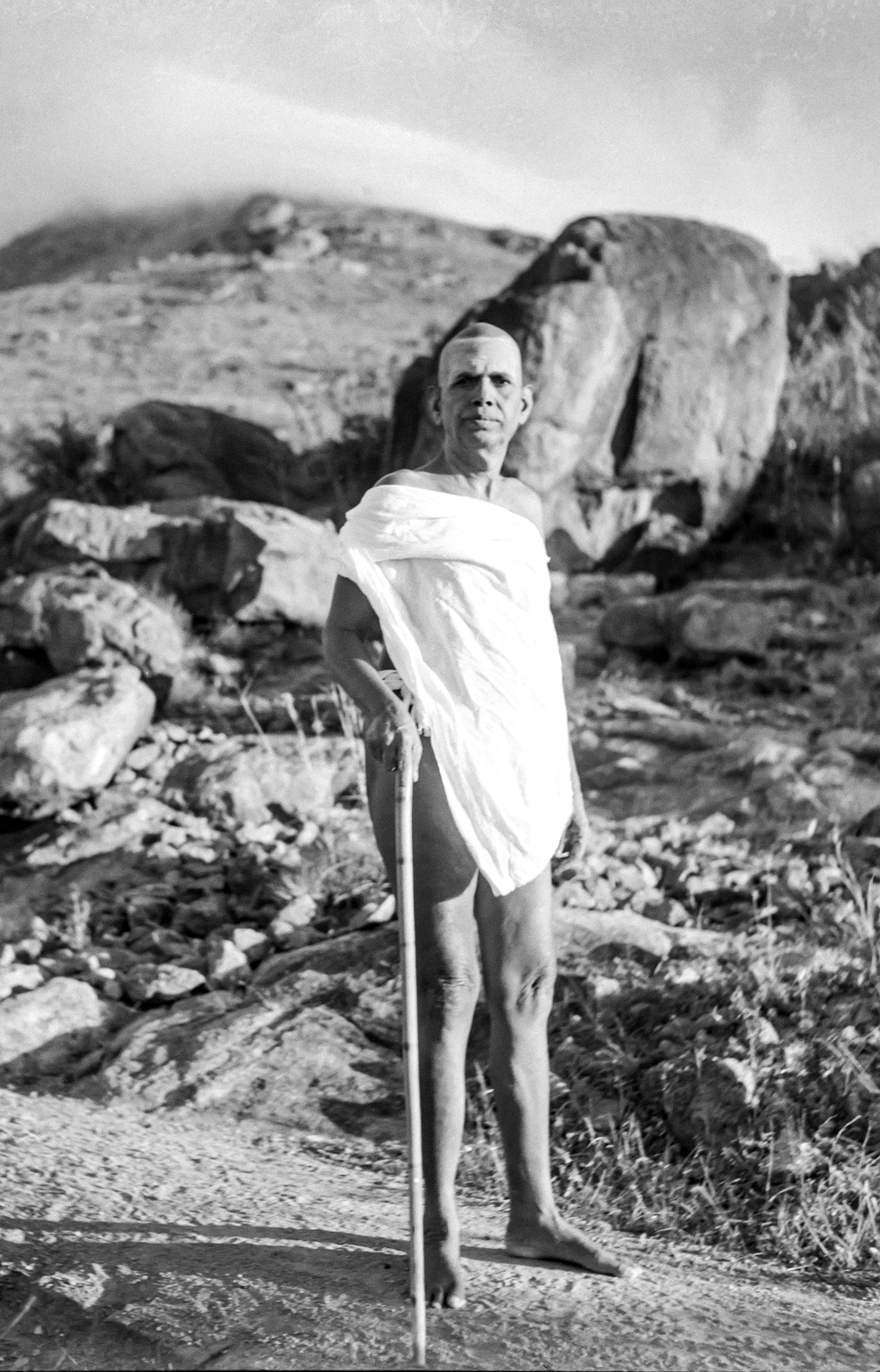
44. ॐ गिरिश्वरः नमः OM Giriśvaraḥ namah - Lord of the Hill
“Ocean of nectar, full of grace, engulfing the universe in thy splendor - Arunachala, the True Transcendent Self, be Thou the Sun, and open the lotus of my heart in bliss.”
Thus reads the first stanza of Arunachala Pancharatnam in address to Arunachala, a hill on earth, but verily the ocean of compassion.
We continue our series with the next rāśi in the sequence of 12 — Karkata, meaning “The Crab,” known in Western astrology as Cancer. This rāśi is the first of the water, or āpas signs and also the first of those that deal with the fourth goal of human life: mokṣa, or liberation.
The fourth house, the natural home of Karkata rāśi, rules the chest, including the lungs and ribcage, as well as the breasts. It can also be said to rule the womb. This of course, is because the most famous signification of the fourth house is the Mother and everything that comes with the divinely feminine: nourishment, silence, intuition, and the inner world. If Gemini and the third house is the crystallization of sound energy into intelligible speech, then Karkata is what comes after the intellect fails to deliver the most final of results — silence.
The role of silence in Sanatana Dharma is epitomized by Dakshinamurthy, who appeared in order to satisfy the aspirations of the four Kumaras — mind-born sons of Brahma. They wished only to be delivered from worldly existence. In the form of a radiant 16-year-old boy, Lord Siva sat under a banyan tree and taught these four eternal children the secrets of Brahma-Vidya, or Self-knowledge. Yet, when they were unable to understand through words, he lapsed into silence, and the power of this tidal wave of love, paired with his chin-mudra (the thumb and the index finger held together to symbolize the oneness of Reality and the Jiva, respectively) eventually breached the fortresses of the Kumaras’ minds and gave them liberation. It is that same Lord Dakshinamurthy who is known in Tiruvannamalai as Arunagiri Yogi, and who, even today, rains down grace from the Northern slope of the Hill in the form of a 16-year-old ascetic.
If Dakshinamurthy represents the Guru in his highest form, jyotiṣa likewise recognizes that same principle through Brihaspati, the guru of the Devas. Among the nine planets in jyotiṣa, the most beneficent, Jupiter, is known as Guru and is the embodiment of Brihaspati. In the chart of any individual, this planet matures at the age of 16, and is then capable of giving its fullest fruits — just like Dakshinamurthy, like Adi Shankaracharya, who took sannyas at 16, and like our Bhagavan, who had his liberating death experience at the same ripe age. Incidentally, it is within Karkata rāśi that the planet Guru not only finds its exaltation — its most favorable position in any of the signs of the Zodiac — it is also where Brihaspati himself is immortalized in the form of a star cluster, or nakṣatra.
The star Puṣya, ruled by Brihaspati, is known as the greatest of all the 27 nakṣatras — the most auspicious home of the guru principle itself. The name Puṣya comes from the root puṣ, meaning “to nourish.” Its symbol is the udder of a cow and its primary power is that of Brahmavarcasa Śakti: the ability to create spiritual energy. Just as Lord Siva rains down grace from the summit of Arunachala, like the Ganges flowing down from Kailash through his matted locks, the Guru rains unceasing nectar, the milk of grace, upon his disciple.
Yet, if the Lord, who is classically of blue throat, wearing rudrākṣa and a tiger’s skin, is meant to be the Ultimate and Primal Guru and source of spiritual nourishment, why should he also appear as a nondescript, if radiant, mountain on Earth? What is Arunachala?
In the first place, the protruding mound of rock that was once a glorious column of light is the first lingam, or marker of Lord Siva. The word lingam itself means “pointer.” In essence: it is that which indicates. Beingness, the phrase “I am,” indicates anything that is attached to it. Being young is indicated by the phrase or thought “I am young.” Lord Siva is himself “beingness,” the reality “I am.” Thus, the lingam, as an indicator of beingness, is both its own form and function at once: that which is indicative of indication. This is similar to the form and function of Dakshinamurthy’s chin-mudra: a wordless signifier of transcendence which is given meaning by the ocean of silence upon which it floats.
It is no coincidence that, throughout all spiritual traditions, the ocean has been the preferred metaphor for the endless expanse of bliss that is Brahman. Just as the wave is not separate from the ocean, so too is the individual soul inseparable from the one Reality. The seashore is, perhaps, the one place on earth where humans can both glimpse the seemingly infinite expanse of something much larger than themselves, while at the same time interacting with it — touching, tasting, and hearing its pulsating message with each wave upon the sand.
Thus, just as the localized form of the ocean is conducive to the function of expansiveness, the form of Arunachala is exactly commensurate with its function of bestowing liberation. As a mountain, there is, in essence, no meaningful distinction between what is physically present and what is metaphorically conveyed as Reality: like a mountain, the Lord is unshakeable, most ancient — His grace silent and ever-flowing; He is the established Heart Center within and without, around which all else orbits. “Ocean of nectar, full of grace” — this is the language of intuition — of the merging of apparent opposites: hill and ocean; fire and water; materiality and transcendence. Bhagavan and the sages speak sideways (or indirectly) because this is the means by which the heavy machinery of the mind is surpassed.
As a crab protects its soft insides with a hard shell, sleeps in the day and becomes active in the night, and crawls sideways, slowly — so too does the Sage, the Lord sitting atop the Hill, couch his radiant transmission of Love in the motherly silence of his physical frame.
R. Vaidya
V. When Nothing Is Left to Do
Grace, as the seeker encounters it, conforms to the mould of the seeker’s own life — appearing as the longing that turned attention inward, as the practice that sustained it, as the intimacy that made the Guru’s presence resonate within the heart’s own depths.
There comes a juncture, however, when, after long effort and full-hearted devotion, exertion and yearning are no longer possible. The energy for diving within, the questioning, the doubting, the pining, and the praying have been exhausted. When a seeker once asked Ramana whether he should try to make no effort at all, the reply was unequivocal: “Here it is impossible for you to be without effort. When you go deeper, it is impossible for you to make any effort.”[2] In this utter stillness, no intention can arise. There is nothing left to accomplish, nowhere to go. No more dissatisfaction. No more impulse to change one’s state.
This stillness is neither resolution nor consummation. It is the stark inability to move in any direction. The inclination to progress or attain does not subside because it has been fulfilled; it falls away because it is no longer sustainable. Effort and longing have burned through their own fuel. The one who strained toward realisation finds no ground from which to advance or even to move.
What remains then is not vacancy but an unalloyed transparency. This is the state of vṛtti-jñāna — purified being no longer scattering itself outward but resting in clarity at the very threshold of the Source. The mind, once turbid and fickle, is now lucid and becalmed. In this stillness, only sheer being persists.
This transparency is not, however, barren. At this depth, a seeker may experience ānanda — the bliss or ecstasy of meditation — the last vestige of separation from the Self. Ramana identified this too as a final obstruction: “...ananda, is also called an obstacle, because in that state a feeling of separation from the source of ananda, enabling the enjoyer to say ‘I am enjoying ananda’ is present.”[3] So long as there is an enjoyer standing apart from the enjoyment, a shadow of duality remains.
This duality is rooted in what Ramana called chit-jaḍa granthi — the entanglement of pure consciousness and inert materiality. It is this knot that gives rise to the sense that ‘I am a body.’ As long as this knot endures, even the most refined stillness retains a locus — the faintest trace of one who abides.
Mano-nāśa — the destruction of the mind — is the dissolution of this knot.[4] It is not the annihilation of something real; what seemed to bind never possessed independent standing. The ego, attenuated to its root, cannot effect its own extinction, for the act of intending extinction itself would reconstitute agency. Here, where effort can no longer function, Grace alone remains.
Grace does not destroy the ego. It reveals that there never was an ego to destroy.
Upon mano-nāśa, the distinction between effort and Grace does not survive. What was seen earlier as striving was Grace appearing within the condition of individual agency. The two were never separate. The standpoint from which they appeared as separate simply ceases.
Describing the deepening of the quest and the shift that ensues, Ramana said: “The moment you get into a movement of quest for the Self and go deeper and deeper, the real Self is waiting there to take you in, and then whatever is done is done by something else and you have no hand in it.”[5] This ‘something else’ is Grace.
Nor does this occur incrementally. In the Ramana Gita, Vaidarbha asked Ramana whether jñāna arrives progressively or “does it, like the Sun, blaze forth all at once in all its fullness?” Ramana’s reply was categorical: “Jnana does not come gradually, little by little, day by day. It blazes forth all at once in all its fullness, when the practice has matured to perfection.”[6]
On another occasion, he elaborated upon the realisation experience: “You can feel yourself one with the One that exists. The whole body becomes a mere power, a force-current. Your life becomes a needle drawn to a huge mass of magnet and as you go deeper and deeper, you become a mere centre and then not even that, for you become a mere Consciousness; there are no thoughts or cares any longer — they were shattered at the threshold — it is an inundation. You, a mere straw, are swallowed alive, but it is very delightful, for you become the very thing that swallows you. This is the union of jiva with Brahman, the loss of ego in the real Self, the destruction of falsehood, the attainment of Truth.”[7]
When a seeker once pressed Ramana on whether mano-nāśa meant absolute destruction, he answered: “The mind gets clear of impurities and becomes pure enough to reflect the truth, the real Self. This is impossible when the ego is active and assertive.”[8] What is ‘destroyed’ is a superimposition; its removal is Grace itself.[9]
In this revelation, nothing new is gained. The language of culmination falls silent, because there is no longer anyone to whom culmination could occur. What endures is the Self as it has always been — whole and self-luminous. As Ramana said: “The state we call realisation is simply being oneself, not knowing anything or becoming anything. If one has realised, he is that which alone is and which alone has always been.”[10] This is what had presented in Ramana himself, unsought and without preparation — the plenitude of the Self.
When even the subtlest sense of ‘I’ ceases, Grace no longer appears as effort, enquiry, or surrender. It is the Self’s own luminosity.
VI. Ramana Satguru: Grace Embodied
Ramana’s realisation was not accomplished by the one who underwent it. What endured was a form in which nothing stood between Grace and its expression. A form persisted — a name, a body dwelling on a hillside — but agency did not. The jñānī has no saṅkalpa, no volitional resolve; what acts through such a one is Grace itself.
When the egoic centre has been irrevocably erased, nothing remains that can claim to act. What endures is transparency, in which Being and its Śakti — ground and activity — are not divided. The activity that seemingly occurs is inseparable from the unchanging Reality upon which it rests.
This indivisibility of ground and activity — the unity of the Self’s stillness and its radiance — is succinctly portrayed in Sri Ramana Chatvarimsat and its associated commentary.
न करुणागुणस्तव विदांपते ।
हृदयतेजसः सहजभैव ते ॥
na karuṇā guṇas tava vidāṃpate |
hṛdayatejasaḥ sahajabhaiva te ||
Translation: O, the lord of the learned, compassion is no attribute of thine. It is verily the natural splendour of the light in thy heart.
Commentary: It is usual to say that compassion is the attribute of the Maharshi and he employs it for the upliftment of the disciple. This is not true. He does not make any special effort. The natural splendour of the light in his heart acts spontaneously and does the work.[11]
Ramana’s Grace is thus not a quality he possessed but the intrinsic radiance of the Self when nothing stands in the way. It simply shines.
How this manifests is recorded in the most intimate episode of a devotee’s life with Ramana. Aḻagammal had lived by her son’s side for six years, her devotion deepening through proximity to that Presence. His patient instruction had loosened the hold of orthodoxy and ripened her heart. So total was her surrender that she wished only to end her life with him by her side: “Even if you were to throw away my dead body in these thorny bushes, I do not mind, but I must end this life in your arms.”[12] In her, devotion, guidance, and proximity had opened the horizon where Grace alone can prevail.
On the morning of 19 May 1922, at Skandashram on the slopes of Arunachala, Ramana sat beside his dying mother. As long as she remained conscious, he gave her spiritual instruction. By evening, her body was racked by the violent heaving of breath — ūrdhva śvāsa — that signals the close of life. Her outer senses had already withdrawn. Ramana placed his right hand upon her heart, his left upon her head, and looked at her intently. Around him, disciples chanted the Vedas, Akṣaramaṇamālai, and Rāma-nāma.[13] [14]
What occurred in those final hours, he later described almost clinically. The accumulated vāsanās rose in subtle sequence — scene after scene appearing in the inner consciousness, even as the outer senses lay extinct. He called it a struggle: the latent tendencies surfacing and dissolving, surfacing and dissolving, until nothing further remained. He paid attention to the course of the prāṇa so that it did not disperse outward through the senses, but was drawn within and absorbed in the Heart. Toward eight in the evening, the final quiver of the heart was spent. The soul, he said, was “at last disrobed of the subtle sheaths before it reached the final destination, the supreme peace of liberation from which there is no return to ignorance.”[15] He recounted later: “After Mother breathed her last, her body glowed with a divine resplendence. She looked, not like a corpse, but like a yogini in meditation.”[16]
Ramana then rose and asked that the evening meal be served. He declared that no ritual pollution had been incurred. When someone later referred to the ‘passing away’ of Aḻagammal, Ramana corrected him with a short rejoinder: “She did not pass away, she was absorbed.”[17]
And yet, when asked whether he had granted liberation to his mother, his response was unequivocal: “Can anybody give liberation to another? No. One’s own jñāna alone can give one liberation.”[18]
There is no paradox here. The hands were placed upon the heart and head. The vigil endured. The prāṇa was not allowed to be diverted. But the one through whom they occurred denied personal agency, not out of humility but out of fidelity. For the jñānī, there is no volitional centre from which intention can arise. As he himself explained elsewhere, even the thought to save is a saṅkalpa, and the jñānī has no saṅkalpa. But when the jñānī’s eyes fall upon something, what he termed an “automatic divine action” takes place.[19]
In that small room on the Hill, Grace prevailed as that automatic divine action. What devotion had prepared over Aḻagammal’s years at Arunachala found its consummation through a form in which Grace functioned unimpeded.[20]
This is what Ramana Satguru signifies: Grace individualised without individuality.
The absorption of Aḻagammal was the same continuous Grace that had drawn her for years, appearing in all its fullness in her final hours. What seemed to be accomplished was simply the falling away of what had never been more than appearance.
The clay pot had disintegrated. The space within stood revealed as not other than the space without.
Nothing was added. Nothing was conferred.
VII. The Abiding Presence
In Ramana’s final months, as the body was failing, devotees, stricken at the prospect of his death, beseeched him not to leave. He replied: “They say I am dying, but I am not going away. Where could I go? I am here.”[21]
This was no mere consolation offered to grieving devotees. It was an affirmation of the truth of his life and teachings: the Self does not come or go. When he said, “I am here,” he was disclosing that his presence was never contingent upon a body. When that form fell away, they lost only the locus through which the source had been encountered. The manifestation of the Self was never the accomplishment of the body-mind through which it radiated, and its cessation could not dim what it had not produced.
What devotees experienced as Bliss and Grace in his physical proximity was the Self’s own radiance, appearing within the conditions of embodiment as the felt presence of the Guru. During Ramana’s lifetime, to sit before him was frequently described as entering a field where the mind grew still without effort and the heart was stirred unbidden. Questions dissolved before they were spoken; anxieties that had seemed ineradicable dropped away unnoticed. Many came seeking verbal answers and departed having received something ineffable yet indisputable. Viswanatha Swami called it Ramana lahari — the blissful atmosphere of Ramana: “In this ecstasy of grace one loses one’s sense of separate individuality and there remains something grand and all pervading, all devouring.”[22]
Ramana never claimed to be the source of this influence. He insisted that Grace is not something external to the seeker — it is the Self itself, omnipresent, acting from within. If Grace is the Self, then what appeared outwardly as the Guru’s influence was only the Self recognising itself across the apparent distinction of individuality. The Guru does not bestow something that the seeker lacks. The Guru functions as a transparency through which the Self reveals its own presence to itself — the natural radiance of one abiding as what is.
Those who turn toward Ramana today encounter not a memory or a relic but that same luminosity, undiminished and as vital as ever. On the night following the mahāsamādhi, Bhaurao Athavale, a Maharashtrian devotee, lay weeping in the ashram, inconsolable at the thought that he would never again see Bhagavan in embodied form or enjoy the bliss of his presence. In the dead of night, footsteps were heard. “Lo! There came Bhagavan with a lantern in his hand! He straightaway approached me, removed the curtain and said to me in a soft, gentle, loving voice, ‘Oh! Why do you weep? Did I not tell you that I am here?’”[23]
What Athavale encountered that night, others encounter in forms perhaps less dramatic but no less certain. Without evident cause, the mind is stilled. The heart is filled. A deep peace pervades. Concerns that once seemed urgent lose their purchase because the ground beneath them no longer holds. For some, it comes as a single encounter; for others as a current that discloses itself only in retrospect, having been drawing them all along. Ethel Merston, an English devotee, observed: “We who knew him in the body are not the only ones to feel his presence. Even after he left the body, people in England who never knew him in the flesh, have told me that after reading about him, they have had the experience of his actual presence near them, even of his touch, ready with his grace to help.”[24]
His presence is inseparable from Arunachala. The hill he revered as Guru and Self is the same Grace approachable in another form, not a secondary locus adjacent to his own. To speak of Ramana’s abiding presence without evoking Arunachala would be to separate what continues undivided. He identified the hill with the Heart of Being: the Self made manifest as the unmoving, magnetic centre whose pull upon consciousness is Grace itself — the same force that drew him from Madurai as a boy and held him there, rooted, for the remainder of his life. In Akṣaramaṇamālai, addressing Arunachala directly, he wrote:
“From my home Thou didst entice me, then stealing into my Heart didst draw me gently into Thine, (such is) Thy Grace, Oh Arunachala!”[25]
Arunachala is Grace accessible as a hill, just as Bhagavan Sri Ramana Maharshi was Grace accessible as embodied presence. Both are the Self, drawing consciousness inward through limitations it has assumed.
The Grace that seemed to arrive through a particular life, in a particular era, at the foot of a particular hill, was never localised to any of these. What appeared as the Guru was none other than the Self — presenting as both manifestation and return, indivisible and without cause. The Guru does not complete a process. The Guru dissolves the assumption that there is one.
What Ramana embodied, and what Arunachala embodies still, is not a bridge between the seeker and the Self. It is the Self — appearing as intimacy and guidance for as long as the heart imagines itself apart.
VIII. The Self’s Own Stillness
These reflections have conformed to the language of movement: Grace drawing the seeker inward, enquiry tracing the ‘I-sense’ back to its source, surrender ripening the heart. But movement toward what? Undertaken by whom?
Ramana said: “What is permanent must be eternally present. Can it be newly got and be permanent also? …Once veiled by ignorance and later revealed, Reality looks as if newly realised. But it is not new.”[26]
The distinctions that were necessary from the outward vantage — between the Guru’s guidance and the seeker’s practice, between effort and Grace, between Silence, Grace, Enquiry, and Surrender — do not emerge from the inward arc intact. Enquiry, when traced to its root, is not a practice arriving at Silence, but Silence itself finding expression as Enquiry. Surrender, when all claims of agency fall away, is not devotion answered by Grace, but Grace itself appearing as the heart’s yearning for union. These aspects of practice resolve into the ground they have always been — the Self’s undivided being, named Silence and Grace only from the perspective that is dissolved.
What the seeker had known as effort was Grace operating within the presumption of individuality. When that presumption ceases through the exhaustion of the standpoint from which will can actuate, the concept ‘effort’ ceases with it. Grace does not prevail over effort; it alone is always operative. The formulations that were necessary within the appearance of individuality — effort and Grace as concurrent, attenuation and severance, devotion and union — can never apply to what is. Grace is the Self itself, and from the standpoint of the Self, there is no such thing as realisation, for there is nothing separate from the Self.
What appeared as a return was never a departure.
This is the ground of Ramana’s Presence — the Self in and by itself, prior to the arising of the root ‘I-thought,’ prior to the emergence of mind, prior to awareness of the world. Within manifestation, it is perceptible as stillness: the disclosure that draws the mind inward and in which the knot of identity is recognised as never having independent existence. The apparent journey unfolds from this ground and resolves within it, just as waves swell upon the surface of the ocean and fall back into the source from which they were never separate.
This stillness is the Self’s own nature. The Self that was sought as the completion of the search has been here all along — whole, unchanging, and perfectly still.
Be Still
Summa Iru
சும்மா இரு
Endnotes
1 Part One of Ramana Satguru was published in the July 2026 issue of The Mountain Path. Part One traced Grace as it appears to the seeker — as longing, as practice, and as lived experience. The present article continues that movement inward. Readers coming to this article fresh may find it useful to begin with Part One. ↩
2 Sastri, K., Sat Darshana Bhashya, Rejection of Thoughts. ↩
3 Mudaliar D., Day by Day with Bhagavan, 25-4-46. ↩
4 Mano-nāśa should be distinguished from mano-laya — the temporary quiescence of mind in which latent tendencies are suspended but not eradicated. In Verse 13 of Upadeśa Sāram, Ramana makes this distinction clear: “That mind which is lying down [in laya] will rise. But if its form dies, it will not rise.” ↩
5 Sastri, K., Sat Darshana Bhashya, The Self Within Waits for You. ↩
6 Sri Ramanasramam, Ramana Gita, Ch. 17, On the Attainment of Jnana. ↩
7 Sastri, K., Sat Darshana Bhashya, Retiring Abode in the Body. ↩
8 Sastri, K., Sat Darshana Bhashya, Is Brahman Beyond? ↩
9 With regard to the earlier discussion of the term vṛtti-jñāna, note that Ramana used it in two closely related senses. When describing the aspirant’s progress, he spoke of it as the mind’s consummate refinement — the final transparency in which the ego is attenuated to its root. In this context, realisation may be said to require a decisive consummation: as the Sat Darshana Bhashya records, Divine Grace gives “the overt and immediate finishing touch” by cutting asunder the root-knot of ego-sense. However, in other contexts — particularly when correcting the notion that realisation is inert or blank — he identified vṛtti-jñāna directly with realisation itself: the eternal shining of the Self as aham sphuraṇa, the pristine light of “I-I.” The two usages are not contradictory. The first speaks from the standpoint of the seeker, for whom effort reaches its limit and responsibility no longer compels; the second names what is always the case when superimposition no longer obscures and Grace alone prevails. At mano-nāśa, the root vṛtti no longer arises; what remains is the Self alone. ↩
10 Mudaliar D., Day by Day with Bhagavan, 22-3-46. ↩
11 Sri Ramanasramam, Sri Ramana Chatvarimsat, verse 28. ↩
12 Nagamma, S., Letters from Sri Ramanasramam, 3rd April 1947, (102) Mother Alagammal. ↩
13 Swami, K., Reminiscences of Kunju Swami, Ch. 43. Mother’s Soul Rests in Peace. ↩
14 Bhikshu, K., Ramana Leela, Ch. 32. The Mother’s Nirvana. ↩
15 Sri Ramanasramam, Arunachala Ramana – Eternal Ocean of Grace, Section 53. Azhagammal’s Liberation. ↩
16 ibid. ↩
17 ibid. ↩
18 Brunton P. and Venkataramiah M., Conscious Immortality, Section 16, “Sagehood as an Ideal.” ↩
19 Subbaramayya, G.V., Sri Ramana Reminiscences, pp. 21-22. ↩
20 Aḻagammal’s spiritual ripeness, wrought by years of surrender, was itself jñāna. As Ramana has said: “What the bhakta calls surrender, the man who does vichara calls jñāna. Both are trying only to take the ego back to the source from which it sprang and make it merge there.” (Mudaliar, D., Day by Day with Bhagavan, 2-11-45). Aḻagammal’s jñāna was not a culmination of Self-enquiry, but the ripening of devotion; it established the condition for the absorption that Grace effected through Ramana’s form. ↩
21 Osborne, A., The Maha-Nirvana of Bhagavan Sri Ramana Maharshi, Ch. 2. ↩
22 Narain, L., Face to Face with Sri Ramana Maharshi, Ch. 57. ↩
23 Narain, L., Face to Face with Sri Ramana Maharshi, Ch. 145. ↩
24 Narain, L., Face to Face with Sri Ramana Maharshi, Ch. 77. ↩
25 Sri Ramanasramam, Akṣaramaṇamālai, verse 97. ↩
26 Venkataramiah M., Talks with Śri Ramaṇa Maharshi, Talk 439. ↩
The Jnani’s Action, The Self’s Stillness
The Editors
The following records and reminiscences, drawn from multiple sources and years, trace facets of the inward movement — as the Guru who acts without sankalpa, as the Presence unbound by the body, and as the stillness that is the Self’s own unchanging nature.
The Jnani and Doership
Source: Nagamma, S., Letters from Sri Ramanasramam, 16th May, 1947.
Bhagavan: [Jnanis] do not have the feeling that they are one thing and the shakti or Ishwara is another. The force, that is, is only one. They realise that they are moving because of that shakti and keep themselves from the feeling that they are the doers.
The Jnani’s Actions
Source: Venkataramiah, M., Talks with Śri Ramaṇa Maharshi, Talk 158
Mr. Frydman: Janaka was a Jnani and still he ruled his dominions. Does not action require activity of the mind? What is the rationale of the working of a jnani’s mind?
M.: You say, “Janaka was a Jnani and yet active, etc.” Does Janaka ask the question? The question is in your mind only. The Jnani is not aware of anything besides the Self. He has no doubts of the kind.
The Jnani’s Body
Source: Mudaliar, D., Day by Day with Bhagavan, 19-11-46.
Bhagavan: You are under the impression you are the body. So you think the jnani also has a body. Does the jnani say he has a body? He may look to you as having a body and doing things with the body, as others do. The burnt rope still looks like a rope, but it can’t serve as a rope if you try to bind anything with it.
The Jnani’s Interactions
Source: Nagamma, S., Letters from Sri Ramanasramam, 2nd February, 1947.
Bhagavan sometimes used to say, “The Jnani weeps with the weeping, laughs with the laughing, plays with the playful, sings with those who sing, keeping time to the song. What does he lose? His presence is like a pure, transparent mirror. It reflects our image exactly as we are. It is we that play the several parts in life and reap the fruits of our actions. How is the mirror or the stand on which it is mounted affected?”
The Jnani’s Omnipresence
Source: Venkataramiah, M., Talks with Śri Ramaṇa Maharshi, Talk 474
As a European Countess was leaving for Europe tonight she requested him to bless her and her family.
M.: You do not go anywhere away from the Presence as you imagine. The Presence is everywhere. The body moves from place to place; yet it does not leave the one Presence. So no one can be out of sight of the Supreme Presence. Since you identify one body with Sri Bhagavan and another body with yourself, you find two separate entities and speak of going away from here. Wherever you may be, you cannot leave ME.
The Abiding Presence
Source: Mudaliar, D., Day by Day with Bhagavan, 9-3-46.
Bhagavan: Contact with them [jnanis] is good. They will work through silence. By speaking, their power is reduced. Silence is most powerful. Speech is always less powerful than silence. So mental contact is the best.
Question: Does this hold good even after the dissolution of the physical body of the jnani or is it true only so long as he is in flesh and blood?
Bhagavan: Guru is not the physical form. So the contact will remain even after the physical form of the Guru vanishes.
The Guru’s Grace
Source: Sundaresa Iyer, T.K., At the Feet of Bhagavan, Section 3, A Voice From The Hill Of The Holy Beacon.
Now the Master speaks: “People think the Master is confined in a human frame, but it is not so; His existence and presence are universal, cosmic, because He is the True Guru (sad-guru) and Truth (sat) as such is not a newly discoverable entity. He has always been there with you even while you were undergoing all the pangs of existence. In fact, I am the ‘I’ in you; you and I have never been apart, nor ever can be. But you, with your separate ‘I’ and its exclusive and warring interests, could not know Me, much less feel Me. Now that that ‘I’ in you has dropped away, I alone live in you.” This is the meaning of Tattvamasi (“That thou art”), and this is the meaning and the function of the Guru’s Grace.
The Guru is the Self
Source: Venkataramiah, M., Talks with Śri Ramaṇa Maharshi, Talk 612
M.: If the seeker knows the Master to be the Self he sees no duality in other respects either and is therefore happy, so that no questions arise for him.
But the seeker does not bring the truth of the statement to bear in practice. It is because of his ignorance. This ignorance is however unreal. The Master is required to wake up the seeker from the slumber of ignorance and he therefore uses these words in order to make Reality clear to others.
The only thing that matters is that you see the Self. This can be done wherever you remain. The Self must be sought within. The search must be steadfast. If that is gained there is no need to stay near the Master as a physical being. ... The Master is thus God manifest as human being. He gives out His experience so that the seeker might also gain it. His experience is to abide as the Self. The Self is within. God, Master and the Self are therefore seeming stages in the Realisation of the Truth.
Initiation through Silence
Source: Venkataramiah, M., Talks with Śri Ramaṇa Maharshi, Talk 519
M.: The mahavakyas and their interpretation lead to interminable discussions and keep the minds of the seekers engaged externally. To turn the mind inward the man must directly settle down in the ‘I’. Then there is an end of external activities and perfect Peace prevails.
Later, a passage from the Yoga Vasishtha was read out before Sri Bhagavan, indicating initiation by look and initiation by touch.
Sri Bhagavan observed: Dakshinamurti observed silence when the disciples approached Him. That is the highest form of initiation. It includes the other forms. There must be subject-object relationship established in the other dikshas. First the subject must emanate and then the object. Unless these two are there how is the one to look at the other or touch him? Mowna diksha is the most perfect; it comprises looking, touching and teaching. It will purify the individual in every way and establish him in the Reality.
Scriptures and Stillness
Source: Narayana Iyer, T., To See God is To Become God, Ch. 4.
Once a few very learned Sanskrit scholars were sitting in the old hall, discussing portions of the Upanishads and other scriptural texts with Bhagavan. Bhagavan was giving them proper explanations and it was a sight to remember and adore! At the same time, I felt genuinely in my heart, ‘Oh, how great these people are and how fortunate they are to be so learned and to have such deep understanding and be able to discuss with our Bhagavan. Compared with them, what am I, a zero in scriptural learning?’
I felt miserable. After the pundits had taken leave, Bhagavan turned to me and said: “What?”, looking into my eyes and studying my thoughts. Then, without even giving me an opportunity to explain, he continued: This is only the husk! All this book learning and capacity to repeat the scriptures by memory is absolutely no use. To know the truth, you need not undergo all this torture of learning. Not by reading do you get the truth. BE QUIET, that is truth. BE STILL, that is God.
I Am the Self
Source: Venkataramiah, M., Talks with Śri Ramaṇa Maharshi, Talk 363
M.: Your duty is to be: and not to be this or that. ‘I AM that I AM’ sums up the whole truth. The method is summed up in ‘BE STILL’. What does ‘stillness’ mean? It means ‘destroy yourself’. Because any form or shape is the cause of trouble. Give up the notion that “I am so and so”. Our sastras say: ahamiti sphurati (it shines as ‘I’).
D.: What is sphurana (shining)?
M.: (Aham, aham) ‘I-I’ is the Self; (Aham idam) “I am this” or “I and that” is the ego. Shining is there always. The ego is transitory; When the ‘I’ is kept up as ‘I’ alone it is the Self; when it flies at a tangent and says “this” it is the ego.
D.: Is God apart from the Self?
M.: The Self is God. “I AM” is God. “I am the Self, O Gudakesa!” (Ahamatma Gudakesa).
Perfect Awareness and Perfect Stillness
Source: Venkataramiah, M., Talks with Śri Ramaṇa Maharshi, Talk 609
M.: …Effort is required and it is possible in the waking state only. There is the effort here: there is awareness also; the thoughts are stilled; so there is the peace of sleep gained. That is the state of the jnani. It is neither sleep nor waking but intermediate between the two. There is the awareness of the waking state and the stillness of sleep. It is called jagrat-sushupti… It is the state of perfect awareness and of perfect stillness combined. It lies between sleep and waking; it is also the interval between two successive thoughts. It is the source from which thoughts spring... Go to the root of the thoughts and you reach the stillness of sleep. But you reach it in the full vigour of search, that is, with perfect awareness… If you are free from thoughts and yet aware, you are That Perfect Being.
The State of Mouna
Source: Venkataramiah, M., Talks with Śri Ramaṇa Maharshi, Talk 122
M.: Mouna is said to be that state which spontaneously manifests after the annihilation of the ego. That state is beyond light and darkness, but still it is called light since no other proper word could be found for it.
The Nature of the Self
Source: Sri Ramana Maharshi, Who Am I?
16. What is nature of the Self?
What exists in truth is the Self alone. The world, the individual soul and God are appearances in it, like silver in mother-of-pearl, these three appear at the same time and disappear at the same time.
The Self is that where there is absolutely no ‘I’-thought. That is called ‘Silence’. The Self itself is the world; the Self itself is ‘I’; the Self itself is God; all is Siva, the Self.
Be Still
Source: Venkataramiah, M., Talks with Śri Ramaṇa Maharshi, Talk 338
M.: Stillness is the sole requisite for the realisation of the Self as God.
Connect with Sri Ramanasramam: Live Streams and ‘In Focus’ Videos
Sri Ramanasramam offers live streaming of the Sri Chakra Puja on the first and last Friday of each month. Daily live streaming (Monday to Saturday) from 8:00 to 9:30 a.m. and 5:00 to 6:45 p.m. IST continues, and includes the Vedaparayana, puja, and Tamil Parayana. On Sundays, the Aksharamanamalai Parayanam is streamed from 6:00 a.m. to 6:30 a.m.
To access the videos, please visit:
https://youtube.com/@SriRamanasramam/videos
Sri Ramanasramam publishes a monthly “In Focus” video on its YouTube channel showcasing the Ashram’s activities. To watch and subscribe, please visit:
https://www.youtube.com/@SriRamanasramam/playlists
The Healing Grace of Pancharatnam
B. K. Croissant
B.K. Croissant was caught in the jaws of the tiger in 1995. Since then her quest has been unceasing inner worship.
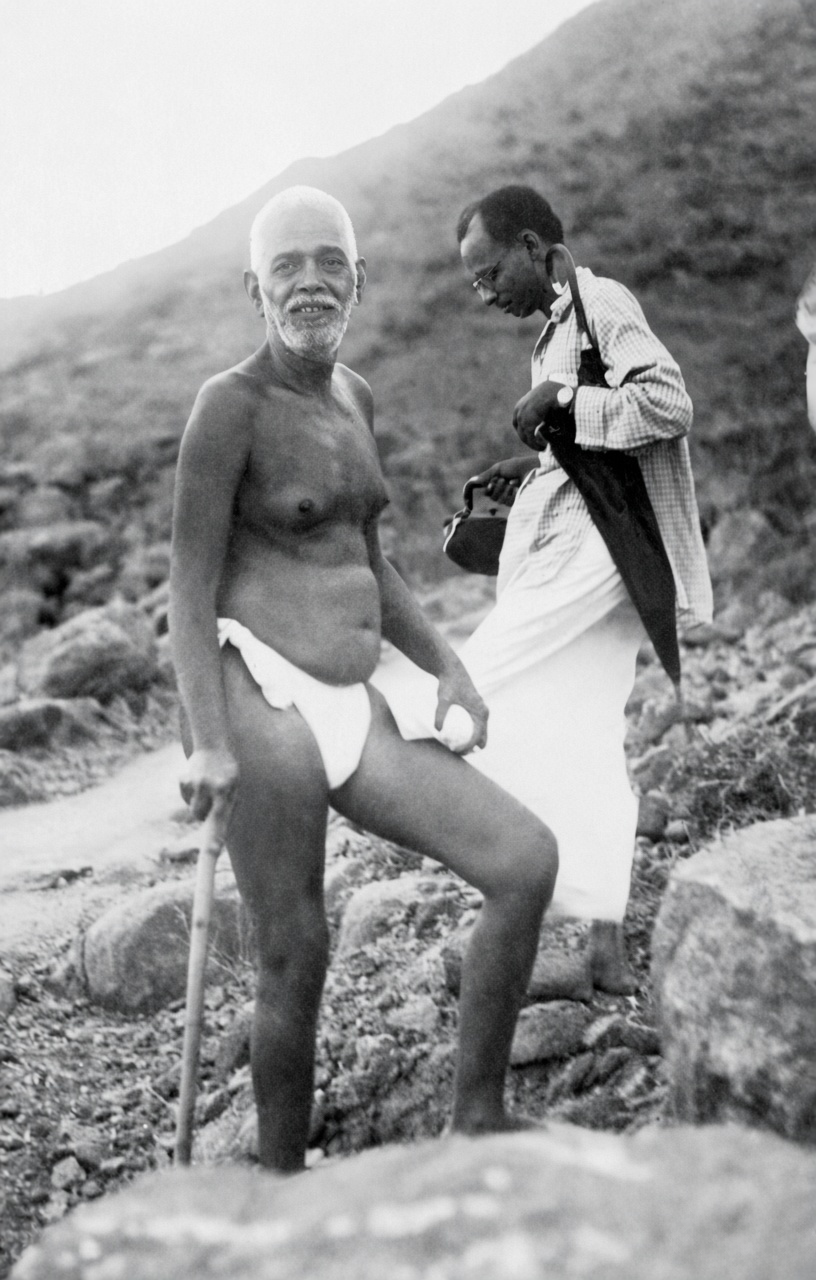
When cruelty and injustice abound on the world scene, and we, as jīvas, suffer great distress, we need to remind ourselves of Bhagavan Sri Ramana Maharshi’s response. To whom is the pain? He who embodied the Ocean of Compassion, whose ego was annihilated, read the daily news and was unaffected by it. The Creator knows best how to care for his creation, he would say. Put down the suitcase on your head and trust in the Lord alone. If you are impelled to action, your duty is to act without concern for the result. The best course is to turn within and reform ourselves.
So, what does Bhagavan mean by reforming ourselves? See the unreality of the ego. Change our perspective from the ego’s eye to the infinite ‘I’, the eye of jñāna. The battle we see in front of us is the battle within. Consider verse 396 in Guru Vācaka Kōvai, which applies to the situation now as it did in the hoary past when the Bhagavad Gītā was composed. “The mind [oneself] is turned outward due to the force of habit developed in many past births. The act of turning that mind inward through ātma vicāra, which is the untiring endeavour to investigate, ‘Who am I?’, is indeed the war between the devas and asuras, which goes on within oneself.”[27]
Personally, I have found great consolation from Bhagavan’s Sri Arunāchala Pañcharatnam (Five Gems to Sri Arunachala), the last of his Five Verses to Arunachala. Isn’t the Red Hill the medicine for all of our ills? This article will treat the first two verses, to be followed by a second article on the last three verses.
First let’s look at the origins. Here is T. K. Sundaresa Iyer’s account. “The ‘Arunāchala Pañcharatna’ last of the hymnal series, was first composed by Sri Bhagavan in Sanskrit, and subsequently translated by Himself into Tamil verses. The first stanza, commencing ‘karunaa purna sudaabdhe’, alone was casually written by Sri Bhagavan. Long afterwards, someone showed it to Sri Kavyakanta Ganapati Muni, who requested Him to write four more verses in the same ārya metre, the first being benedictory, the second on the Divine, and the next three being on Jnana, Yoga and Bhakti.”[28]
An unknown author from Sri Ramanasramam writes: “The great Sanskrit poet and devotee Ganapati Sastri, who was a follower of Bhagavan, begged him to write a poem in Sanskrit. Bhagavan replied, laughing, that he scarcely knew any Sanskrit and no Sanskrit metres. Sastri, however, explained a metre to him and repeated his request. When he returned the same evening this hymn had been written in perfect, flawless Sanskrit.”[29]
Krishna Bikshu sums it up this way: “Pranavananda, who was present then (in July and August 1917), requested Sri Ganapati Muni to compose a song on the Guru, so the latter immediately wrote the Guru Gita. Then some of the disciples called for a benedictory verse. Long before this, just to while away his time, Sri Bhagavan had composed one single verse in ārya metre beginning ‘Karunā purna sudhābdhe!’ That incident came to light on the occasion, so immediately Ganapati Muni requested Bhagavan to compose four more verses which, along with the first, could form the benedictory verses to the Guru Gita. Ganapati Muni also mentioned that in the rest of the verses the subject matter should be (1) a definition of the Self (ātma-lakshana), (2) Self-enquiry (vichāra), (3) yoga, and (4) karma and bhakti. Thus the Arunāchala Pañcharatnam took shape. The concluding verse beginning ‘Srimad Ramana Maharsher’ was written by Gajānana (alias Daivarata) immediately.”[30]
To that, Devaraja Mudaliar adds a little more information. “G.V.S. slightly altered his translation of the Pañcharatna and showed it to Bhagavan. In the talk that followed, Bhagavan, said, ‘This is how the Pañchratna was composed: I had somehow composed the first stanza in a slightly different form when Ganapati Sastri saw it and altered it a little and said it had become Arya Geetha and asked me to write four more similar stanzas saying that he would use them as mangalam for his works. That was in 1917. Later, in 1922, Aiyasami Pillai was getting up an edition of the first four songs of the present Arunāchala Stuti Pañchakam and I was asked to translate the Pañcharatna also into Tamil to go along with them, and I did.’”[31]
Finally, Kanakammal gives her own version. “Once while conversing with Nayana, Bhagavan spoke of the veṇbā metre in Tamil prosody, asking him to adopt it either in Sanskrit or in Telugu. Nayana tried but without success. To him veṇbā metre was more demanding in its observance of the rules of prosody than the most difficult ārya metre of Sanskrit. Subsequently, he attempted it in Telugu versification, only to give up in despair.”
“Now it was Nayana’s turn to request Bhagavan to adopt it in Sanskrit composition. Bhagavan declined, saying he had little knowledge of Sanskrit and even less of Sanskrit prosody. Notwithstanding Bhagavan’s reluctance, Nayana explained the technique of ārya metre, requesting him to compose in it. Bhagavan composed the famous sloka starting with the words: ‘karunā pūrna sudhābdhē’.”
“Later, in 1917, when Nayana was contemplating on the invocatory verses to Ramana Gita, which he had just then completed, he remembered this sloka of Bhagavan. Approaching Bhagavan immediately, he prayed to him to grace him with five benedictory verses to Ramana Gīta. He wanted four verses from Bhagavan, one each on the nature of Reality, Enquiry, Yoga, and Bhakti, while he would retain the earlier one of Bhagavan—‘karunā pūrna’—as the first of the five. Thus, Aruṇāchala Pañcharatnam was born in response to Ganapati Muni’s prayer. The concluding verse ‘Ramana Maharishier...’ was composed by Daivarata (Gajānan). Later, Bhagavan rendered Pañcharatnam in Tamil, including the verse by Daivarata.”[32]
Now on to the first verse. It’s a universal prayer, heart-felt and full of compassion for all living beings who suffer on the planet.
Verse 1:
karunāpūrna sudhābdhē
kabalitaghanaviśvarūpa kiranāvalyā
arunāchala paramātmanarunō bhava chittakañjasuvikāsāya
O ocean of ambrosia, the overflowing fullness of grace!
O Arunachala, supreme spirit, by [whose] series of rays
the solid form of the universe is swallowed!
Be the sun for the complete blossoming of [my] mind-lotus.
arulnirai vāna vamudak kadalē
virikadirāl yāvum vizhungum – aruna
giriparamān māvē kilarulappu nandrāy
viripariti yāha vilungu
O ocean of ambrosia, which is the fullness of grace!
O supreme spirit Arunagiri, who
swallows everything by spreading rays!
Shine as the sun which will open completely
[my] mind-flower, which is swelling.
[There are several differences between the Sanskrit and Tamil versions. ‘Series of rays’ in the Sanskrit becomes ‘spreading rays’. ‘The solid form of the universe’ becomes ‘everything’. Although the meaning is basically the same, ‘solid form’ significantly points to delusion because objects perceived by the senses are merely fabrications of the mind. ‘Be’ becomes ‘shine’ and is a leitmotif in all of Bhagavan’s five hymns to Arunachala, like ‘arul’ or grace. ‘Shines’ implies light, the light of jñāna and pure self-awareness. ‘Which is swelling’ in the Tamil version is a wonderful addition! Bhagavan is teaching all of us how to pray but specifically aspirants who have embarked on the path already, gone beyond love for self as ego to love for self as ātman but not yet attained perfect abidance where thoughts no longer even emerge from their source, the ātman.]
‘O ocean of ambrosia, which is the fullness of grace’ has great power because its import is beyond the mind and beyond the imagination. It can only be experienced, and when it is experienced, no words can describe it! ‘Swallow’ also has great power for those who investigate the mind through the mind and reach the heart. When that is attained, grace immediately destroys all bonds. It alone can break the knot that ties consciousness to the insentient, which is the root of all suffering. Summā iru (Be still). There is only everlasting Peace. What more powerful analogy can there be than comparing the sun that makes the flower bloom to the ātman that makes the jīva whole?
Once when Bhagavan was asked to give the meaning of this verse, he replied: “The sun illumines the universe, whereas the Sun of Arunachala is so dazzling that the universe is obscured and an unbroken brilliance remains. But it is not realised in the present state and can be realised only if the lotus of the heart blossoms. The ordinary lotus blossoms in the light of the visible sun, whereas the subtle Heart blossoms only before the Sun of Suns. May Arunachala make my heart blossom so that His unbroken brilliance may shine all alone!”[33]
In Arunāchala Padikam he also prays with heart-felt devotion: “If you, who by [your] grace took charge of me, are not gracious, giving to me sight of you, what will be my state if I leave this body [after] pining and suffering intensely in [this] dark and miserable world? Without seeing the sun will a lotus blossom? [Likewise] being the sun to the sun, O love called the great hill Aruna, where grace surges as a spring, gushing forth abundantly [will my heart blossom without seeing you?]”[34]
Verse 2:
tvayyarunāchala sarvam
bhūtvā sthitvā pralīnamētacchitram
hridyahamityātmatayā
nrityasi bhōstē vadanti hridayam nāma
O Arunachala! In you all this picture comes into existence, is sustained, and is destroyed.
You dance in the heart as self (or spirit) as ‘I’, [and hence] they say ‘heart’ is name to you.
chittiramā mihdellām semmalaiyē ninbālē
yuttidamāy nindrē yodungidumāl – nittiyamum
nānen dridaya nadittiduvai yālunpēr
tānidaya mendriduvar tām
O Red Hill! All this, which is a picture, rises, stands and subsides only in you.
Since you dance eternally [in] the heart as ‘I’, they say that your name itself is ‘heart’.
[The only difference between the two versions is the addition of ‘eternal’ in the Tamil. Even in the midst of chaos, your nature is peace. It never changes.]
Although Arunachala is the ultimate substance within which the entire world is contained, it is not touched by the rise and fall of all phenomena, which are merely an appearance having no existence of their own. It shines, dancing in the heart as the one and only reality, veiled until revealed by the grace of self-investigation.
Some of the verses in Guru Vācaka Kōvai shed light on the second verse of Pañcharatnam. In verse 1053, the unchanging and eternal ātman is glorified. “Whatever appears to our perception [whatever it is] let it appear; and whatever then disappears [whatever it is] let it disappear. Does the ātma svarūpa, true knowledge (jñāna) incur any loss through that, or any gain? [None at all]. Even as all these things manifest in the one reality, Śivam, which shines as the totality of all that is, and then disappear again, that alone which remains over and endures is our own self, ātma svarūpa.”
Verse 1018 makes it clear that regarding phenomena as real is the path of death. “One’s own being, the space of consciousness, is the underlying reality within which all the very many worlds evolve and appear, filled with moving and unmoving phenomena [like the underlying screen in a cinema show]. For those who are deluded, seeing it as unreal, and taking the world appearance that is perceived through the five senses to be real, it will be impossible to gain the supreme reward of true knowledge.”
Verse 1054 evokes Nataraja’s dance. “When the deceitful ego subsides and is destroyed through the investigation, ‘Who is this I?’, that which suddenly flashes forth, that which the Upaniṣads praise and loudly proclaim as [the darśana of Naṭarāja], the glorious, divine dance, performed in grace by Lord Śiva — that is the very form of the ātman, the supreme awareness that is the clear apprehension of the clarity of the grace of God.”
Bhagavan’s interpretation of the verse says it all: “The universe is like a painting on a screen — the screen being the Red Hill, Arunachala. That which rises and sinks is made up of what it rises from. The finality of the universe is the God Arunachala. Meditating on Him or on the seer, the Self, there is a mental vibration ‘I’ to which all are reduced. Tracing the source of ‘I’, the primal ‘I-I’ alone remains over, and it is inexpressible. The seat of Realisation is within and the seeker cannot find it as an object outside him. That seat is bliss and is the core of all beings. Hence it is called the Heart. The only useful purpose of the present birth is to turn within and realise it. There is nothing else to do.”[35]
Finally, let Draupadi’s shining example inspire us. When surrender is complete, the ego subsides and the Lord comes to our rescue. “The chaste wife, Draupadi, who was holding on tightly to her sari, in the end let go of it and [joining both her palms above her head], worshipped the Lord, crying out for his protection with the words śaraṇa gati. Accordingly, through the divine grace of Lord Krishna, her sari kept on growing longer, until the evil Duchasana, who was stripping her of the sari, fell down in a faint. This was how she safeguarded her honour in this world, is it not?”[36]
Isn’t that how we go from darkness to light, from suffering to bliss, our real nature? Keep reforming yourself, relentlessly, and let the mind’s pain subside.
Om śāntiḥ, śāntiḥ, śāntiḥ
Endnotes
27 Guru Vācaka Kōvai, composed by Sri Muruganar, prose paraphrase by Sri Sadhu Om and translation from the Tamil by Robert Butler, Sri Ramana Center of Houston, 2023, p. 90. ↩
28 T.K. Sundaresa Iyer, At the Feet of Bhagavan, Ch. 28. ↩
29 Five Hymns to Sri Arunāchala, Sri Ramanasramam, 1982, p. 13. ↩
30 Krishna Bikshu, Mountain Path, July 1982, p. 179. ↩
31 A. Devaraja Mudaliar, Day by Day, 19-6-46. ↩
32 Smt. T. R. Kanakammal, Commentary on Aruṇāchala Stuti Pañchakam and Upadēsa Nūn Mālai, Sri Ramanasramam, Tiruvannamalai, 2009. ↩
33 See for a remarkably insightful interpretation of Pañcharatnam by Sadhu Om and Michael James. ↩
34 Translation by Michael James. ↩
35 Talks with Sri Ramana Maharshi, Talk 219. ↩
36 Verse 468 in Guru Vācaka Kōvai. ↩
Bhagavan: A Personal Rediscovery
Siddhartha
Editor: This article first appeared in the Ashram Bulletin of the Jayanti 1993 issue of The Mountain Path. Written close to half a century after Bhagavan’s Mahanirvana, it offers a vivid and moving testimony to his continued presence and guidance. Such experiences of Bhagavan’s grace are attested by devotees even to this day.
As my stay at Sri Ramanasramam draws to a close, I reflect on the events of the previous two months, a period which began with a sudden experience of Bhagavan Sri Ramana Maharshi’s divine grace and culminated with my arrival at Tiruvannamalai in the summer of 1993.
During the past several years, I had considered myself as belonging to that half of humanity who, though spiritually inclined and sincere in their desire to realise God, have resigned themselves to accepting that the divine bird called ‘Grace’ perches on the halo of those who form the other half of mankind. Thus, although my search continued and the study of spiritual literature was sustained, somewhere along the line there was an underlying feeling that perhaps I was going to discover nothing miraculous at the end of the rainbow.
But this was before that hot May afternoon when I visited my favourite bookshop in search of a commentary on the Ashtavakra Gita, an ancient sacred text. Since the book was not available, I began idly to browse through the shop in the hope of laying my hands on something else of interest. I had no inkling that this casual browse was about to precipitate the greatest event of my life.
Yes, the volume that almost sought me out, as it were, was Talks with Sri Ramana Maharshi, with the kind face of Bhagavan looking benignly at me from the cover.
I began to read. The question-and-answer format quickly turned into a one-to-one relationship between Bhagavan and myself. All the questions asked by various devotees were my questions. The answers were all Bhagavan’s. I found myself akin to a small boy holding Bhagavan’s hand, walking through a dark and dense jungle, pattering away with question after question to Bhagavan, whereas Bhagavan himself appeared to me as a powerful beacon of light cutting through the darkness, dispelling all my doubts and all my ignorance. Every time my unsteady feet faltered, Bhagavan held my hand ever so strongly, reassuring me that he would never let me fall, never let go.
And then it happened. Something began to well up inside me, like the surge of the mighty ocean. Slowly but steadily, it swelled into a powerful tidal wave, roaring and thunderous. It swept through all of my being, all my inhibitions, everything that I held myself to be. I began to cry openly, as I had never cried before, as if I had never known anything else in the world except to cry. Tears flowed uncontrollably. My nose ran. I must have presented a spectacle to onlookers, but I was beyond caring because in these tears I had received the greatest joy of my life. I was being washed clean of something—what, I did not know. I felt so pure, so light, so unburdened, as if a great load had been taken off my head and heart.
I composed myself, bought the Talks, and brought it home. I was overwhelmed all over again, by the same powerful, purifying feeling. As soon as I set eyes on Bhagavan’s picture, my whole body was bathed, my whole being awash with love and kindness so powerful that, unable to bear it, I would simply sob uncontrollably.
Then, as I proceeded to read on, ever so slowly, it began to dawn upon me. It could not be true; it was unbelievable, but it was so. Bhagavan was showering his grace on me. He was transforming my whole being. He was cleansing me. He was purifying me. He was washing away layer upon layer of the dirt of ignorance, making me see myself as the pure being that I was. That was it!
As I studied the Talks, Bhagavan’s teachings became more and more clear to me. I proceeded to bring home more works on or by him. These included The Collected Works of Sri Ramana Maharshi, Letters from Sri Ramanasramam, Guru Ramana, and Day by Day with Bhagavan.
While on the one hand I imbibed the meaning of these teachings, on the other his grace filled me with devotion and the urge to surrender at his feet, dropping long-held beliefs, opinions and ideas, as well as innumerable doubts and uncertainties. As the days passed, certain changes in my personality became apparent, not only to me but also to the people around me. I had begun to spend more and more time by myself, preferring solitude to company. I became quieter, both in speech and thought. I became less demanding and simpler in my needs. I gave more and expected less.
The reading of various reminiscences had drawn a vivid picture of life in the Ashram during Bhagavan’s days. I began to experience the Ashram growing around me. I was as much a part of the Ashram as Suri Nagamma, Chadwick or Mudaliar. I was there when Cow Lakshmi lived and died, when squirrels and monkeys played truant with Bhagavan. I was watching him with bemused and adoring eyes. With so much of my life immersed in the Ashram, the next step was inevitable — to undertake a visit to Sri Ramanasramam, more than forty years after Bhagavan attained Mahasamadhi.
I arrived at this oasis of peace and tranquillity in July 1993. Before I landed here, I hadn’t the vaguest idea of what I was going to find. All I had in my head was the Ashram of almost half a century ago. Most of the inhabitants of yesteryear — man and animal alike — were long gone, not to speak of Bhagavan’s own powerful and blissful presence. Although I alone was responsible for setting up a blind date with the Ashram, was I in for a surprise!
Well, having spent two weeks here, I can say that the blind date has turned out to be a bonanza. The dice was loaded in my favour in every way. The Ashram of today is every bit as spiritually energised as it was during the days of yore, plus so much more comfortable and full of conveniences. The all-powerful Grace of Bhagavan permeates every leaf, every bird, every human. Lord Arunachala oversees and blesses his devotees with his mighty presence. What more can a spiritual seeker ask for?
A walk around the Ashram on my very first day was a trip down memory lane. The hall where Bhagavan lived and slept and gave audience to innumerable devotees still has his magnificent presence. The dining hall, where he shared his meals with everyone, continues to retain its old-world charm, with vintage photographs adorning the walls, which take you back in time, making you envious of those who shared the same time-span with Bhagavan. Then the small room where Bhagavan gave his last darshan to inconsolable devotees, still kept in the same way as when Bhagavan attained Mahanirvana. Eyes moisten.
The magnificent Mother’s Temple and Bhagavan’s shrine, side by side, almost signifying their close relationship when they lived, and after they attained Mahasamadhi. Both shrines come alive, morning and evening, with the chanting of mantras during puja and Vedaparayana. When I observe men and women of different nationalities and faiths from all parts of the globe present in the hall, all bathed in Bhagavan’s silent grace, I cannot help recalling his reply to a devotee’s question regarding the Guru’s influence on devotees after he leaves the body. Bhagavan said: “Guru is not the physical form. So the contact will remain even after the physical form of the Guru vanishes.”
How true! All of us here, to a man, feel his presence here and now.
It rained last night, a heavy downpour, and this morning everything seems awash with Nature’s own nectar. The trees seem greener, the flowers brighter, the peacocks even more colourful. The birds sing their music as God taught them, each so different from another in tone and melody, and yet there seems such a harmony among them that it sounds to the ear as Nature’s perfect symphony.
I feel so much at peace, so much a part of the world around me, as if I and the world are not different from one another. The same God prevails everywhere, and only if we remained sensitive and aware at all times, it would seem to us that way always.
And thus I pack my bags and take leave from this oasis of peace and tranquillity — happier, lighter, and liberated, in my own way.
As I board the bus for my return journey, I ask myself, “Will I be back again?” My whole being replies in chorus:
“Yes, I will!”
Essence of Śrī Ramaṇa
Paravidyopaniṣad — Part 11 – “I-AM” is the Whole Truth
Annotated by V. Krithivasan
Mr. V. Krithivasan is a highly accomplished author of many articles and was the editor of Ramana Jyothi, the magazine of the Ramana Kendram in Hyderabad. He has been associated with the Kendram in various capacities for over forty years.
Brahman is the Substratum
आधारसद्वस्तु विना कथं नु विश्वं मनश्चेत्युभयं च भायात्।
रज्जुं विना कोन्विह वीक्षतेऽहिं शुक्तिं विना पश्यति को नु रौप्यम्।। 170
ādhārasadvastu vinā kathaṃ nu viśvaṃ manaścetyubhayaṃ ca
bhāyāt|
rajjuṃ vinā konviha vīkṣate’hiṃ śuktiṃ vinā paśyati ko nu
raupyam||
Without a supporting substratum, how can the two — the universe and the mind — appear at all? Is there anyone who sees the serpent without its basis, the rope, or one who sees silver without its basis, the oyster shell?
The author points out that for unrealities to appear, a real substratum is needed. The metaphors of a rope appearing as a snake in dim light or an oyster shell appearing as silver, are once again repeated in this verse to reinforce the truth that because of avidya (ignorance), the substratum, Brahman, appears as the variegated universe. In other words, the universe cannot be real in and of itself — apart from the underlying Reality.
“M: The purpose of all these illustrations is to direct the seeker’s mind towards the one Reality underlying them all.” [37]
Eliminating the unreal, the Reality survives. When a rope is mistaken for a snake, it is enough to remove the erroneous perception of the snake for the truth to be revealed. Without such an elimination, the truth will not dawn.
These two illustrations are similar: false appearance of a seemingly different entity superimposed on a real object — appearing under specific conditions and producing an illusion. One may wonder why two illustrations were needed when either the snake on a rope or the silver on nacre metaphor might have sufficed. It is interesting to note that each illustration touches upon a different aspect of human reactions: silver on nacre references raga or desire, and snake on the rope references dvesha or aversion — opposing ends of the spectrum of emotional responses are thus reflected in these two illustrations!
अस्मीति बोधं न रुणद्ध्यविद्या बोधोऽहमस्मीति तु बोधमेव।
स्वयं वेत्ति सन्तं खलु सर्व एव विहाय वैज्ञानिकवादमुग्धान्।। 175
asmīti bodhaṃ na ruṇaddhyavidyā bodho’hamasmīti tu
bodhameva|
svayaṃ vetti santaṃ khalu sarva eva vihāya
vaijñānikavādamugdhān||
Ignorance (avidya) does not obstruct the awareness ‘I Am’,
but only awareness of the fact ‘I Am Awareness,’
since everyone, with the exception of those deluded by the scientific creed
— knows of his own existence.
An important clue is given in this verse, namely, that ignorance obscures the knowledge that one is pure awareness. It can never obscure the awareness that ‘I-am.’ This self-recognition is an ever-present truth that pervades all the three states. Even in the deep sleep state, where the mind is absent, awareness of pure being-ness continues, enabling one to proclaim on waking up, ‘I slept well; I did not know anything.’ What then is obscured? It is the fact of one’s real nature being awareness itself. All sādhanā is aimed at realising one’s real nature as pure awareness alone. Not ‘awareness as’ someone or ‘awareness of’ something, but pure awareness, non-dual, without content. Bhagavan says in Upadesa Undiyar:
uNarve naamayuLam undeepaRa
“We are Awareness alone!”[38]
Ignorance in the form of the rising mind obscures this pure awareness when it holds on to something other than itself and ‘awareness as’ or ‘awareness of’ an object is experienced. Even though there may be moments of thought-free awareness in one’s daily life, they pass unnoticed.
“D: If the jiva is by nature identical with the Self, what is it that prevents the jiva from realizing its true nature?
M: It is forgetfulness of the jiva’s true nature; this is known as the power of veiling.”[39]
“D: If it is true that the jiva has forgotten itself, how does the ‘I-experience’ arise for all?
M: The veil does not completely hide the jiva; it only hides the Self-nature of ‘I’ and projects the ‘I am the body’ notion; but it does not hide the Self’s existence which is ‘I’, and which is real and eternal.”[40]
In the above conversation with Gambhiram Seshayya, by Self-nature of ‘I,’ Bhagavan means ‘I am Awareness.’
Brahman Alone Shines as the Self
ब्रह्मैककं सत् सकलस्य जन्तोः स्वयं सदैवाहमहन्तयाऽन्तः।
भात्यात्मरूपेण हि नान्य आत्मेत्येषाऽस्ति वाणी भगवत्तमस्य।। 178
brahmaikakaṃ sat sakalasya jantoḥ svayaṃ
sadaivāhamahantayā’ntaḥ|
bhātyātmarūpeṇa hi nānya ātmetyeṣā’sti vāṇī bhagavattamasya||
Here is the utterance of Bhagavan Ramana:
Brahman, which is only One, Itself shines in the Heart of all creatures as the Real Self in the form, ‘I’, ‘I’; there is no other Self.
Dr. Lakshmana Sarma refers to Bhagavan’s famous ekāślokī (hṛdaya-kuhara-madhye) wherein Bhagavan says: “In the interior of the Heart-cavern, Brahman alone shines directly as the Self, pulsating continuously as ‘I-I’. Enter into the Heart by inquiring into the Self, or by diving deep within, or by restraining the breath, and remain firmly established in the Self.” Bhagavan clearly states that the ultimate reality is not to be found in some distant heaven but is present right here and now as one’s own Self.
“M: Objects perceived by the senses are spoken of as immediate knowledge (pratyaksha). Can anything be as direct as the Self — always experienced without the aid of the senses? Sense-perceptions can only be indirect knowledge, and not direct knowledge. Only one’s own awareness is direct knowledge, as is the common experience of one and all. No aids are needed to know one’s own Self, i.e., to be aware.”[41]
“M: Give up the notion that ‘I am so and so.’ Our sastras say: ahamiti sphurati (it shines as ‘I’).
D: What is sphurana (shining)?
M: (aham, aham) ‘I-I’ is the Self; (aham idam) ‘I am this’ or ‘I and that’ is the ego. Shining is there, always. The ego is transitory; when the ‘I’ is kept up as ‘I’ alone it is the Self; when it flies at a tangent and says ‘this,’ it is the ego.
D: Is God apart from the Self?
M: The Self is God. ‘I AM’ is God. ‘I am the Self, O Gudakesa!’”[42]
चैतन्यमस्मीति मदीयरूपमिति श्रुता मोससनामकेन।
या देववाणी प्रथिताऽस्ति तस्या भावोऽयमेवेत्यपि सोऽयमूचे।। 179
caitanyamasmīti madīyarūpamiti śrutā mosasanāmakena|
yā devavāṇī prathitā’sti tasyā bhāvo’yamevetyapi so’yamūce||
He also said: This same is the meaning of the utterance of the famous Heavenly Voice
which told Moses, ‘My real nature is just the Consciousness ‘I AM.’
Bhagavan referred to the Biblical statement ‘I AM THAT I AM’ very often in his Talks and used to appreciate the concise definition of God given in that statement.
“The one Infinite Unbroken Whole (plenum) becomes aware of itself as ‘I’. This is its original name. All other names, e.g., OM, are later growths. Liberation is only to remain aware of the Self. The mahavakya ‘I am Brahman’ is its authority. Though the ‘I’ is always experienced, yet one’s attention has to be drawn to it. Only then does knowledge dawn. Thus, the need for the instruction of the Upanishads and of wise sages.”[43]
“The only permanent thing is Reality; and that is the Self. You say, ‘I am’, ‘I am going’, ‘I am speaking’, ‘I am working’, etc. Hyphenate ‘I am’ in all of them. Thus I-AM. That is the abiding and fundamental Reality. This truth was taught by God to Moses: ‘I AM that I-AM’. ‘Be still and know that I-AM God’. So ‘I-AM’ is God. You know that you are. You cannot deny your existence at any moment of time. For you must be there in order to deny it. This (pure existence) is experienced by the still mind. When the mind’s outgoing disposition is turned within, in course of time, it becomes still and ‘I-AM’ alone prevails. ‘I-AM’ is the whole Truth.”[44]
“D: How shall I realise God?
M: God is an unknown entity. Moreover, He is external. Whereas the Self is always with you and it is you. Why do you leave out what is intimate and go in for what is external?
D: What is this Self again?
M: The Self is known to everyone but not clearly. You always exist. The Be-ing is the Self. ‘I am’ is the name of God. Of all the definitions of God, none is indeed so well put as the Biblical statement ‘I AM THAT I AM’ in EXODUS (Chap. 3).[45] There are other statements, such as Brahmaivaham, Aham Brahmasmi and Soham. But none is so direct as the name JEHOVAH = I AM. The Absolute Being is what is — the Self. It is God. Knowing the Self, God is known. In fact, God is none other than the Self.”[46]
सर्पभ्रमः शाम्यति रज्जुबोधान्नैवं जगत् भ्रान्तिरपैति साधोः।
श्रुत्याऽपि युक्त्या विदितेऽपि तत्त्वे पूर्वं यथा दृश्यत एव विश्वम्।। 187
sarpabhramaḥ śāmyati rajjubodhānnaivaṃ jagat bhrāntirapaiti
sādhoḥ|
śrutyā’pi yuktyā vidite’pi tattve pūrvaṃ yathā dṛśyata eva
viśvam||
The illusory notion of the serpent ceases when the rope is
known (to be the truth).
Not so does the world-illusion cease for the aspirant.
Even after the truth (unreality of the world) is known by the
help of Revelation
and by arguments, the world continues to appear (as real).
In Advaita Vedanta, creation is explained as follows: Brahman, the fundamental substratum, appears as the world without undergoing any transformation in its essential nature. Many metaphors or illustrations are used as explanation. One such is the illusory appearance of a snake in a rope. On the substratum of the rope, a snake is falsely seen under dim light; the rope does not undergo any change but becomes the basis for the false perception of the snake. In this illustration, the rope is equated with Brahman and the snake with the world. When the reality of the rope is seen in clear light, the illusion of the snake vanishes once and for all. The same person encountering the rope again is not fooled into thinking that it is snake. But it is not so with our experience of the world. We continue to see the world as world and not as the non-dual Brahman. Even after the statements in the Upanishads are well understood and the unreality of the world is recognised, our actual experience and corresponding behaviour still indicate that ‘the world is indeed real.’ Why is it so? This is explained through yet another illustration in the next verse.
भूयोऽपि वीक्षा मृगतृष्णिकाया अस्त्येव तत्त्वे विदितेऽपि तस्याः।
एवं निरस्तेऽपि च संशयेऽस्मिन् उदेति भूयोऽपि च संशयोऽत्र।। 189
bhūyo’pi vīkṣā mṛgatṛṣṇikāyā astyeva tattve vidite’pi tasyāḥ|
evaṃ niraste’pi ca saṃśaye’smin udeti bhūyo’pi ca saṃśayo’tra||
Even after the truth of it (the unreality of the mirage-water)
becomes known,
there persists vision of water in the mirage.But even when this doubt is cleared, another doubt arises
(in its place).
A mirage is an optical illusion (which typically occurs in a desert) wherein light rays bend through layers of air with different temperatures. This bending creates an image of the sky on the ground at a distance, often appearing to be a pool of water. When the desert traveller excitedly approaches the spot where it is seen, he does not find any water; he realises it was just an optical illusion. Once this knowledge dawns on him, he is no longer deceived, but nevertheless, the optical illusion continues to be seen. This illustration is used to explain the fact that the world-vision will continue even after it is understood to be an unreal appearance.
Analogies are used by the scriptures and the Sages as a means of helping us to understand the teachings which seem contrary to our experiences in the mind-identified state. The unreality of the world is explained by means of three analogies: the rope mistaken for a serpent, the desert on which a mirage appears, and dreams. All the three analogies are necessary and should be taken together; for the truth cannot be explained adequately by means of any single analogy.
“When a rope is first mistaken for a serpent, and then recognised to be a rope, the serpent ceases to appear. That does not seem to be the case with the world. Even when it is known that the world is only an appearance of the real Self, the world continues to appear. This is the objection raised by one that has heard the teaching and been more or less convinced. The correct explanation is that mere theoretical knowledge does not dissolve the world-appearance, but only the actual Experience of the Self. It must be remembered that analogies are not proof, and no Sage thinks that he is proving anything by means of analogies. The Sage seeks to convince us that a false appearance may continue to be seen even after it is known that the thing is false. This is illustrated by the analogy of the wasteland on which a mirage is seen. The mirage is a false appearance, just like the snake. But it continues to be seen even after it is known that there is no water in the place. We thus see that the mere fact of an appearance persisting is no proof that it is real. But then a further doubt arises. The disciple says, “the case of the mirage is distinguishable; the water of the mirage is conceded to be unreal, because even though it does not cease to appear after the truth of it becomes known, its unreality is proved by the water not being available for quenching thirst; the world is not so, because it continues to serve innumerable purposes.” The Sage dispels this doubt by appealing to the experience of dreams. The things that are seen in dreams are useful; food eaten in a dream satisfies dream-hunger. In this respect the state of waking is in no way superior to the dream-state; the use of dream-objects seems as valid within the dream as the use of waking-objects within the waking state. A man that has just eaten a full meal goes to sleep and dreams that he is hungry, just as a dreamer, having eaten a full dream-meal, wakes hungry. Both are proved false in sleep. This much we have seen from the dream-analogy: that a thing may seem to satisfy a need, and yet is an illusion. The fact is, the need and its satisfaction are both equally unreal.”[47]
निद्रेयमज्ञानमयी न यावद् व्यपैति साधोरपरोक्षबोधात्।
स्वप्नोऽनुवर्तेत हि जागराख्यो यस्मिञ्जगत् सत्यवदेव भाति।। 192
nidreyamajñānamayī na yāvad vyapaiti sādhoraparokṣabodhāt|
svapno’nuvarteta hi jāgarākhyo yasmiñjagat satyavadeva bhāti||
So long as this deep sleep of ignorance does not cease
by Direct Experience of the Truth of the Self,
this dream called waking, wherein the world appears as real,
will continue.
Direct experience, as against theoretical knowledge, is emphasised here. What is direct experience or aparoksha anubhuti? We assume that there is no consciousness apart from the thoughts of the mind. Hence, we tend to think that sense-perception alone is direct knowledge or experience. But sense-objects are not self-manifest. Hence sense-perception is not direct knowledge. The Self is self-manifest, and hence knowledge of the Self is direct. When the veil of ignorance (the sleep called self-forgetfulness) lifts, the Self is revealed and the world-vision dissolves into the Self.
“We are told by the Sages that we shall cease to identify ourselves with the three bodies — and thus be free once for all from the sufferings that come through them — only when we attain direct experience of the real Self. Just as we now have direct experience of the body as the Self, so we must have direct experience of that Self as he really is. The Brihadaranyaka Upanishad (4.4.12) says: “If one becomes conscious of the Self by the experience ‘I am He,’ then for whose sake, and for desire of what thing, shall he be fevered through the body?” This ignorance is an ingrained habit of thought, which has been bred and reinforced in the mind through a long course of wrong acting and thinking. Out of it have arisen numerous attachments to things. These thought habits form the very structure of the mind; and the mere introduction of a contrary thought will make very little difference. The mind will still flow along the same habit-channels; it will still be subject to the same attractions and repulsions. And this will be so because, while it may be possible for the book-learned philosopher to be able to feel at times that he is not the body, he cannot with equal felicity come to feel that he is not the mind. And this double ignorance will cease only when the Self is known not theoretically, but practically, that is, by actual experience of the Self.”[48]
Reality is Undivided Consciousness
भेदं च जीवेश्वरयोस्तथान्यान् प्रत्येति भेदान् मन एव सर्वान् ।
भेदप्रतीतिर्मनसो हि धर्मो भावेऽमनस्के न हि सन्ति भेदाः।। 196
bhedaṃ ca jīveśvarayostathānyān pratyeti bhedān mana eva sarvān |
bhedapratītirmanaso hi dharmo bhāve’manaske na hi santi bhedāḥ||
It is the mind that knows the difference between
the individual soul and God and all other differences.
It is the nature of the mind to perceive differences.
In the mind-free state, there are no differences.
The one, undivided Consciousness, when reflected in the mind or buddhi, splits into subject and objects, the I-thought and the this-thought. Identifying itself with the body, the limited Ithought further projects a whole world of objects and becomes the instrument for perceiving differences between the projected objects, and between objects and itself. When the mind is absent, as in sleep, all differences disappear and there is only the substratum of consciousness.
This is what the Sage tells us: “The Reality is neither broken into parts, nor does It suffer limitation. It only seems to be so. The mind it is that causes the appearance of parts, by falsely identifying It with bodies or sheaths and thus limiting It. The mind imagines the Reality as finite, thinking itself to be finite. These limitations and divisions are in the mind alone. But the mind has no existence apart from the Self. A jewel made of gold is not quite the same as gold, because it is gold with a name and a form super-added. But it is not other than gold. Mind is just a mysterious power of the Self, by which the One Self appears as many. Only when the mind rises, do the three — God, the soul and the world — appear. In sleep the three are not seen nor thought of.”[49]
“Impersonality is Consciousness undiminished. It is Existence in its entirety — Existence as pure Consciousness. This Existence is made into the three by the mind. The Sage explained it as follows: “Existence plus variety is the world. Existence plus individuality is the soul. Existence plus the idea of the all is God. In all the three, Existence is the sole element of reality. Variety, individuality and all-ness are unreal. They are created and imposed on Existence by the mind. Existence transcends all concepts, including that of God. Inasmuch as the name ‘God’ is used, the concept of God cannot be true. The truth about God is most faithfully expressed as ‘I AM’. The Hebrew name of God, ‘Jehovah,’ — which means ‘I AM’ — expresses the truth of God perfectly.”[50]
Endnotes
37 Venkataramiah, M., Talks with Sri Ramana Maharshi, Talk No. 399. ↩
38 Upadesa Undiyar, Verse 23. ↩
39 Seshayya G., Self-Enquiry, Q. 38. ↩
40 Seshayya G., Self-Enquiry, Q. 39. ↩
41 Venkataramiah, M., Talks with Sri Ramana Maharshi, Talk No. 92. ↩
42 Venkataramiah, M., Talks with Sri Ramana Maharshi, Talk No. 363. ↩
43 Venkataramiah, M., Talks with Sri Ramana Maharshi, Talk No. 92. ↩
44 Venkataramiah, M., Talks with Sri Ramana Maharshi, Talk No. 503. ↩
45 Moses’ encounter with God occurred at Mount Horeb, where God commissioned him to lead the Israelites out of Egyptian bondage. While tending sheep, Moses noticed a burning bush on fire but staying unconsumed by the fire. When he approaches it, he hears a heavenly voice calling his name. The voice says, “This is holy ground and I am the God of Abraham, Isaac, and Jacob.” God then goes on to instruct Moses on what he has to do. Moses asks what he should tell the Israelites if they demand to know the name of the God who sent him. In response, God delivers a profound declaration of His absolute identity. God tells Moses, “I AM THAT I AM.” This is the Biblical story in Exodus, Chapter 3. ↩
46 Venkataramiah, M., Talks with Sri Ramana Maharshi, Talk No. 106. ↩
47 Sarma L., Maha Yoga, page 57. ↩
48 Sarma L., Maha Yoga, page 31. ↩
49 Sarma L., Maha Yoga, page 116. ↩
50 Sarma L., Maha Yoga, page 118. ↩
Mantra Japa as an Aid to Ātma Vichāra
Sneha Choudhury
Self-enquiry or ātma-vichāra is a tool to realise the Self. Bhagavan advocated “Who Am I?” as the direct path by which one can turn the mind inward and realise the Self. When devotees asked him about japa, or the chanting of holy names, he approved of such incantation as an aid to ātma-vichāra. The sacred chanting of divine names is practised by most devotees, and it is rooted deeply in the bhakti traditions of love and devotion. Bhagavan tells us that the entire point of japa is to keep other thoughts away, except the thought of Om or Ram or Siva or God. All japa is a means to purify the mind.
To a devotee used to reciting the name of his Guru and seeing the Guru’s form while invoking his name, Bhagavan said: “You may continue in your present method. When the japa becomes continuous, all other thoughts cease and one is in one’s real nature, which is japa or dhyāna. We turn our mind outwards to things of the world and are therefore not aware of our real nature being always japa. When, by conscious effort or japa or dhyāna, we prevent our mind from thinking of other things, then what remains is our real nature. So long as you think you are name and form, you can’t escape name and form in japa also. When you realise you are not name and form, then name and form will drop off by themselves.”[51]
In Upadesa Undiyar, Bhagavan says: “This is certain. Worship, incantations and meditation are performed respectively with the body, the voice and the mind and in this they are of ascending order of value.”[52] He goes on to explain the concept of mantra japa: “Better than hymns of praise is repetition of the Name; better low-voiced than loud, but best of all is meditation in the mind.”[53]
When one is chanting a sacred syllable or singing a devotional song, other thoughts get subsumed by the japa. Bhagavan orders japa into four stages. The first is vāzhuttallil vaak kucham — chanting the mantra aloud — Om Namo Bhagavathe Sri Ramanāya, Om Namah Sivāya, Om Namo Nārāyana, and so on. The second stage is the soft uttering of the mantra. One evolves from the first stage to vāi kul japam — saying it within — without any sound. When a mantra is chanted aloud, the sound goes to the external world. In the second stage, chanting silently takes the mind within.
The vibrations of the mantra reverberate in all the cells of the body and mind. The principle behind this is that repetition of the mantra focuses the mind. Any word can be chanted. However, chanting a holy mantra is much more efficacious because the associated form, the associated meaning, and the quality of the Lord get embedded in one’s mind. When we chant Om Namah Sivāya the quality of Lord Siva gets embedded in us. When we chant Om Namo Bhagavathe Sri Ramanāya and think of Bhagavan, all the qualities, the vibrations of Bhagavan are assimilated by us: Bhagavan’s absolute simplicity, absolute devotion, absolute compassion, absolute clarity of mind, absolute focus, and absolute kindness. All these vibrations permeate us. Bhagavan’s teachings, his words, his sentences, arise in the mind and we become absorbed in Bhagavan. This is the beauty of chanting — the mind gains absolute clarity. The associated purity of Bhagavan gets embedded in it: citta-śodhakaṃ mukti-sādhakam;[54] this becomes a means to liberation.
In the third stage, the transformation brought about by the mental repetition makes the mantra our dominant thought and removes every other thought. The reverberation of the mantra reaches from the conscious to the subconscious level — even without the word, the whole mind becomes a meditation itself. Mental repetition of the mantra can be done at any time and no special conditions are required. It can be done anywhere, whether one is walking, sitting, or lying down. For those who cannot enter the meditative state easily, the first two stages, repetition of the mantra aloud and then silently are a powerful aid to preparing one for the third stage, where the mantra itself has a meditative effect.
Bhagavan says: “When the japa becomes mental where is the need for the sounds thereof? Japa, becoming mental, becomes contemplation. Dhyāna, contemplation, and mental japa are the same. When thoughts cease to be promiscuous and one thought persists to the exclusion of all others, it is said to be contemplation. The object of japa or dhyāna is the exclusion of many thoughts and confining oneself to one single thought. Then, that thought too vanishes into its source, absolute consciousness, i.e., the Self. The mind engages in japa, and then sinks into its own source.”[55]
The fourth stage is the ultimate stage: dhyānam uttamam. After chanting becomes purely mental, it advances into contemplation and meditation. The mind gets focused only on a single thought. With continued awareness and contemplation, the one thought also dissolves into its source, pure consciousness. This is the stage of Oneness; it is Sat-Chit-Ananda; it is the most perfect; it is absolute consciousness. Bhagavan advised Kavyakantha Ganapathi Muni to take to this practice when the latter went to meet him in Virupaksha cave: “When a mantra is repeated, if attention be directed to the source whence the mantra-sound emanates, the mind will get absorbed in that. That is tapas.”[56]
There is a verse by poet-saint Nammalwar wherein he says, “When the sheen of the gold ornament goes down, the goldsmith rubs the pure gold dust over it several times, and the gold gets back its original shine. Likewise, O Lord, I went on rubbing my tongue with your holy name. The impurity in my mind has gone, my mind has become totally pure. Then I entered you and you entered me.” This is the whole beauty of chanting the mantra continually and with dedication.
Sri Bhagavan approved of mantra japa as a potent aid to sādhanā, provided the seeker receives initiation from a qualified preceptor authorised to transmit the practice. To illustrate this point, Bhagavan told the following story.
“A King visited his Premier in his residence. There he was told that the Premier was engaged in repetition of sacred syllables (japa). The King waited for him and, on meeting him, asked what the japa was. The Premier said that it was the holiest of all, Gayatri. The King desired to be initiated by the Premier. But the Premier confessed his inability to initiate him. Therefore, the King learned it from someone else, and meeting the Minister later he repeated the Gayatri and wanted to know if it was right. The Minister said that the mantra was correct, but it was not proper for him to say it. When pressed for an explanation, the Minister called to a page close by and ordered him to take hold of the King. The order was not obeyed. The order was repeated, and still not obeyed. The King flew into a rage and ordered the same man to hold the Minister, and it was immediately done. The Minister laughed and said that the incident was the explanation required by the King. ‘How?’ asked the King. The Minister replied, ‘The order was the same and the executor also, but the authority was different. When I ordered, the effect was nil, whereas, when you ordered, there was immediate effect. Similarly with mantras.’”[57]
A devotee asked Bhagavan, “How should I carry on nāma japa?” Bhagavan replied: “One should not use the name of God mechanically and superficially without the feeling of devotion. To use the name of God one must call upon Him with yearning and unreservedly surrender oneself to Him. Only after such surrender is the name of God constantly with the man.”[58]
The Srimad Bhagavatam carries a beautiful story of Ajamila, which illustrates the immense power of chanting the holy name of God, even involuntarily. Ajamila was a pious Brahmin boy, dutiful and sincere, who went astray. He abandoned his wife and family and led a life with a prostitute, through whom he had ten children. He became sinful and neglected all his duties. Amidst all this, he was fond of his son, whom he named Narayana. The turning point in his life came at the time of his death, when the messengers of Yama came to claim him. He cried out “Narayana, Narayana” (his son) with such intensity that a host of Vishnu dutas (attendants) descended to claim him, thus giving him salvation.
Whatever sins have been committed — even across thousands of crores of years — the utterance of the divine name in absolute surrender and helplessness, even in ignorance, destroys them all. It is like the fire which burns up fuel, or the medicine which cures; irrespective of whether the person has knowledge or was ignorant, the simple calling of God’s name with fervour and total surrender is what matters most.
This is the same bhāvana that the 15th-century Saint Arunagirinathar had when he called out to Lord Skanda as he was jumping to end his life from the gopuram of the Arunachaleshwara temple. Lord Skanda, riding on his peacock, came immediately and, lifting him up midair, prevented his fall. The Lord thus rescued him from the mire of samsāra and also made him his devotee.
Bhagavan says: “Oral japa consists of sounds. The sounds arise from thoughts. For one must think before one expresses the thoughts in words. The thoughts form the mind. Therefore, mental japa is better than oral japa.”[59]
Why does Bhagavan give greater importance to soft chanting over loud chanting? There is a direct connection here to pranayama — slow controlled breathing which leads to calmness. When one is agitated the mind is not calm. He breathes heavily and fast. He starts quarrelling. He is upset, and even though someone may be sitting next to him, he will start shouting. The distance between him and his neighbour sitting close to him increases and he shouts to reach him. When the mind is tranquil, one need not shout. One talks in whispers to an intimate friend. When one is in a romantic mood, when one is with a lover, words are not necessary — a simple glance is enough. When a sadhaka is totally devoted to God, the need to talk to God disappears and he feels almost one with the Divine. Then the silence is enough. A sphuraṇa then arises:
hṛdayakuhara madhye kevalaṃ brahmamātram।hyamahamiti sākṣad ātmarupeṇa bhāti।।hṛdi viśa manasāsvaṃ cinvatā majjatā vā।pavana calana rodhād ātmaniṣṭho bhava tvam।।
In the centre of the heart-cave Brahman alone shines in the form of the Self with direct immediacy as ‘I-I’.Enter into the heart with questing mind or by diving deep within, or through control of breath and abide in the Atman.[60]
This stage comes when the mind is turned within, when it goes deeper and deeper into the silent recesses and sound vanishes. Then, one realises that the Sadguru is not different, He is not far. He is deep within one’s heart. He is atra, here and now.
Saint Arunagirinathar addresses the Sadguru thus, “O Sadguru, how can I talk about your grace, which gave me the honey of bliss, the bliss of the heart within, how can I talk about it? I cannot even talk about it; it is beyond words. In the peak of your infinite mountain, the mountain of jnānam — the honey of unending flow of bliss is there, the ultimate jnānam is there. You are the karuṇākara, the unending flow of bliss. I have been all along trying to get the bliss, wanting to go from ānandam to satchitānandam. It has come to me through the light of your own teaching. The light of jnāna, the mount of jnāna is already there. But I had not seen it so far because there was total darkness.”[61]
We are like a traveller, sleeping in the darkness. Because of the total darkness, we fail to see the beauty of the world. The Sadguru, through his immense grace and compassion, throws his light on us and removes the ignorance and darkness that envelops us. By this immense compassion and the grace of the guru, the great jnāna bodhanam, the great mountain of knowledge, is revealed to us.
Armed with the knowledge and beauty, and the immense compassion that the guru has bestowed, we start to climb the mountain of jnāna. As we climb higher and higher up the mountain, whatever is lower becomes smaller and smaller. When we reach a high altitude, all the dirt that was below vanishes from sight and one enjoys the cool air in the area. When one reaches an even higher stage of jnāna, all negative qualities vanish and one enjoys only positive qualities like bhakti, prayer, and devotion. As one ascends even higher, the positive qualities also vanish. The pāpams get washed away, the punyams also disappear, one goes beyond punyam and pāpam. One is beyond thought and word as one reaches the top of the jnāna bodha. This is the beauty of Bhagavan’s teaching.
The darkness that is caused because of our ignorance is a knot: granthi. In advaita it is called chit-jada granthi — chit is the ultimate knowledge, consciousness; jada is ajnānam, ignorance, which ties the chit with the achit. In the darkness, one cannot untie a knot. Light is needed. The Sadguru shines the light on you; the knot is untied and you attain Self-knowledge. Then you reach adiyin idaidattil — the inner core of the Heart. When one gets jnāna, there is infinite love and devotion for God. Bhagavan is the embodiment of both jnāna and love. When one combines devotion and love with japam and dhyānam, then the tēṉ, the honey of Self-knowledge, comes. Prayer is knowing that you are nothing, and that God is everything. Self-surrender is the only complete prayer. Through Self-surrender and jnāna, the honey of Self-realisation is revealed.[62]
Endnotes
51 Mudaliar, D., Day by Day with Bhagavan, 9-3-46 Morning. ↩
52 Upadesa Undiyar, v. 4. ↩
53 Upadesa Undiyar, v. 6. ↩
54 Sri Ramanasramam, Upadesha Saram, v. 3. īśvarārpitaṃ necchayā kṛtam citta-śodhakaṃ mukti-sādhakam. Disinterested action, surrendered to the Lord, purifies the mind and points the way to moksha. ↩
55 Venkataramiah, M., Talks with Sri Ramana Maharshi, Talk 328. ↩
56 Narasimha Swami, B.V., Self-Realisation, Ch. XV. ↩
57 Venkataramiah, M., Talks with Sri Ramana Maharshi, Talk 8. ↩
58 Sri Ramanasramam, Maharshi’s Gospel, Ch. IV. ↩
59 Venkataramiah, M., Talks with Sri Ramana Maharshi, Talk 328. ↩
60 Sri Ramanasramam, Sri Ramana Gita, Ch. 2, v. 2. ↩
61 Saint Arunagirinathar, Skandar Alankaram, v. 8. ↩
62 Osborne, A., The Teachings of Bhagavan Sri Ramana Maharshi in His Own Words, Other Methods. ↩
A Flood of Prayer
Niharika Sanyal
Oh Arunachala,
A flood of prayer
pours out of me.
Please accept this, if you may,
feeble as it is.
Please open again
that door of my Heart
on which you knocked
that first day.
With sweet intensity,
burn me entire.
No longer afraid, I call you down,
like lover to God:
Oh when will you come
and make me yours?
You who are
the face behind every face,
please show me how to Love
as though the world itself
was the face of my Beloved
looking back at me
through the eyes of my own Heart.
For it is you, it is you
that I have sought and seek,
in life after life, in face after face.
I offer to you all of my Heart and more
for your occupying.
For I have no doubt that my path is you —
In you, through you, for you,
Of you, by you, as you.
Difficulty in ‘Realising’ the Self
Hari Haran
Bhagavan Ramana Maharshi speaks of Ātma Vidyā as something effortlessly available, singing, “Ayye, athisulabham, āthma vidhyai, ayye athisulabham.” The translation of this line amounts to the beautiful realisation that knowing the Self is so very easy. Ādi Śaṅkarācārya, in his colossal treatise Vivekacūḍāmaṇi, similarly notes “muktiḥ karaphalāyate,” meaning that liberation comes as readily as a fruit held right in one’s own palm. As ardent devotees on the path of ātma-vicāra and vedānta cintanam, we often possess absolute intellectual clarity and conviction. We know deeply that the physical body, the mind, and the ego, which are rooted in the five senses, are not our true nature. We understand that our real nature is the Self — shining as the ultimate ‘One’ — which is the substratum of all that we perceive.
Yet, despite this clear understanding, we continue to struggle. We painstakingly engage in endless sādhanā, upāsanā, and various other intensive spiritual practices to ‘realise’ the Self. If the ‘I’ is indeed our true nature, and if it is already so intrinsic and intimate to us, why does realising it feel so profoundly difficult? The difficulty, as we know, lies in our constant association with the false ‘I’ — the ego — which is rooted in our wrong identification with the physical body. Even when we possess complete intellectual clarity regarding our true nature, the ego’s roots run so deep that we mistakenly seek the liberation of this ‘I,’ whereas in reality, true freedom is the liberation from this ‘I.’
If we critically examine this ‘I,’ we see that it is merely a relative sense originating in childhood and built up through a lifetime of experiences. Our body acts as the primary agent of these experiences; we perceive, feel, and interact with the world through this instrument. When a constant stream of experiences flows between the outside world (all that is perceived) and the body (the interfacing agent), a false identity is created that asserts, “I am this body.” If we observe closely, we realise that this false identification is only a relative, phantom-sense born out of worldly interactions and is not our real nature. A person’s genetics, upbringing, surroundings, and exposure to life define their personality, or ego-sense. Yet, when the world is not perceived, as in deep, dreamless sleep, this ego-sense completely disappears. Even in dreams, we might identify with a completely different dream-ego, sometimes imagining ourselves as entirely other personalities, or even as animals and birds. Thus, the ego is a relative phenomenon that cannot exist independently; it is inextricably tied to the existence of the body.
Interestingly, we existed in this very birth without this deep body-association. Up until about three years of age, we had no defined body-sense, yet we existed perfectly. The trouble began only when we were introduced to the complex combinations of worldly experiences with the body-agent firmly occupying the centre. The true ‘I’ within us, which existed long before this so-called ego came into being, is something we completely lost sight of. We began identifying with the body as ‘I’ and consequently became the ‘enjoyer’ when pleasant experiences came, and the ‘sufferer’ during painful ones.
What happens to our ātma-vicāra when viewed through the lens of this ego-sense? Let us untangle the layers of daily experience to understand this better, using the simple act of reading a book. For an experience as simple as reading, there are four distinct phenomenological layers. The first layer consists of the physical surroundings, such as the room or environment, and the book itself. The second layer involves the hands holding the book and the eyes reading the words. The third layer comprises the mind and intellect processing and understanding the content. Finally, behind all of this sits the fourth layer, which is the notional ‘I’ that claims, “I understand what is written in this book.” Within every one of these layers, deep imprints of the ego are present, expressing themselves as “my book,” “my hands,” “my mind,” and “I understand.” We can extend this tiered approach to any worldly experience, finding the deep-rooted ego embedded at every single level. There is almost nothing in our everyday awareness that falls outside of this structure. Even physical pain, though lacking the outermost layer of external objects, retains these inner tiers. This is exactly where the problem lies. We pursue the path of ātma-vicāra carrying the heavy baggage of these multi-tiered layers of ‘I.’ We search for the Self in the exact same way we seek worldly experiences. When we question the mind and ask, “Who am I?”, we subconsciously expect a tangible answer, a blinding effulgence, or some divine experience to happen to us. This immediately brings us right back to the dualistic trap of an experiencer and an experience.
The ultimate key is to break through this multi-layered structure of experience and simply Be the subject — the real experiencer, who is not scattered as a phantom ‘I’ across multiple tiers. This ‘Being’ our true nature, is never an object of experience; it is the ultimate Seer. This is beautifully explained in the text Dṛg-Dṛśya-Viveka,[63] which states, “rūpaṃ dṛśyaṃ locanaṃ dṛk taddṛśyaṃ dṛktu mānasam. dṛśyā dhīvṛttayaḥ sākṣī dṛgeva na tu dṛśyate.” This teaching illuminates the truth that, while the form is the Seen, the eye is its Seer; that eye itself then becomes the Seen, and then the Mind becomes its Seer; furthermore, the thoughts of the Mind are seen by the Witnessing Seer, which alone is the real Seer, but can never itself be seen.
The path forward is to disassociate oneself from these layers — from anything that is an object other than oneself. When this is done, liberation dawns naturally, without effort. As Bhagavan Ramana notes in his Devīkālottara commentary: “Being rid of worldly knowledge, the great hero who has acquired pure wisdom, in which there are no sense objects and which is all-pervading and without any form, will attain immutable moksha without fail, even though he may have no desire to attain liberation.” (verse 12).
If the solution is simply to ‘Be,’ why do we find it so complicated? It is because we have grown deeply accustomed to taking orders from this phantom ‘I.’ This ego chatters incessantly in the form of the mind, and its very nature is to pursue one object after another. Its worldly playbook is: desire (kāma) leads to effort (karma), which leads to the fruit of action (karma phala). When the ego approaches ātma-vicāra, it mistakenly uses this exact same playbook, translating it into a desire for liberation. Even though we intellectually understand that this worldly strategy cannot work in the realm of the Spirit, we are so conditioned by habit that we try to physically ‘catch hold’ of the Self and gain realisation through sheer ego-driven effort.
There is a famous example in the Vedantic tradition about a mahout and the Mātaṅgalīlā — an authoritative Sanskrit treatise on the behaviour and training of elephants. A newly trained mahout, having mastered the text, walked up to a wild elephant filled with pride, fully expecting the animal to obey his theoretical knowledge. Instead, the elephant simply grabbed him and tossed him aside. Similarly, we may learn all the scriptures and study all the Vedantic texts, but when we try to apply them through the ego, the elephant of the mind throws us aside, leaving us to struggle.
What then is the way forward? As householders, we often try to run the worldly playbook while attempting to also lead a parallel spiritual life. Treating the kāma–karma– kāma phala cycle of our worldly existence and the practice of detachment in our spiritual life as two independent, co-existing ‘lives’ is the root cause of our distress. For an ardent seeker, divinising our worldly life is absolutely essential. If we look closely at the starting point of the worldly cycle — kāma (desire) — we find that its root is selfishness, which is merely an expression of our illusory, self-imposed limitation. If we can eliminate selfishness, the entire root of the ego’s cycle is destroyed.
However, this is far from easy. Throughout our lives, we have diligently practised selfishness, operating continuously from a place of ‘I’ and ‘mine.’ The defining characteristic of selfishness is the craving for a specific result (karma phala) for personal enjoyment, born out of desire (kāma), for which we are ready to deploy our efforts (karma). To break this loop, we must target its most vulnerable link: our attachment to the results, or karma phala. Because we are householders living in a materialistic world, navigating worldly responsibilities, this is the most crucial step in our sādhanā. The Bhagavad Gita, deliberately set on a battlefield — mirroring the battlefields of our own daily lives — places immense emphasis on karma phala tyāga, which is the renunciation of the selfish desire for results.
Bhagavan Ramana expresses this beautifully in the Upadēśa Sāram by writing, “īśvarārpitam necchayā kṛtam, cittaśodhakaṃ mukti-sādhakam.” This verse says that actions dedicated to the Lord, performed without personal attachment to the fruits, purify the mind and serve as a direct means to attain liberation. This is where śaraṇāgati, or surrender, is the way. When we recognise a higher power and surrender all our actions to it, we gradually break free from the ego’s old playbook. Every daily act becomes a pūjā, or offering, to the Divine, which naturally purifies the mind. This matches the wisdom of Sri Krishna in the Bhagavad Gītā, where he commands that whatever you do, whatever you eat, whatever you offer as oblation to the sacred fire, whatever you bestow as a gift, and whatever austerities you perform, do them completely as an offering to Him (BG. Ch.9.27).
Though the solution appears beautifully simple, it remains difficult in practice. Why? Because of the immense negative ‘wealth’ we have accumulated across countless lifetimes as well as this current one — our vāsanās or latent tendencies. Even when we earnestly practice surrender and perform our duties, our vāsanās secretly whisper to us, subtly directing us toward a preferred set of outcomes. We simply find it incredibly hard to let go. Vāsanās are so powerful that even in the midst of surrender, we catch ourselves thinking, “Surrender is fine, but what if my results go wrong?” This demonstrates that true śaraṇāgati has not yet taken place. Letting go of these vāsanās is the only real task before us.
Our vāsanās and ego are always strongest where our deepest pride and attachments reside — whether in our career, our unique abilities, our wealth, or our family. This is the true home of the vāsanās. Ultimately, vāsanās are nothing but ignorance born out of wrong identification. While the entire universe is nothing but the one supreme Consciousness, the ego creates the illusion that we are a limited entity bound to a physical body. The vāsanās act as fuel for this false entity, generating the persistent dualities of pleasure and pain. In absolute reality, there is no ego, no vāsanās, and no separate mind; there is only the one supreme Self, all-pervading, temporarily veiled by ignorance. Surrendering this ego to the Self, to God, and allowing ourselves to be purified is the path forward — and it is the hardest thing we will ever do.
This inner battle is illustrated through a beautiful story in the Vana Parva of the Mahabharata, depicting the encounter between Arjuna and Kirāta. Arjuna was a legendary warrior; his deepest sense of identity and ego was anchored in his peerless skills in warfare. He went to the Himalayas to perform intense tapas to please Lord Shiva. However, his inherent nature was not that of an ascetic; he was a warrior at heart. Initially, his penance yielded little result. When Lord Shiva decided to bless him, He knew He first had to dissolve Arjuna’s ego and bring him to a state of absolute surrender. Because Arjuna’s pride lay in his martial prowess, the Lord appeared before him disguised as a Kirāta — a forest hunter.
The two began to quarrel over a wild boar they had both shot. Slipping instantly out of his meditative state, Arjuna’s warrior ego flared up and he began to fight the hunter. He unleashed his legendary archery skills upon the Kirāta, but his arrows had absolutely no effect. He then deployed his powerful divine weapons, yet he could not scratch the hunter. Eventually, having exhausted every single arrow, Arjuna drew his sword. When that too shattered, he resorted to fighting the Kirāta with his bare hands. A fierce, desperate struggle ensued, until Arjuna finally fell to the earth, utterly defeated, his immense pride crushed by a simple forest hunter. Accepting his complete defeat, Arjuna closed his eyes, thinking, “This is the end of Arjuna.” But when he opened his eyes, the forest hunter had vanished, and Lord Shiva stood before him in all His glory.
This is the very fight we all face. When we finally give up the ego after a tremendous inner struggle — annihilating our own treasured possessions and vāsanā-driven weapons — the Kirāta within us is revealed to be none other than Lord Shiva. The limited ego dissolves into the unlimited Self. At that point, surrender becomes entirely natural, our daily work automatically transforms into worship, and we become divine instruments in the hands of the Lord. Yet, even to achieve this, we must ultimately depend only on Grace to save us. As Bhagavan Ramana beautifully prays in verse 63 of the Akṣaramaṇamālai, “nōkkiyē karudimey, tākkiyē pakkuvam ākkinīāndarul, Arunāchalā.” He asks Arunachala to graciously take him as His own, having made him mature by looking at him, thinking of him, and touching him. May our only prayer be to lose the armour of our limited ego, so that through His quiet look, thought, and touch, we are matured by Grace and gathered into the eternal embrace of Arunachala.
Endnotes
63 A foundational Advaita Vedanta text commonly attributed to the 14th-century scholars Bharatī Tīrtha or Vidyāraṇya Svāmī. ↩
Unknown Unfolds by Grace
Vijayalakshmi Ramsai
In 2010, I happened to attend a discourse at Sri Ramana Kendra in Chennai, where I first heard about Bhagavan Sri Ramana Maharshi and Arunachala. That very evening, I had an extraordinary dream. I saw Arunachala Hill radiating with dazzling light. It appeared to have branches or formations that looked like shining metal, and at their tips were brilliant, multicoloured flashes, sparkling like diamonds. The vision was so vivid and beautiful that when I woke up, I realised it had only been a dream.
Until then, I had neither seen nor heard anything like it. I wondered, “How could a hill appear in such a form?” It was beyond my understanding. Hesitant to speak about it, I shared it only with my mother. She simply said, “It is Shiva Swaroopa.” Beyond that, even she could not explain the vision or the feelings it evoked in me. I carried the memory silently within me, for the vision was too profound to forget.
Years passed. After the COVID pandemic, I began visiting Sri Ramanasramam more frequently. I would spend time in meditation and, whenever possible, return to the Ashram to soak in its silence and grace.
In July 2026, I stayed at the Ashram for three days. While browsing in the library, a book titled Silent Power – The Cult of the Hill caught my attention. As I read it, my curiosity about Arunachala deepened. This led me to search for The Glory of Arunachala, an extract from the Skanda Purana. There, Sage Gautama describes how Arunachala manifested differently in each Yuga: as a mass of fire in Krita Yuga, as a hill of jewels in Treta Yuga, as a hill of gold in Dvapara Yuga, and as a hill of stone in Kali Yuga.
I was deeply moved. The description of Arunachala as a hill of dazzling jewels and radiant gold resonated so closely with what I had seen in my dream sixteen years earlier. The glittering, diamond-like brilliance and the metallic radiance I had witnessed seemed to echo these ancient Puranic descriptions. It left me speechless.
For sixteen years, I had carried this vision without understanding its significance. It was only when the time had ripened, through the boundless grace of Bhagavan Sri Ramana Maharshi, that its meaning slowly unfolded before me. Looking back, I realised that what I had seen was not something I could have imagined on my own. At that time, I had neither read the Skanda Purana nor knew anything about the Yuga descriptions of Arunachala. Yet, by His grace, the unknown patiently waited to reveal itself when the moment was right.
Even today, I continue to dwell on that vision. I cannot explain why the dream came to me, nor can I fully express the peace and wonder it left behind. My thirst to know Bhagavan only grows deeper with time. I feel His presence everywhere — in Arunachala, in silence, and in the heart of every being.
The greatest message I have received from Bhagavan is the power of Silence. In that Silence, questions dissolve, and only grace remains.
I offer this humble narration not as an explanation of a dream, but as a testimony to the mysterious working of grace. What remained unknown for sixteen years unfolded effortlessly when the time was ripe.
May this humble offering be a Samarpanam at the holy feet of Bhagavan Sri Ramana Maharshi from this unknown jeevan.
Vijayalakshmi Ramsai
Tirukkuṛaḷ:
The Wisdom of Sage Tiruvaḷḷuvar
M.R. Kodhandram
8. Loving Nature
71. அன்பிற்கும் உண்டோ அடைக்குந்தாழ் ஆர்வலர்
புன்கணீர் பூசல் தரும்.
anbiṛkum uṇḍō aḍaikkun-tāzh ārvalar
pun-kaṇ-nīr pūsal tarum.
Meaning
Is there a latch that can shut in love? The sorrowful tears of the loving person will itself reveal to others (the love within).[அன்பிற்கும் உண்டோ அடைக்கும் தாழ் = Is there a latch that can shut in love? ஆர்வலர் = loving person; புன்கண் = sorrowful; புன்கண்நீர் = sorrowful tears; பூசல் தரும் = will itself reveal to others]
Commentary
Tears come to the eyes in both extreme joy and extreme sorrow. In joy, they well up at the outer corner of the eye; in sorrow, at the inner corner. In this Kuṛaḷ, Sage Tiruvaḷḷuvar refers to the tears of sorrow. When there is love within the heart, it cannot remain hidden — it reveals itself in one’s words and actions, and arises of its own accord.
One who loves another cannot bear to see them suffer, and the sorrow brings tears to the eyes, revealing the love within. Love can stay concealed for some time, but it cannot be shut away under a latch: when a loved one suffers, or has to part from us for a long time, the loving feelings show themselves as tears. Thus, the love a person bears towards another cannot always be hidden, but reveals itself in times of sorrow.
72. அன்பிலார் எல்லாம் தமக்குரியர் அன்புடையார்
என்பும் உரியர் பிறர்க்கு.
anbilār ellām tamakkuriyar anbuḍaiyār
enbum uriyar piṛarkku.
Meaning
Those who have no love in their hearts will keep all their resources to themselves, while the tender-hearted will (not only utilise their resources for others’ benefit but) also serve them physically.[அன்பு இலார் எல்லாம் தமக்கு உரியர் = Those who have no love in their hearts will keep all their resources to themselves; என்பு = bone, body; அன்புடையார் என்பும் உரியர் பிறர்க்கு = while the tender-hearted will also serve them physically]
Commentary
Those who have no love in their hearts behave selfishly, keeping all their wealth to themselves and thinking no further than their own family. Those who have love, by contrast, are considerate towards others; their concern expands to embrace siblings, friends, and relatives. Such love makes them help others not only with their resources but, when they have the strength, serve them physically — and some give even their own bodies for the benefit of others, as those who donate their eyes or kidneys. Here, Sage Tiruvaḷḷuvar uses the word என்பு, which means both bone and body. Taken as bone, it suggests that the loving give even their bones for others’ benefit — perhaps an allusion to Dadhichi Maharshi of the Puranas, who gave up his own spine so that the weapon Vajra could be fashioned from it to slay the asura Vritra.
In good health, one can help others not only financially, morally, and intellectually but also physically — attending to those who suffer, offering solace and moral support, and being present in their distress, all of which needs a lot of empathy. Thus, Sage Tiruvaḷḷuvar shows how love is translated into action, benefiting the giver as much as the receiver.
73. அன்போடு இயைந்த வழக்கென்ப ஆருயிர்க்கு
என்போடு இயைந்த தொடர்பு.
anbōḍu iyainda vazhakku-enba āruyirkku
enbōḍu iyainda toḍarbu.
Meaning
The union that has occurred between the precious soul and (the human) body is only to lead a life full of love.[இயைந்த in the first line means ‘full of’, while இயைந்த in the second line means ‘union’; என்பு = body; ஆருயிர்க்கு என்போடு இயைந்த தொடர்பு = The union that has occurred between the precious soul and (the human) body; அன்பு = love, kindness, compassion; வழக்கு = practice, என்ப = அசை, an expletive; அன்போடு இயைந்த வழக்கு என்ப = is only to lead a life full of love]
Commentary
Sage Tiruvaḷḷuvar says that this precious human life is given to us so that we may lead a life full of love and understanding. Humaneness is the very nature of humanity, and it is in human life that love finds its fullest expression. Affection exists among animals too, but it is basically instinctive and limited to caring for their young ones; they do not share the human capacity for moral discrimination and conscious choice. Love shows itself in action, manifesting in kindness, in helpfulness, in sharing our resources with the needy out of empathy. Thus, sharing and caring form the essence of love. One who, though born a human being, displays no love has a life that can be said to be scarcely above an animal existence.
74. அன்புஈனும் ஆர்வம் உடைமை அதுஈனும்
நன்பு என்னும்நாடாச் சிறப்பு.
anbu-īnum ārvam uḍaimai adu-īnum
nanbu-ennum nāḍāc chiṛappu.
Meaning
Devotion leads to (spiritual) earnestness, which in turn, will lead one to the attainment of the priceless treasure of Jnana or Self-Realisation.[அன்பு ஈனும் ஆர்வம் உடைமை = Devotion leads to (spiritual) earnestness; அது ஈனும் நன்பு என்னும் நாடாச் சிறப்பு = which (in turn), will lead one to the attainment of the priceless treasure of Jnana or Self-Realisation]
Commentary
Here Sage Tiruvaḷḷuvar shows how Bhakti leads to Jnana. Devotion makes one eager to reach the object of one’s love; to seek, reach, and become one with it is the very nature of true devotion, whose aim is to end all separation from the Lord. Supreme love for the Lord gives rise to earnestness, to Mumukshutvam, which is the ardent desire for Liberation. This then drives the effort to reach the Lord. God then comes in the form of the Guru, the visible form of the divine, whose teachings the devotee strives to practise. The more one loves the Lord, the nearer one draws to Him and the farther from the world, until desires and attachments fall away of their own accord. Pursuing the sadhana that the Guru has prescribed with devotion, surrender, and earnestness, the mind grows subtler and stronger, until one reaches the Lord who dwells within as the Self, attaining Self-Realisation or Jnana. This is the supreme goal of life, and Liberation from the cycle of birth and death.
Thus, true Bhakti leads to Jnana and Liberation. This is why Bhagavan Sri Ramana Maharshi described Bhakti as the mother of Jnana.
75. அன்புற்று அமர்ந்த வழக்கென்ப வையகத்து
இன்புற்றார் எய்தும் சிறப்பு.
anbuṭṛu amarnda vazhakkenba vaiyagattu
inbuṭṛār eydum siṛappu.
Meaning
Those who seek to lead a life of love will attain the excellence of a happy life in this world.
[வழக்கு = practice, என்ப = அசை, an expletive, அமர்ந்த = seek; அன்புற்று அமர்ந்த வழக்கு என்ப = Those who seek to lead a life of love; வையகத்து இன்புற்றார் எய்தும் சிறப்பு = will attain the excellence of a happy life in this world]
Commentary
One who leads a life of love is always happy. A loving nature is a great asset: love shown to others brings joy to both the giver and the receiver. The loving person shares what they have without expectation and runs spontaneously to the aid of those in distress, relieving their misery. Such deeds earn the punya karma that protects them in turn. Love springs from the Heart, the fount of all happiness, and happiness shared is happiness doubled. A loving nature can also forgive those who have done wrong, and in forgiving, the mind grows peaceful. A loving person never hurts another, and so leads a virtuous life that brings happiness and draws them towards God, who dwells as the Self of all in the Heart.
76. அறத்திற்கே அன்புசார் பென்ப அறியார்
மறத்திற்கும் அஃதே துணை.
aṛattiṛkē anbu sārbenba aṛiyār
maṛattiṛkum akhdē tuṇai.
Meaning
Those who think that love is helpful only for family life are not aware that it is so helpful in inspiring valour too.
[அறம் = இல்லறம், family life; அறத்திற்கே அன்பு சார்பு என்ப = those who think that love is helpful only for a family life; மறம் = valour; அறியார் மறத்திற்கும் அஃதே துணை = are not aware that it is so helpful in inspiring valour too]
Commentary
Love sustains a harmonious and happy family life; where it is missing, relationships become full of friction and family life turns miserable. The same love also can inspire valour. A soldier fights bravely when inspired by a loving wife or a loving king, ready even to lay down his life. In daily life also, a person will rise to the defence of those that they love. It is out of love for the people that social reformers struggle for the upliftment of society. Thus, love supports having a harmonious family life and, if required, also brings out a person’s valour.
77. என்பில் அதனை வெயில்போலக் காயுமே
அன்பில் அதனை அறம்.
enbil adanai veyil-polak kāyumē
anbil adanai aṛam.
Meaning
Even as the scorching sun burns up the boneless (worm), so too, family life would be miserable for the one who has no love in his heart.
[என்பில் அதனை வெயில் போலக் காயுமே = Even as the scorching sun burns up the boneless (worm); அறம் = இல்லறம், family life; அன்பில் அதனை அறம் = so too, family life would be (miserable) for the one who has no love in his heart]
Commentary
A worm, having no bones to give it strength, is scorched when exposed to the sun. This is why pulses or cereals that have developed worms are spread in the sun, where the worms perish, unable to flee to safety. Other creatures, having bones, can escape to the shade. So too, one who has no love in the heart leads a rude, mechanical life, indifferent to others’ feelings, selfish and unyielding; and like the boneless worm, such a person finds no shelter in times of trouble, for few will come to their aid. One who shows love to others, by contrast, finds love, solace, and support when it is needed. Here, Sage Tiruvaḷḷuvar uses the lowly worm to show how miserable is the life of a person without love.
78. அன்பகத்து இல்லா உயிர்வாழ்க்கை வன்பாற்கண்
வற்றல் மரந்தளிர்த்து அற்று.
anbagattu illā uyir-vāzhkkai vanpāṛkaṇ
vaṭṛal maram-taḷirttu aṭṛu.
Meaning
The life of one who has no love in his heart will not flourish, like a dried-up tree in a desert tract that cannot put forth leaves.[அன்பு அகத்து இல்லா உயிர் வாழ்க்கை = The life of one who has no love in his heart; வன்பாற்கண் வற்றல் மரம் தளிர்த்து அற்று = (will not flourish) like a dried-up tree in a desert tract that cannot put forth leaves]
Commentary
In a desert, a dried-up tree cannot put forth leaves or grow into a shady tree because there is no water in the soil. Having sprung up after some long-ago rain, it merely subsists on whatever moisture it can get from the air. Waterless soil is like a heart without love: it may survive, but it cannot flourish. Fittingly, the Tamil word ஈரம் (īram) means both moisture and loving kindness. As water is vital to a plant, so is love to a happy and flourishing life. A life without love is as bleak as a tree struggling in a wasteland.
79. புறத்துறுப்பு எல்லாம் எவன்செய்யும் யாக்கை
அகத்துறுப்பு அன்பில் அவர்க்கு.
puṛattuṛuppu ellām evan-seyyum yākkai
agattuṛuppu anbil avarkku.
Meaning
What is the point in having a nice-looking body with good features when there is no love in the heart?
[யாக்கை = body; புறத்து உறுப்பு எல்லாம் எவன் செய்யும் யாக்கை = What is the point in having a (nice-looking body) with good features? அகத்து உறுப்பு அன்பில் அவர்க்கு = when there is no love in the heart]
Commentary
We attach great importance to our appearance — grooming, exercise, fine clothes, and the desire for a good-looking partner. This is not wrong in itself, since a presentable appearance earns respect in society. But Sage Tiruvaḷḷuvar reminds us that a fair body is not enough. There must also be love in the heart, and inner beauty matters much more. Appearances are deceptive and do not last, and no relationship endures on looks alone without love to sustain it. Just as a buyer of a gold necklace weighs its quality before its design, we should care less for our appearance than for the love within. Without it, life will become selfish, dull, and meaningless.
80. அன்பின் வழியது உயிர்நிலை அஃதிலார்க்கு
என்புதோல் போர்த்த உடம்பு.
anbin vazhiyadu uyir-nilai akhdilārkku
enbu-tōl pōrtta uḍambu.
Meaning
Only the path of love (provides a good) quality of life; without it, man would be but a frame of bones covered with skin (dull and lifeless)![அன்பின் வழியது உயிர்நிலை = Only the path of love (provides a good) quality of life; அஃது இலார்க்கு என்பு தோல் போர்த்த உடம்பு = without it, man would be but a frame of bones covered with skin]
Commentary
Only a life of love gives our existence quality and value. One without love in the heart is dull and lifeless. Such a person is a human being in appearance only, a frame of bones wrapped in skin, lacking the one vital quality within. Where there is love, we keep good relationships with all and go readily to the aid of those in distress, discharging our duties lovingly and serving society selflessly. This is the very basis of a virtuous life. Such a nature does not let friction escalate but quickly lets it go and restores the relationship, holding no lingering hurt, so the mind soon returns to peace. Thus, life becomes happy, and we advance swiftly towards the true purpose of life, which is Liberation.
Guru Purnima
Suresh Kailaash
In the lamp of the mind,
with the oil of desire running dry,
The scorching flame of becoming,
flickered and then died.
Leaving the silent shrine of being,
bathed in self-effulgent light,
Like the cool shower of moon rays,
on Guru Purnima night.
Ramana Darshan: I Beheld His Holy Feet
D. Thiyagarajan
When Appar Peruman was blessed with the divine vision of Lord Shiva, he spontaneously sang:
விருப்புண்டு விரும்பி மெய்ம்மையே
யுள்ளிக் கால்கொடுத் திருக்கையிலிருந்து…
கண்டேன் அவர் திருப்பாதம் கண்டறியாதன கண்டேன்!
Viruppundu virumbi meimmaiye yullik kaalkoduth tirukkaiyilirundhu... Kanden avar tiruppaatham kandariyaathana kanden!
With yearning and devotion, realizing the Truth...
I beheld His holy feet, I saw what I had never seen before!
When Manikkavacakar of Tiruvathavur beheld his Guru beneath the Kuruntha tree in Tirupperunturai, his heart melted in supreme bliss as he sang Sivapuranam, and later in Tirukazhukkundram he sang about his darshan:
சிந்தனையை வந்துருக்கிச் சிவமாக்கிய என்தேவன்...
கழுக்குன்றில் கண்டேனே!
Sindhanaiyai vandhurukkich sivamaakkiya endhevan...
Kazhukkundril kandene!
My Lord who came to melt my thoughts and turn them into Shiva...
I saw Him at Kazhukkundram!
The moment Tirujnanasambandar witnessed the compassion-filled vision of Lord Shiva and Goddess Parvathi, he lost himself entirely in that supreme love, pointing his hand and singing:
தோடுடைய செவியன் விடையேறியோர் தூவெண் மதிசூடி
Thodudaiya seviyan vidaiyaeriyor thooven mathi soodi
The one with the ear adorned with an earring, the rider of the bull, the wearer of the pure white crescent moon.
When the Lord Himself came forward to claim Sundaramurthy Nayanar, the young saint’s heart rejoiced, and he surrendered completely, singing:
மற்றப்பற்று எனக்கின்றி நின்றிருப்பாதமே சிந்திப்பேன்
Matrappatru enakkindri nindriruppaathame sindhippen
With no other attachments, I shall meditate only on Your holy feet
The exact same awe-inspiring experience, spiritual liberation, and complete surrender that these four great Saiva saints attained upon directly witnessing Lord Shiva was experienced by devotees when they first laid eyes upon Bhagavan Sri Ramana Maharshi, who stood as the very embodiment of Silence at the foot of Arunachala.
One can draw a parallel here to the mystical experience of Vivekananda, who challenged Sri Ramakrishna Paramahamsa with logic, asking: “Have you seen God?” He then had his ego annihilated and had a cosmic vision through the mere touch of his master.
Those who came to Bhagavan Sri Ramana Maharshi merely to meet a man ended up discovering a spiritual master who would guide them in swimming across the vast ocean of existence. Compiled below are the first experiences of darshan as recollected by a few among the countless devotees who lost themselves in the graceful gaze and wordless silence of Ramana Bhagavan.
1. Darshan Experiences of Early Devotees
In the early days, when Bhagavan Ramana came to Tiruvannamalai and engaged in silent penance, many pure souls sought him out, drawn by his divine magnetism.
Ramanatha Brahmachari: He was one of the most notable early devotees among Ramana’s followers. Arriving for Bhagavan’s Darshan at a very young age, he renounced all worldly attachments the moment he saw him. Though physically frail, he was a great warrior in his devotion to Bhagavan. His very first darshan instilled in him the resolute conviction: “Ramana is my destiny, my life, and my everything.” — a belief he later wrote about in his Stotranubhuti.
Palani Swami: He had the privilege of being witness to Bhagavan’s majestic spiritual stature up close during his silent penance at the Patala Lingam and later at Gurumurtham. He holds the honour of having served the young Ramana — who was entirely absorbed inward, oblivious to his surroundings — serving him with a mother’s care as his first close attendant.
Sivaprakasam Pillai: A philosophy graduate, he asked the question about the nature of the ‘I’. Bhagavan first offered silence as the answer and later graced him with a written response. That very first meeting gifted the world the magnificent treasure of ‘Who am I? — the Ramana philosophy.’
Masthan Swami: A Muslim devotee from a community of weavers, he went to see Bhagavan for the first time at the Virupaksha Cave. Bhagavan, standing outside the cave, looked straight at him. The very moment that penetrating gaze of grace fell upon him, he lost normal consciousness and slipped into a deep samadhi for several hours. He stands as a stellar testament to Ramana’s overflowing grace, which could plunge a person into spiritual absorption at first sight.
2. The Surrender of Intellectuals: The Moment of Ego Annihilation
Geniuses who tried to measure the world through their intellect, and minds dense with logic, lost themselves in the presence of Bhagavan.
Kavyakantha Ganapati Muni: Despite mastering numerous scriptures, he lacked inner peace and sought out Brahmana Swami (Ramana) with deep yearning. When he asked, “What is the true nature of tapas (penance)?”, Bhagavan broke his silence to bless him, saying, “Watch where the feeling ‘I’ arises. That is tapas...” That single teaching transformed the Muni’s life. He was the one who gave the name “Bhagavan Sri Ramana Maharshi,” announcing his spiritual greatness to the world.
Devaraja Mudaliar: An eminent lawyer, he approached Bhagavan with many logical questions. But Bhagavan’s radiant eyes, and his smile, which conquered all arguments, vanquished Mudaliar’s ego. Following his first darshan, Mudaliar surrendered to Ramana, became a key chronicler of the ashram, and gifted the world the book Day by Day with Bhagavan.
G.V. Subbaramayya: An English professor, he came to see Bhagavan in 1933, carrying the immense grief of having lost his beloved little son. The moment he entered the sanctum, Bhagavan’s compassionate gaze fell upon him. In that very first look, all his sorrows evaporated, and he found boundless comfort akin to resting in a mother’s lap.
Lakshmana Sarma (‘Who?’): Exhausted by a quest pursued through logic and rationality, he came to realize the profound depths of the soul from Bhagavan’s silent darshan. He spent over twenty years in close association with the Master, meticulously studying his supreme philosophy. This led to his authoring treatises such as Maha Yoga and Śrī Ramaṇaparavidyopaniṣad.
3. The Nectar of Maternal Love: The Immeasurable Devotion of Female Devotees
Many female devotees saw Bhagavan as both a mother and God at the same time.
Desur Akhilandamma: Around 1903, Akhilandamma had her first darshan of Bhagavan at the Virupaksha Cave. The young ascetic’s serene face and eyes brimming with compassion melted her heart. In her very first darshan, she accepted Bhagavan as her child and her deity, dedicating her entire life to the service of feeding him.
Echammal and Mudaliar Patti (Grandmother): Having faced numerous tragedies in their lives, these two unassuming devotees found peace in their very first darshan of Bhagavan. They were blessed souls who lived with the steadfast vow of never eating without first offering food to Bhagavan.
Suri Nagamma: Widowed at a young age, she arrived at the ashram in 1941, searching for peace to ease her unsettled heart. The moment she saw Bhagavan seated on the sofa in the Old Hall, she felt his presence and she later wrote: “His compassionate look calmed my troubled mind.” Accepting Ramana as the Guru who was dearer than her own life, she later penned the book, Letters from Sri Ramanasramam, which remains a revered text for Ramana devotees to this day.
Kanakammal: Coming for Bhagavan’s darshan in 1946, in their very first meeting, she was drawn as if by a magnet by his luminous eyes. Renouncing worldly life to become a permanent ashram resident, she later wrote commentaries on Muruganar’s works and completely dedicated herself to serving Ramana.
4. Pillars of the Ashram: The Eternal Devotees Who Quietly Served
Sundaresa Iyer: He had the fortune of seeing Bhagavan for the first time at the tender age of twelve. The attraction he felt upon seeing Bhagavan’s divine face at that young age stayed with him throughout his life. Taking charge of the ashram’s postal duties, he served as a close attendant to Bhagavan.
Balarama Reddy: He had been practicing meditation for many years at the Sri Aurobindo Ashram. He came to the ashram to see Bhagavan in 1937. As soon as he entered the Old Hall and sat down, Bhagavan’s intense gaze rested upon him. All his racing thoughts froze in that single glance, and he felt a profound silence descend upon him. Realizing Ramana as his ultimate Guru, he stayed permanently in Tiruvannamalai.
Viswanatha Swami: A relative of Bhagavan, Viswanatha Swami became a renunciate after experiencing Bhagavan’s cosmic silence in his first darshan. He was a deeply devoted soul who grasped Bhagavan’s profundity, and dedicated his entire life to the master.
Annamalai Swami: Arrived without even knowing what meditation was, but was transformed into a realized soul through his steadfast practice of Bhagavan’s teachings. Annamalai Swami was responsible for supervising the construction of many of the buildings in the Ashram.
5. The Love and Songs of the Poets
Muruganar: He shone as the Manikkavacakar among the devotees who reached the presence of Ramana. When he came to see Bhagavan for the first time in 1923, he brought with him a soulful hymn he had composed, beginning with the words: Paarvalar kayilaip panimalai muniva... (O Sage of the snow-clad Mount Kailash...).
He lost himself and wept out loud the moment he saw Bhagavan. Declaring, “He is my Lord,” he dedicated the rest of his life to Ramana and gifted the world the treasures Ramana Sannidhi Murai and Guru Vācaka Kōvai. He beautifully noted how the Supreme Lord assumed the form of Bhagavan Ramana, and sported with devotees.
Sadhu Om: Living as the shadow of Muruganar, he poetically rendered Bhagavan’s teachings in simple Tamil. He too was bound by Bhagavan’s supreme love right from his first darshan.
6. The Light of Ramana Spreading in All Directions: Western Devotees
Many from Western countries found their soulful peace in Bhagavan’s language of silence. Their accounts of how they came to Bhagavan are treasures of the spiritual world.
Paul Brunton: When he finally came to Ramana after wandering all over India, that silent gaze subdued his ego and gave him a taste of peace beyond words and understanding. He was influential in introducing Ramana to the world through his book A Search in Secret India.
Major A.W. Chadwick: A former British military officer, he entered Bhagavan’s presence in 1935 and was overwhelmed with the profound realization, “I have come home.” He remained there for the rest of his life.
Arthur Osborne: During his first meeting, Bhagavan’s penetrating gaze brought about a ‘conversion of heart’ within him. He served as the first editor of the renowned English ashram journal, The Mountain Path.
S.S. Cohen: An Iraqi Jew, he came to Tiruvannamalai in 1936 in search of peace. Witnessing the majesty and tranquility of Bhagavan seated in the Old Hall, Cohen felt that he was “standing before a great divine emperor.”
Eleanor Pauline Noye: An American woman who came to Bhagavan in a very dark and anguish-filled state, and had her life transformed by Him. She later wrote: “When He smiled it was as though the gates of Heaven were thrown open. I have never seen eyes more alight with Divine Illumination – they shine like stars… His look of Love and Compassion was a benediction that went straight to my heart.”
The Essence of the Darshan: Silence is the Greatest Language
There was one common aspect in the first meetings of the devotees mentioned above, and that was “Silence.” They came with countless sorrows in their lives and difficult philosophical questions; however, upon seeing Bhagavan’s intense gaze and divine smile, all their questions melted away like snow; only Silence remained.
The very same vision of Shiva that Appar Peruman had in Tiruvaiyaru was witnessed by these devotees in the holy form of Ramana Maharshi in Tiruvannamalai. That first meeting initiated a new inner life within them. For every soul yearning to swim across and reach the shore of the vast ocean of birth and death, Ramana’s gaze continues to shine today as a guiding lighthouse and an ocean of compassion.
“I beheld His holy feet... I saw what I had never seen before!” — this remains the eternal experience echoing in the heart of every Ramana devotee.
Still and Silent
Saranagati
When the summer sun rises in the east,
and scorches the earth with its heat,
still and silent is the hill.
When clouds that seemed like fluffy fleece,
transform into fearsome beasts,
still and silent is the hill.
When wind, rain and lightning streaks,
lash and slash its rocky peak,
still and silent is the hill.
Ah, Ramana, how soon will be the day,
when, like you, I too am able to stay,
still and silent like the hill!
Muruganar in His
Own Words — Part Eleven
Hari Moorthy
Hari Moorthy is well-versed in the teachings of Bhagavan Ramana with special emphasis on the poetry of Muruganar.
Cooing for doing Bhagavan’s service
Muruganar’s extraordinary gift of composing poetry on Bhagavan’s unique glories is unparalleled. In singing the glories of his guru, Muruganar enumerated various historical events in Bhagavan’s life. In the subsequent section of Kīrttit Tiru-Ahaval in Sri Ramana Sannidhi Murai, it is apparent that Bhagavan’s life is intertwined with that of His devotees. The purpose of His entire presence in the world is to rain grace on His devotees and thereby lead them to the source of all — the Self.
Reading about the lives of Bhagavan’s early devotees inspires us to serve at His feet with devotion. Time and again, we see that Bhagavan’s grace did not simply alleviate their physical or emotional pain; it also granted an inner divinity that allowed these devotees to transcend all suffering, which is especially evident in their final moments, when so many experienced the immense peace of Bhagavan’s presence. As Muruganar highlights in the next section, Bhagavan’s grace flows to all those who surrendered — some were even granted His physical touch as a final blessing on their passing on to the ultimate spiritual rest.
அழற்கண் இழுதாய்க் கழற்கண் உருகித்
தொழற்கண் உகுவார் உளத்து அண்ணித்தும்
பசுமரத்து ஆணி அறைந்தா லெனப்பதம்
இசைவுறத் தொண்டர் இதயத்து இலக்கியும்
அன்பர் சிலர்நிரி யாண காலத்துத்
தன்பது மக்கரம் அவர்நெஞ் சத்தலத்து
உறுத்தி அன்னார் உயிர்உளத்தின் நீங்காது
நிறுத்தி அன்னார்க்குடன் நிறைபதம் நேர்ந்தும் (135-142)
Meaning: For those whose hearts melt in devotion at His feet like butter in fire, He grants jubilant inner bliss. He permanently imprints His presence, shining in their hearts by driving it deep into their hearts like a nail driven into a green, living tree. For certain devotees in their final days, He placed His lotus hands upon their chests, dissolving the last remnants of their vasanas to ensure they abided forever in the heart as their ultimate resting place, granting them liberation.
In singing about Bhagavan’s grace, Muruganar gives us a glimpse into His motherly compassion for all living beings. From biographical accounts, we see just how fortunate certain beings were to receive this grace in their final moments. Among them was Valli, a pious deer deeply devoted to Bhagavan; as her final moments approached, Bhagavan sat tenderly by her side, guiding her to rest. “Bhagavan kept his hand on Valli’s heart for an hour. Once, during this period, Valli urinated on Bhagavan, but he paid no attention. He remained by her side, touching her head and heart-centre, until she finally passed away.”[64]
Sri Kunju Swami provides a vivid account of Bhagavan sitting beside Sri Palaniswami during his final moments, gently placing His hands upon his chest and head. In a similar manner, Bhagavan granted liberation to His mother, Alagammal during her last hours — a scene beautifully witnessed by those present and later confirmed by Bhagavan himself. “Amidst all of this activity and sorrow, Sri Bhagavan sat silently, deeply indrawn, with his right hand on her heart and his left on her head. Hours passed in this manner. Sri Bhagavan neither moved nor said anything. His unfathomable loving silence wrapped the mother and all others in a soft cloud of serenity. All sorrow and anxiety ceased little by little. Alagammal’s breathing became more shallow and quiet. Her rapid eye movement ceased and, with that, the breath stopped. Bhagavan remained for some time more in the same position and then quietly removed his hands.”[65]
Numerous similar instances have been recorded by other devotees throughout the 1940s, long after Muruganar composed this poem in the 1930s. Among these remarkable devotees was the deeply devoted Cow Lakshmi. “When Bhagavan came to the cowshed at 9.45 a.m. as usual he came to see Lakshmi. Bhagavan sat on the hay by her side, lifted her head with both his hands, and passing one of his hands lightly over her face and throat, and then placing his left hand on the head, began pressing with the right-hand fingers her throat right down to the heart. With the divine touch of Bhagavan, the outer breath of Lakshmi began subsiding and the movement of the body began to decrease. When the doctor came at 10.30 a.m. and gave an injection Lakshmi remained unaffected as if the body was not hers. There was no death agony. Her sight was calm and clear.”[66]
As the poem continues, we see Bhagavan as the supreme form of Arunachala Himself, the endless pillar of Light that neither Vishnu nor Brahma could ever fully measure.
அன்றிய மனத்தால் அரியும் பிரமனும்
பன்றியொடு அன்னமாய் இடந்தும் பறந்தும்
துரு வொணாது எழுந்த சோதிப் பிழம்பாம்
திருவணா மலையாய்த் திகழ்ந்ததோடு அவ்வரை
உத்தர சிகரத்து ஒருவரும் காணாது
அத்தகு சித்தனாய் ஆல்நிழல் அமர்ந்தோன்
அத்தட வரையின் அடிக்கொரு முனியாய்
ஒத்தனை வரும்காண்குற எழுந்த ருளியும். (143-150)
Meaning: In their bitter rivalry, Lord Brahma, in the form of a swan, and Lord Vishnu, in the form of a boar, strove to find the head and the feet of Lord Shiva’s immeasurable form. They could find neither His head nor His feet, for He had manifested as an infinite column of light only to later reveal Himself as Tiruvannamalai. Thereafter, He abided as the Siddha (Arunagiri), seated beneath the great banyan tree on the northern side of the hill in an invisible form. Out of His supreme grace for devotees longing for His visible presence, He also appeared on the southern slope as the great sage Ramana.
In this verse, Muruganar portrays Bhagavan as the supreme Arunachala mountain as well as the indweller on its northern slope. Muruganar’s words come from his experiential wisdom, for he himself had experienced Bhagavan as the infinite column of effulgence. The reference to the great Siddha, Arunagiri, and the large banyan tree originates from an Arunachala Purana verse cited by Bhagavan: “On the northern peak of the hill there is seen a banyan tree where the great Lord in the form of a Siddha eternally sits. The immense shade of the tree constitutes a charmed circle of immortality. Its expanse of foliage represents the entire universe, including men and gods.”[67]
The beauty of this section lies in how Muruganar reveals the grace of the supreme effulgence of the Self. Though invisible even to Vishnu and Brahma, this infinite light has assumed successive forms for the sole benefit of the Lord’s devotees. For those unable to comprehend the formless, infinite Self, He first manifested as the great hill of Arunachala. Then, as Arunagiri Siddha on the northern slope of that very hill, He sat beneath the banyan tree, silently radiating the grace of the Self. Finally, that same supreme reality took the physical form of Bhagavan Ramana. By his depiction of this lineage, Muruganar firmly reminds us that Bhagavan must never be mistaken for a human who once walked the earth. He is the Supreme Being, ever-present and shining within the heart. Bhagavan Himself revealed this truth in a verse He composed in Malayalam: “Arunachala Ramana is the Paramatma Himself who plays about as Consciousness in the hearts of all living beings.”[68]
தனாது வடிவாய்த் தயங்கும் அம்மலையைத்
தனாது அடியவரொடு தான்வலம் வந்தும்
கோயிலில் சிறப்புக் கொண்டு அருளும்தன்
நாயகக் கோல நல்லணிகாண் குற்றெனக்
கடந்த நாட்டத்தன் கரந்த வேடத்தோடு
அடர்ந்த கூட்டத்தில் படர்ந்துதான் சென்றும்
அகந்தை மோக மளாய விகற்பம்
இகந்த இயல்பால் எந்தை சிலகால்
கூடும் அடியர் குலவித் தன்புகழ்
பாடும் பொழுது உடன்தானும் பாடியும். (151-160)
Meaning: Though His very form is the supreme Arunachala, He still circumambulated (girivalam) the hill along with His devotees. Devoid of any personal desire, He once mingled with the temple crowds in disguise to admire the deity’s special ornamentation (alankaram). Having completely dissolved the ego, my father, Lord Ramana, joined His devotees in singing the very hymn that praised His own supreme form.
In this section, Muruganar enumerates several historical events associated with Bhagavan, drawing upon his own experiences and stories narrated by Bhagavan Himself. It is well-documented that Bhagavan encouraged girivalam for any devotee physically capable of it. He routinely walked the circuit himself until the late 1920s, a practice Muruganar beautifully describes as a paradox: though Bhagavan was identical to the hill itself, He circumambulated it solely for the sake of His devotees. In answering a query from Sri Devaraja Mudaliar, Bhagavan affirmed thus: “The jnani, though he knows that meditation on the Self is the best worship, will join in all the other kinds of worship for the good of others and as an example to them. In fact, he may observe all the other ways even more correctly and steadfastly than those who follow only those paths and know nothing of jnana.”[69]
Muruganar also writes about an event from Bhagavan’s early life, when Bhagavan assumed a disguise to visit the temple. Bhagavan described this event beautifully: “That was during the early days of my life on the hill. At that time some Vaishnavaites used to come to me, and at their pressing request I used to put on the namam, having nothing to lose thereby. Not only that. Do you know what I did once? Those were the days when a Kalyana Mandapam was constructed in Arunachaleswara Temple. It was Navaratri time. (Dasara Festival). A bhajana troupe had arranged in the temple a display of dolls for worship. They pressed me to go with them to see the display. As I was afraid that somebody might recognise me and start doing all sorts of services, I put on a dhoti of Palaniswami’s and covered my body with another cloth, put on a namam like a Vaishnavaite and went with them. The administrators of the temple knew me well. I wanted to avoid them. They however recognised me at the gate itself, and came after me saying, ‘Swami! Swami! You also have come here to see the Swami? You yourself are a Swami, aren’t you?’ What to do? I felt I was deceiving myself. I somehow managed to evade them and get inside but I felt that everyone was looking at me only. I did not see the Mandapam nor could I see anything else. I turned back intending to return unnoticed but the chief amongst the archakas (priests) caught me again at the gate. ‘Swami! Swami! You have come in this dress? Aha! How nice it is, Swami! Please wait.’ So saying he stopped me, and addressing his assistants, he said, ‘You fellow! bring a garland of flowers; bring sandal paste; bring prasadam. Our Brahmanaswami has come here putting on the dress of Lord Sri Krishna. It is our great luck.’ So saying, they began to shower temple honours on me.”[70]
Muruganar emphasises Bhagavan’s infinite nature in the final four lines of this section. Citing an instance involving the song Ramana Sadguru, he highlights how Bhagavan never identified with His own name or form: “One of his songs hails Sri Bhagavan as ‘Ramana Sadguru.’ Once when it was being sung Sri Bhagavan himself joined in. The devotee who was singing it laughed and said, ‘This is the first time I have heard anyone singing his own praise.’ Sri Bhagavan replied, ‘Why limit Ramana to these six feet? Ramana is universal.’”[71]
Moving into the next section, Muruganar honours Kavyakantha Ganapati Muni, the extraordinary Sanskrit scholar and poet who stood as a towering figure among Bhagavan’s early devotees, singing both the poet’s greatness and Bhagavan’s supreme glory.
மாணுறப் பிறக்குமம் மலையினின் றொற்றிவாய்ச்
சேணுறப் பறந்துசென் றின்னருள் செய்தும்
புலர்தரு முன்னிராப் பொழுதிடை வல்லே
சிலர்பலர் வரைந்திடச் சின்னா ழிகைக்குள்
வாய்ப்புறக் கணபதி வாய்கொடு வடமொழி
யாப்புப் பன்னூறு இனிதுவந் திசைத்தும்
பாத்துப் பதினெண் பகுதியில் கீதை
சாத்தர் களிக்கத் தயையொடு பணித்தும் (161-168)
Meaning: Travelling through the air from the self-effulgent hill (Arunachala), Bhagavan appeared in Tiruvottiyur to grace His devotees. In the wee hours before dawn, His presence so inspired the great poet Ganapati Muni that the scholar dictated hundreds of verses to his disciples overnight. Furthermore, Bhagavan’s answers to the questions posed by the Muni and his circle were later compiled into the 18 chapters of Sri Ramana Gita, serving as a guide for sincere seekers.
Citing an extraordinary incident recollected by Bhagavan, Muruganar describes an experience that Kavyakantha Ganapati Muni had in 1908, which was later confirmed by Bhagavan on October 17, 1929: “Several years ago I was resting at Virupaksha cave. I was not in samadhi. Yet I felt as if the body was floating in air. As the upward floating continued all material objects vanished from my sight, only white light was all around. Suddenly the body began descending and objects came into view. I thought this was what was meant by the disappearance and reappearance of those with occult powers (siddhis). It struck me that it was Tiruvottiyur, and I walked along a main road. As I did so I noticed a Ganesa temple at a distance and I went in. I do not remember what I did or what I spoke. At that stage I woke up and found myself to be asleep at the Virupaksha cave. I narrated this experience at once to Palaniswami.”[72]
The reason for this incident was narrated by Sri Ganapati Muni as follows: “With the Maharshi’s permission Ganapati left Arunachala in 1908 for Tiruvottiyur near Madras for performing tapas. He performed tapas in a Ganesa temple for eighteen days. On the last day he had a problem during the tapas and felt that it would be fine if the Maharishi were to give his darshan. He was asleep while being wide awake. All of a sudden Ramana arrived there and sat by Ganapati’s side. Surprised at this, Ganapati tried to get up but the Maharshi pressed him on the head and made him sit. Ganapati felt as if an electric current had passed through him. He took it to be initiation by hand (hasta-diksha).”[73]
Muruganar goes on to celebrate two of Sri Ganapati Muni’s compositions, beginning with his grand epic, the Uma Sahasram. Having completed 700 of the 1,000 verses, the Muni was left with only a single night to compose the remaining 300 verses to meet his intended deadline. What unfolded next was nothing short of extraordinary, a miraculous event, vividly documented by Sri T. K. Sundaresa Iyer: “At about 8 p.m. on the evening before the dedication day, after supper, Sri Maharshi asked Sri Kavyakanta whether the dedication would have to be postponed to some other Friday, as 300 verses were still to be composed to complete the thousand. But Sri Kavyakanta assured Bhagavan that he would complete the poem immediately. The scene that followed can hardly be believed by one who did not actually witness it. Sri Maharshi sat in deep meditation like the silent Lord Dakshinamurthy. The eager disciples watched in tense admiration the sweet flow of divine music in Sanskrit verse as it came from the lips of the great and magnetic personality of Sri Kavyakanta. He stood there delivering the verses in an unbroken stream while disciples eagerly gathered the words and wrote them down. Oh, for the ecstasy of it all! Life is indeed blessed if only to experience those divine moments.”[74]
Muruganar also makes a particular reference to Sri Ramana Gita, for it was a great composition by Sri Ganapati Muni, consisting of 300 verses in 18 chapters like the Bhagavad Gita. Bhagavan’s first Sanskrit verse, composed at the request of Sri Jagadisa Sastri, is placed as Verse 2 of Chapter two. The rest of the chapters consist of answers given by Bhagavan at various times to Sri Muni and others around him.
(To be continued.)
Endnotes
64 P. 147, Bhagavan Ramana, The Friend of All Creation. ↩
65 P. 51, Alagammal’s Journey - A Sadhana Katha. ↩
66 The Deliverance of Lakshmi the Cow, Letters from Sri Ramanasramam, by Suri Nagamma. ↩
67 The Banyan Tree, Letters from Sri Ramanasramam. ↩
68 Who is Ramana? Letters from Sri Ramanasramam. ↩
69 15-4-46 Morning - Day by Day with Bhagavan. ↩
70 Deceptive Appearances, Letters from Sri Ramanasramam. ↩
71 Pp. 124–125, Ramana Maharshi and the Path of Self-Knowledge. ↩
72 P. 101, Sri Ramana Leela. ↩
73 P. 100, Sri Ramana Leela. ↩
74 Bhagavan as a Classical Sanskrit Poet. Pp. 59–60, At the Feet of Bhagavan. ↩
KEYWORDHṛdaya:
The True State — Part Seven
Ramesh Iyer
A central pillar of the entirety of Bhagavān’s teaching is the destination of the inward journey: the Heart (hṛdaya). In the strict non-dualistic (Advaitic) framework articulated by Bhagavān, hṛdaya is completely stripped of its anatomical, physiological, and even conventionally metaphorical connotations. It is the Absolute Source, the true state — the primary, unconditioned locus from which the fundamental consciousness of existence (‘I am’) emerges, and into which it eventually and inevitably subsides.
Part Six of this series explored Bhagavān’s ecstatic āryāgīti composition, Śrī Aruṇācala Pañcaratnam (SAP), detailing how its third śloka specifically distills the practical methodology of Atma-Vichara. Within the expansive corpus of Vedānta and the direct experiential teachings of Bhagavān, few texts possess the condensed philosophical potency of SAP. While the entirety of the SAP elucidates the supreme reality of the Self — symbolized by the holy mountain Aruṇācala, which is identified not merely as a geological formation but as the ultimate axis mundi of consciousness — it is the third śloka that describes the ultimate phenomenological dissolution of the individual ego into the Absolute, an event anchored entirely in the profound metaphysical concept of hṛdaya. The same part of this series presented the Anvaya-mukhī Ṭīkā of the third śloka and the first two stages in detail out of four distinct, chronological stages of the liberation process articulated by Bhagavān in the śloka.
To recap, through Stage 1 (The Prerequisite Instrument: Supremely Pure Intellect and antaḥ), we recognized the necessity of a supremely pure intellect (amala-dhiyā). In Stage 2 (The Method of Scrutiny: The Core of Atma-Vichara), we engaged that intellect in the active, non-verbal scrutiny of its own origin — a surgical strike tracing the ‘I’-thought back to its source (anviṣya). We now stand at the threshold of the result. Stages 3 and 4 mark the transition from the practitioner’s active effort to the profound epistemological shift and ultimate dissolution that follows. The silent dive we initiated in Stage 2 is about to hit the bedrock of hṛdaya.
Stage 3: The Epistemological Shift (Knowing the Form of ‘I’)
Let us now analyse the words (of Anvaya-mukhī Ṭīkā) of śloka 3, relevant to this stage:
svam: its own; rūpam: true nature;
[sva-sattā śuddha-caitanya-mūlāt eva prāptā iti]: [that its very existence is indeed borrowed/obtained from its Source of pure Consciousness];
avagamya: having realized / having recognized.
The third stage describes “clearly knowing the form (the real nature) of ‘I’”. This is the “Aha!” moment where the intellect realizes its borrowed existence and recognizes its true substratum as Pure Consciousness. This marks a profound epistemological realization. When the intellect fiercely scrutinizes the ego, the practitioner discovers a structural void. The ego possesses no independent ontology; it is discovered to be a phantom. The form of the ‘I’ is revealed to be formless, a mere borrowed reflection of the true Self’s light interacting with the inert physical body.
The Anatomy of the Borrowed Reflection
To understand the structural void, we must first look at the anatomy of the ego. Bhagavān explicitly defines ‘borrowed reflection’. “This inert physical body does not know even itself (for it is devoid of sentience). The absolute Reality has no birth. In between these two — the inert and the sentient — another illusory ‘I’-notion rises, limiting itself exactly to the size of the physical body. It alone is called the ‘ego’. There are other names for this very same ego: the ‘knot’ which connects the sentient and the inert; ‘bondage’ which is the cause of worldly existence; the ‘subtle body’ which travels from birth to birth; the ‘mind’ whose nature is volition and doubt; ‘worldly existence’ consisting of birth and death; and the ‘individual soul’ who is the doer and enjoyer. All these are merely synonymous names for this one single ego.”[75] This clearly indicates that the ego is literally a cognitive illusion. It acts as a knot, borrowing its sense of ‘existence’ from the pure light of the Self, and its ‘form’ from the inert physical body.
Sri K. Lakshmana Sarma perfectly crystallizes this concept: “This individual ego is merely a reflection (ābhāsa), in the form of the knot between consciousness and the inert. But the root source of that conscious part is the Supreme Self itself.”[76]
The Flight of the Phantom
Up until Stage 3, the practitioner’s epistemology is entirely dualistic: the intellect (subject) is observing the ‘I’-thought (object). The ‘Shift’ occurs when the intellect tries to finally grasp this object. Suddenly, the entire framework of ‘knowing’ collapses. The intellect realizes it cannot ‘know’ the ‘I’ as an object, because the ‘I’ has no independent existence to be grasped. Therefore, the way the practitioner knows reality fundamentally shifts from objective observation to identity/being. The Epistemological Shift is the shocking realization that the “Form of ‘I’” is actually Formless.
Bhagavān states this unequivocally: “Grasping form, the formless phantom-ego rises. Grasping form, it endures. Grasping and feeding on forms, it flourishes. Leaving one form, it grasps another. But if sought after (scrutinized), it takes flight.”[77]
Sri Muruganar brilliantly captures this moment of scrutiny and flight: “When the insubstantial ghost, the ego—which rises from the darkness of ignorance and whose dance is itself all this universe—is enquired into, it disappears like the bridegroom’s friend. When it disappears, the Self, like the Sun, rises up, tearing away the darkness of illusion (Maya).”[78] Bhagavān frequently used the famous analogy of the “bridegroom’s friend”.[79] A stranger attends a wedding, posing to the bride’s family as the groom’s friend, and to the groom’s family as the bride’s friend. He eats well and bosses everyone around. But the moment the two families come together and inquire, “Who is this man?”, he instantly vanishes out the back door. Similarly, the moment the intellect turns inward to ask “Who am I?”, the phantom drops its masks and takes flight. This is the ultimate ‘emperor has no clothes’ moment of Atma-Vichara. Bhagavān declares: “When one unceasingly investigates the true form of the mind, it is found that there is no such thing as mind. This is the direct path for all.”[80]
Stage 4: The Ultimate Dissolution (Subsidence into the Heart)
Anvaya-mukhī Ṭīkā’s words relevant to the fourth stage are:
abdhau: into the ocean; nadī: a river; [nāma-rūpa-tyāgena]: [by the giving up of its limiting Name and Form]; iva: like / just as; [sā dhīḥ avidyā-nivṛttyā]: [that intellect, through the complete removal of its root ignorance]; tvayi: into You; śāmyati: becomes peaceful / dissolves its boundaries; [ekībhavati]: [and becomes entirely one / merges completely]
The fourth stage describes the ultimate culmination of Atma-Vichara: the permanent dissolution of the individual ‘I’. Stripped of its conceptual boundaries, the phantom ego permanently subsides into its source. It does not plunge into an empty void; rather, it takes its ultimate śaraṇam—its absolute and final refuge—in the supreme Reality.
The River and the Ocean (Loss of Name and Form)
To illustrate this flawless integration, Bhagavān uses the classical Advaitic metaphor of a river merging into the ocean. When a river merges into the ocean, it loses its separate identity or individuality (individual boundaries, currents, or name) as a river and becomes one with the ocean; therefore, it would be unfitting to call it a “river in the form of an ocean”. Likewise, the individual soul (Jīva) cannot retain its limiting adjuncts (Upādhis) upon realizing the Self. The Ṭīkā clarifies this mechanism with the supplied gloss: [nāma-rūpa-tyāgena] — by giving up name and form. When the inward-facing intellect traces the ‘I’ back to its source in the Heart, the localized sense of individuality collapses, merging inextricably into the infinite, non-dual expanse of Brahman, symbolized here by Aruṇācala.
By choosing the classical Tamil word munnīr (முந்நீர்) instead of a common word for ocean like kadal (கடல்) or samudram (சமுத்திரம்) in his Tamil version of the third śloka (of SAP), Bhagavān is making a highly deliberate poetic and philosophical choice that perfectly enhances the Advaitic meaning of this verse. A river (nadī) is just one specific form of water, confined by its banks and given a specific name (e.g., the Ganges, the Kaveri). However, when the river flows into the munnīr (the ocean of “Three Waters”, viz., rain, spring and river), a radical transformation occurs. The river doesn’t just disappear; it returns to its fundamental, undifferentiated nature as just “water” — indistinguishable from the rain and the springs. Similarly, all vrittis [of ego] including the first vritti, ‘I’-thought, merge into the Self. They do not become ‘cosmic thoughts’; rather, the ego as an instrument of division is entirely dead. To call this state of Brahman a ‘Wholeness-movement’ is as absurd as “calling a river lost in the ocean — a river still.” The dissolution into Aruṇācala is an absolute, terminal event for the ego.
Sri K. Lakshmana Sarma elaborates beautifully on why Bhagavān chose this specific metaphor: “To show the absolute unity and non-return, the Guru gives the example of the river going to the ocean and attaining its form.”[81]
This ‘non-return’ is crucial. The river does not temporarily visit the ocean; it becomes the ocean.
The Permanent Subsidence
Because the ego has been exposed as a structural void, its subsidence is not a temporary yogic trance, but rather the permanent destruction of ignorance. Bhagavān describes the exact mechanics of this subsidence — and what remains when the ego vanishes: “When, through the intense quest of self-enquiry, the seeker reaches the innermost cave of that Heart, the ego falls down, completely destroyed, with its head bowed in total surrender. Immediately thereafter, another supreme ‘I’ shines forth spontaneously (pulsating continuously as ‘I-I’). That which shines is not the limited ego; rather, it is the Supreme Brahman itself.”[82] The continuous throb is the unmediated vibration of the Self. The death of the ego is simultaneously the revelation of the Absolute. The realization is not achieved by the ego, but shines forth ‘of its own accord’ when the ego is removed.
The Ultimate Heart (Tvayi)
Where does this dissolution take place? Bhagavān says: tvayi (in You). Here, “You” is Aruṇācala. However, in the context of this inward journey, Aruṇācala is not an external geographical location. It is the spiritual Heart (Hṛdayam). The Sattvic pure intellect that first turned inward in Stage 1, fiercely scrutinized the origin of the ‘I’-thought in Stage 2, and lost its form in Stage 3, finally merges into the Heart in Stage 4, leaving only the absolute, non-dual radiance of Pure Consciousness.
Higher-Order Insights: The Mechanics of Self-Annihilation
Moving beyond direct textual analysis, the genius of the third śloka lies not merely in its poetic beauty, but in its flawless logical architecture, designed to trap the mind in a paradox from which it cannot escape.
The Epistemological Paradox of the Instrument
A fundamental paradox exists at the core of the śloka: the ego-intellect is tasked with discovering its origin. How can the instrument of illusion (the ego) act as the instrument of liberation? The resolution to this paradox lies in the specific orientation demanded by Bhagavān. The ego nourishes itself exclusively through outward projection — by clinging to objects, whether they be physical forms, concepts, or religious visions. The moment the intellect is forced into an Aham-mukha trajectory, a structural crisis occurs within the ego. Subjectivity cannot objectively observe itself without collapsing. Just as an eye cannot look directly into itself without the aid of a mirror, the ego cannot grasp its own source without dissolving into it. The inquiry “Where does this ‘I’ rise?” forces the ego into a cognitive feedback loop that terminates its externalizing function. Bereft of the objective thoughts it requires to sustain its shape, the ego is consumed in the fire of its own pure attention. The instrument of illusion is thus repurposed into a guided missile that destroys itself upon reaching its target.
The Ontological Collapse of Cause and Effect
In classical logic and mundane experience, cause and effect are distinct and sequential. However, the dive into the Heart initiates a complete ontological collapse of this duality. The external world (the effect) is sustained by the projecting power of the ego, and the ego is sustained by actively ignoring its source in the Heart (the cause). By abandoning external objects (the effects) and diving toward the ‘I’-source, the practitioner effectively rewinds the mechanism of creation. When the river of the ego reaches the ocean of the Heart, it realizes that it was never truly separate from the ocean; its distinct identity was merely a temporary, superficial manifestation of the ocean’s own water.
The Interplay of Volition and Divine Grace (Karuṇā)
While the third śloka heavily emphasizes a highly systematic, self-directed effort, it must be properly contextualized by the role of Grace in Bhagavān’s teachings. The effort of diving deep, controlling the breath, and rejecting distracting thoughts represents the necessary volition of the seeker. The ego must exhaust its own momentum in the pursuit of Truth. However, the final dissolution — the actual event of the river merging into the ocean — is executed by the magnetic, overwhelming pull of the Heart itself. The ego can only trace its way back to the threshold of the Heart; it cannot cross it under its own power. The final annihilation is the act of Aruṇācala swallowing the ego in its infinite light.
The third śloka of SAP stands as a masterful, unparalleled synthesis of ultimate metaphysical philosophy and highly practical soteriology. It is recognized as the ultimate culmination of classical Upanishadic truth, locating the Absolute not in the distant cosmos, but in the immediate, intimate, and non-spatial center of the Spiritual Heart (Hṛdayam).
(Hṛdaya continues to throb...)
Endnotes
75 Saddarśanaṃ, Śloka 26. ↩
76 Aruṇācala Pañcaratna Vārttikam, Verse 49. ↩
77 Saddarśanaṃ, Śloka 27. ↩
78 Guru Vācaka Kōvai, Verse 363. ↩
79 Venkataramiah, M., Talks with Śri Ramaṇa Maharṣi, Talk 612. ↩
80 Upadesa Undiyār, Verse 17. ↩
81 Aruṇācala Pañcaratna Vārttikam, Verse 56. ↩
82 Saddarśanaṃ, Śloka 32. ↩
Aksharamaṇamālai: ‘A’ for Arunachala and Aham
Sharada Bhanu
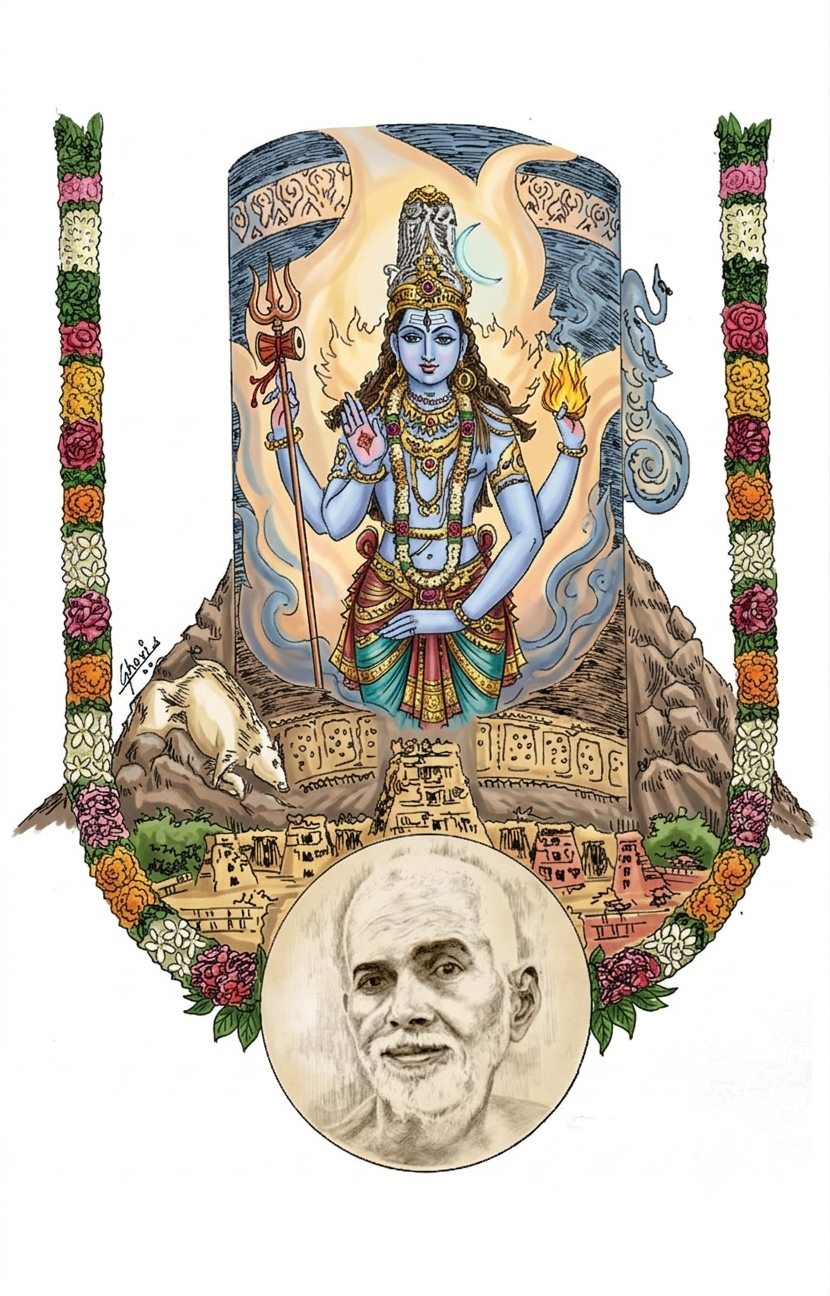
Sketch by Ghovi
Aksharamaṇamālai is a love poem that pleads for divine grace even as it negotiates the distance between the human supplicant and the Primal Being — between indifference and love, destruction and protection, rejection and bestowal, body and spirit, and speech and silence. Voicing a bhakta’s yearning for the Lord, it serves as a primer of spiritual discourse, whereby even the poor and unlearned can rehearse, understand, and cut through centuries of religious disputations to reap eternal joy, the greatest of all rewards.
This poem was composed in 1914 or 1915, when Bhagavan was living in Virupaksha cave. Specifically, it was composed at the request of Bhagavan’s disciples, many of whom were sadhus, living as traditionally prescribed and soliciting bhiksha, or alms, from householders. Others in the town, knowing this, tried to fraudulently pass themselves off as Bhagavan’s disciples in order to solicit the food that was intended for the disciples. Bhagavan’s devotees pleaded with the Maharshi for a song that would identify them as they made their way through the streets of Tiruvannamalai seeking bhiksha. Bhagavan at first refused, saying many songs already existed on Shiva composed by the great saints. Later, he spontaneously composed this masterpiece, which even today is a signature song of Bhagavan and Sri Ramanasramam. Topics such as knowledge, life support, food, alms, and identity are all touched upon and find a place in the text. The central theme, the entreaty to Arunachala, the ever-shining pillar of light, is an ardent plea for grace – aruḷ – which is as necessary for the spirit as food is for the body. This grace brings with it love and protection, and is, above all, existence itself. Verse after verse pleads for grace and light from the radiant hill of fire that destroys all darkness and ignorance.
The letters of the alphabet (aksharas) are considered sacred and eternal in the Hindu tradition. A child’s formal start to schooling and entry into the field of knowledge is commemorated with the ritual of Vidyārambham, when the child first traces the letter ‘a’ on a plate spread with rice. Thus, the ritual conveys that knowledge is divine and as necessary and basic as food. For the child, the gates are opened to the knowledge that will provide sustenance for both soul and body. The word ‘akshara’ in Sanskrit signifies a letter of the alphabet but also denotes that which is ‘undecaying or indelible,’ and therefore refers to Brahman alone. Once, when a devotee begged Bhagavan to write something, even just a letter, in his notebook, Bhagavan composed this verse: “One syllable shines forever in the heart as Self. Who is there anywhere who can write it down?”[83] In Aksharamaṇamālai, the ‘mana’ is of Tamil origin — it means both ‘marital’ and ‘fragrant,’ and ‘malai’ (garland) is common to both Tamil and Sanskrit (mala). The idea of verses strung together like a garland combines the sense of aesthetic beauty and a common devotional offering of flowers to God. In the Tamil tradition, a marital garland offered to the deity is often associated with traditional accounts of Sri Andal’s life.[84] The coinage of the term ‘Aksharamaṇamālai’ is unique to Sri Bhagavan, marrying Sanskrit to Tamil, blending the garland of verses with the image of a marital garland, the fragrant flower with the unfading and immortal letter in the heart.
The Tamil alphabet is composed of ‘uyir’ (literally: breath, life, spirit), ezhuthu (vowels), and mei ezhuthu (consonants). ‘Mei’ is a word with multiple meanings including truth, reality, body, and, in the context of grammar: consonant. Thus, letters (ezhuthu), representing breath and body, unite to produce words (sol) which carry significance (porul). When Devara Dasimayya, the 10th century Kannada Shiva bhakta sang “I am the one who has the body. You are the one who holds the breath,” celebrating the “miracle of your breath in my body,” he was enunciating a spiritual truth that also is the foundation of the Tamil language and lies at the heart of this poem.[85] The Tamil alphabet consists of twelve vowels and eighteen consonants and these combine to form two hundred and sixteen compound letters. Bhagavan’s poem consists of 108 couplets, thus totalling to 216 lines.
Aksharamaṇamālai is in the form of an abecedarium; that is, it is a poem in which each couplet starts with a letter of the alphabet, proceeding in order from the first to the last. Such compositions, known in many cultures, function as a primer that introduces students to the alphabet and can easily be memorized and chanted or sung. The advantage of such a structure is that the alphabet helps the singer remember the couplets without omitting or transposing any. In Tamil Nadu, a famous precedent for this poetic device is Avvaiyar’s[86] ‘Athichoodi,’ an abecedarium used in schools to this day, which provides a moral precept for each letter. ‘A,’ the first Tamil letter, is signified by the ethical admonition: ‘Aram seyya virumbu’ (desire to do the right). Thus, in Tamil literature, this form was used to inculcate valuable moral lessons along with the alphabet. Sri Bhagavan chose to write in this difficult pattern as it conveys a sense of inclusivity. Every letter of the alphabet is incorporated in it, symbolizing that all that can be said is included. Arunachala is beyond words, but words find their meaning in him, as all are within him alone.
In Aksharamaṇamālai, the same letter (akshara) ‘a’ begins both the word ‘Arunachala’ and the word ‘aham,’ the Self — which are, in truth, one. This is the promise and the lesson: “Those who believe that Arunachala is their own Self, their ego is uprooted by Arunachala.” This is the simplest, most straightforward meaning of the first couplet. Owing to the terse, concentrated structure of Bhagavan’s poetry and its skillful wordplay, it can also be read as “Those who meditate on Arunachala in their heart will be freed of the ego.” The concept of interiority and what is closest to the Self is common to the word ‘aham’ (Self, ego) in Sanskrit and in the Tamil word ‘akam’ (home, inner space; in Sangam love poetry, the domestic world of man-woman relationships). The Tamil alphabet does not contain the letter ‘h.’ In Classical Tamil, ‘aham’ is written as ‘akam,’ in an orthographical representation that approximates to the Sanskrit sound. This conflation of Sanskrit ‘aham’ with Tamil ‘akam’ allows the poem to have a third possible meaning: “Those who think of Arunachala as their home, that space within which they exist, (spiritually as much as physically), will be set free from the ego.”[87],[88] The beauty of this poetic device lies in the fact that the bhakta need not go beyond the letter ‘a’ or the first couplet to have understood the heart of this composition. ‘A’ also represents ‘Azhagu’, which means beauty in Tamil; the Sanskrit ‘Sundaram’ also means beauty and, in the second couplet, Bhagavan thereby prays that ‘you’ and ‘I’ may be as indivisible as his own father and mother. [89],[90] Thus, the poem foregrounds the idea of the return to the source, the erasure of duality, especially through a loving union — symbolized by the linguistic parallel between the words ‘Azhagu’ and ‘Sundaram’ — and the erasure of separation between the devotee and the Lord.
Who is the petitioner in this poem? Through the allusion to the names of his parents in the second couplet, Bhagavan hints at himself without overtly taking ownership. Further, the poem is written from the perspective of a devotee ardently seeking spiritual union, not that of a realized jñāni. Hence the supplicant cannot be identified directly as Bhagavan, who further separates himself by taking on the nayika bhava, adopting a female identity. This device has formerly been used by many male poets; among them Manikkavacakar,[91] Nammalvar,[92] Tirumangaialvar,[93] Jayadeva,[94] and Chaitanya Mahaprabhu[95]. This literary convention allows the poet to transcend gender, explore a wider range of emotions, and express with greater intensity the vulnerability, passion and longing felt by the soul towards the Lord. The poem also includes an inner storyline — a romantic elopement. The Lord has inveigled this girl away from her home and into his own and now keeps her imprisoned in his heart’s cave (v. 3). But he has not consummated the union. She is desperately anxious and appeals to his famed reputation, pleading that he will otherwise have to face the world’s blame and questioning of his chivalry, being responsible as he is for her forsaken condition. The girl has surrendered the world but not yet gained a husband (v. 51). However, the poet indicates immediately that this story must be understood as an allegory through the use of the expression “the heart’s cave.” The poem also adopts other frames: stepping away from the romantic element, it praises Arunachala for being kinder than one’s own mother (v. 6). The next two couplets focus on a persistent problem in the spiritual quest and anxiously request the Lord to prevent the mind from wandering (v.7, v.8). The accusation that the Lord is unmoved when his beloved is outraged by the five senses signals the completely allegorical nature of the frame. Just as Arunachala is alternately bridegroom (v.69, v.82), mother (v.14, v.80), master (v.39), Guru (v.19, v.33), the One God (v.48), Primal Being (v.93), and above all, the One without a second (v.12), so too the petitioner is at times the anxious would-be bride, an acolyte being instructed on the spiritual path, Sri Bhagavan himself (v.2, v.85, v.90, v.91), any desperate supplicant approaching God beseeching protection (v.79) and livelihood (v.94), and every spiritual seeker who has arrived at Arunachala, caught in its net of grace (v.102).
Space appears as a recurring motif in this poem. In Bhagavan’s own life, he was aware of Arunachala as a supremely holy spiritual entity well before he realized it was a place that physically existed; thus, Arunachala was a spiritual space before he came to learn that it was an actual physical hill. During his early years at Arunachala, when some pretentious sadhus offered an initiation ritual to Bhagavan, he responded by directing them to the lines in the Arunachala Mahātmyam that promise liberation to all who live within the radius of thirty miles of the Hill, such being its power.[96] There is no distinction between physical and spiritual space at Arunachala. The devotee has been drawn into the Lord’s realm by mere thought of this hill (v.70, v.102). Now he, the dazzling sun, must open the lotus of the heart and manifest within the devotee’s innermost space. “Look within, ever seeking the Self with the inner eye, then will (It) be found. Thus didst thou direct me, beloved Arunachala!” (v.44).
Bhagavan repeatedly reminds the devotee that spiritual maturation is founded on a shift of attention from external to internal space. The devotee rejoices that he is “sunk in Thy Self, wherein merge only those divested of their minds and thus made pure, Oh Arunachala!” (v.47). Diving within, the devotee drops mind as well as body and there is an interpenetration of space. “I am not like a fruit which is overripe and spoilt; draw me then into the inmost recess (of the heart) and fix me in Eternity, Oh Arunachala,” (v.61).
The interpenetration of space is also associated with the theme of food. At one level, the speaker complains that his Lord has ruined his livelihood (v.88). Now his maintenance is the Master’s responsibility (v.94). Arunachala is a spider that has trapped him in His web of grace and has fed on him (v.103). The devotee who sings this song is led to see herself/himself as food surrendered to the Divine and the Lord as the essence of truth, a sweet fruit that will make the consumer mad with ecstasy.
Tamil Bhakti poetry often draws upon the patterns in Sangam poetry that preceded it. Bhagavan combines two categories in Sangam poetry: akam (dealing with love and the inner world of the home) and puram (concerning the outer world, war, praise of the patron) as many Bhakti poets had done earlier. Akam poetry is about the relationship between man and woman, and the frame posits an intense love affair, overcoming of obstacles, and mutual rapture with a happy union as its close. This is also a poem of praise in the mode of puram, as he celebrates the Primal Being who is also “the loving Saviour of helpless suppliants.” As in puram, the devotee craves protection and livelihood from His Master, but also knowledge and eternal joy. Inner and outer worlds merge as the poet knits together these two separate modes, consistent with Advaita Vedanta.
The poet weaves together a garland of all the letters in the alphabet representing all speech; and, in exchange, the Lord makes her his own by opening the lotus of her heart through silence, which is not an inert, stone-like absence of sound, but the stilling of the mind and a flowering of the heart, allowing pure being and consciousness to then manifest.
The poem works through multiple dualities, such as ‘you’ and ‘I,’ stillness and movement, time and timelessness, life and death, and many others, even as it celebrates the transcendence of such mental categories by silencing the waves of thought. The bhāvas or attitudes towards the Lord, particularly those portrayed by the four Nalvars,[97] are all present — mādhurya, the overwhelming love in a man-woman relationship is the predominant mode of the poem (v.34). However, dāsya, the attitude of the servant towards the master (v.39) is also present, as is vātsalya, familial love - here, that of a child towards its parent (v.80), sakhya, turning to the Lord as a friend (v.72), and śānta, abiding in deep peace (v.75). The petitioner also implores Arunachala to “make me one with Thee” through all three modes of imparting spiritual initiation — “by glance, thought, and touch.” (v.63).
The poem depicts several paths to mukti: meditation and jñāna are the themes of the very first verse, with an emphasis on renunciation, both mental and physical. Bhakti is also built into the frame: the primary subject of the poem is Divine union and its means – surrender, which entails taking refuge at the feet of the Lord. Through nāma-japa and saṅkīrtana, the poem also allows the unlearned to join in the refrain with every mention of Arunachala’s name.
“Unasked, thou givest; great is Thy imperishable fame. Do not belie thy name, Oh Arunachala!” (v.22). This beautiful verse is not mere extravagant flattery in the puram mode, a typical reminder by the poet to the patron, to live up to his reputation. It unites in its faith and deep emotion, both bhakti and jñāna. That the bhakta believes this of the Lord indicates the ardent nature of his commitment; the praise itself reflects jñāna. Arunachala’s name, which is uttered in every one of the 108 units of this poem, is entirely intentional. It is intrinsic to the nature of Arunachala’s very being to radiate unwavering love and knowledge. Since He exists within as the devotee’s own Self, His bestowal precedes the capacity of the bhakta to petition. Existence precedes, sustains, and outlasts everything, including the mental operations of seeking and appealing. The Lord’s name and fame reflect the actual experience of all who have known and can attest to His Grace.
The poem starts with the commonest stance of the devotee — a beginning has been made, but the desired end has not been reached, and the search remains incomplete. Sadly, many lives end thus unfulfilled. The poem functions as medicine for this dis-ease. At one level, it follows the pattern of a quest, with alternating moments of anguish, entreaty, hope, elation, illusion, and guidance, all ending in a joyous union. At another level, this horizontal movement along the arrow of time is punctuated by apparently random couplets and bewildering admissions of destruction and triumph, sometimes in the same verse, as here: “When I took shelter under Thee as my One God, Thou didst destroy me altogether, Oh Arunachala!” (v.48)
The poem offers a choice. How will the singer/reader understand and articulate this verse? Will the mood of complaint take over? If so, the verse offers an opportunity to take the pain to the Lord and plead for loving treatment. Will the singer decide that this means that only the ego is finished? An occasion then, for celebration, as jñāna wins the day. Will the singer pay no attention to the words and just let the tide of devotion and love swell from the heart? This would be excellent — the mind would be stilled and the bhakta would be united in love with the Lord. Will the devotee sing mechanically, focusing elsewhere? The poem is helping even this sufferer by repeatedly asking Arunachala to steady the mind. The same singer may go through this entire gamut of responses in repeated vocalizations, growing in spiritual understanding with each effort.
Aksharamaṇamālai is like a signpost, the last page of a mathematics text, alerting the devotee to the fact that, at any time, this whole weary process of seeking and attaining may be discarded, and the pupil may recognize the self-evident truth. “That each one is Reality Itself, Thou wilt of Thy Nature show, Oh Arunachala!” (v.43). This verse calls into question the whole idea of seeking as a sequential process in time. Is there anything at all to be done? Is not all done by the Lord simply revealing himself? By His grace, the seeker arrives at the secret truth of his/her own self, which exists always, is not a destination to be reached and is experienced here, even now.
Inclusivity is the keynote. If the devotee has “a physical frame composed of the five elements” from which he detaches (v.75), Arunachala is all the elements and beyond. He is seen in multiple roles and is subject of both praise and complaint. He is mineral, vegetable, animal, human, spirit, personal God and formless Being. He cannot be limited by the categories of good and evil. Arunachala may seem material, but is truly intangible. By using descriptors like “fiery Gem,” “Hill of Patience,” and “glorious Mountain of Love,” the poet is revealing the secret action and luminous life behind the apparently inert matter of Arunachala’s form. The poet subtly compares the devotee to Arunachala — he too is solid, but in the process of melting like “snow in water” (v.101). He too is matter, but also spirit — a ghost wandering over the world (v.71).
Turning to the use of this poem as signature song, people usually identify themselves by giving a name and stating the place of residence. In South Indian practice, the name of the native village is used to prefix the given name, as in the case of the musician Maharajapuram Santhanam. It was also a traditional practice to give a child the name of the family deity, often the god in the local temple, providing another clue to place of origin. A ‘Meenakshi’ possibly hailed from Madurai, which boasts of a celebrated temple to the goddess. Thus, the name would belong to and connect both deity and devotee. Bhakti poets, however, identified themselves by citing the name of their chosen deity, often in the last line, as the Kannada poet Basavanna (1106–67 CE) names Kundalasangamadeva ‘Lord of the Meeting Rivers’ at the end of each poem. This device transferred ownership of the creative effort to the divine source. In Aksharamaṇamālai, when he arrives at the letter ‘r’ Bhagavan writes “Thinking you are Ramana (the Lord, the delightful and pleasing one,) I have spoken thus; do not be offended but come and give me happiness (“Ramit-tidu Cheyava Arunachala,” v.90).[98]” The name Ramana is bestowed on or rather restored to the Lord from whom it came and converted from adjective and proper noun into the verb ‘ramit,’ which conveys giving delight, bestowing happiness. The next verse repeats this usage, “Ramit-tidu vomva Arunachala,” (let us delight each other, v.91). Thus, the name does not merely designate both participants, but also portrays the experience of mutual ecstasy. The poet asks for forgiveness if, in betraying the Hill’s secret workings, he has said too much. Arunachala must generously treat even his slanders as praise.
In the last verse, as the devotee pleads for union, the names and entities ‘Arunachala’ and ‘Ramana,’ giver and receiver, are melded into one: “Oh Arunachala Ramana! My Loving Lord! Throw Thy garland (about my shoulders) wearing Thyself this one (strung) by me, Oh Arunachala!” This exchange of garlands at the end of the poem symbolizes the exchange of speech for silence, praise for grace, entreaty for response, and tears for ecstasy, and devotee and deity merge into one as the song enacts its desired culmination.
Bhagavan has composed a single verse that states “The state of grace is the speech that rises in the heart of silence.”[99] Aksharamaṇamālai is that space where speech sinks into silence, its home. This is, after all, the great mystery — we think we are merely our bodies, though we are actually the glorious spirit. Arunachala seems to be a mere hill of stone; He is, in fact, being, knowledge, beauty, light, and love. That we are indeed one is something only his grace can reveal as Truth.[100]
Endnotes
83 Osborne, A., The Collected Works of Ramana Maharshi, p. 136. ↩
84 One of the twelve Alvars, 8th century CE. Celebrated Tamil Vaishnavaite bhakti saint and poet who considered herself the bride of Krishna and as a girl, wore the garland before presenting it to the deity. ↩
85 Ramanujan. A.K. (tr.), Speaking of Shiva, 1973, p. 106. ↩
86 A didactic poet from the 12th century CE. ↩
87 Bhagavan was perfectly capable of taking advantage of the spelling to enhance wordplay in line with Advaita and the key themes of his poem; when thieves broke into the Ashram in 1924 and actually hit Bhagavan, he dismissed later enquiries with the linguistic joke that he had merely received some ‘pucai’ (blows), which is the way the Sanskrit word ‘puja’ is adapted to the Tamil script, as Tamil does not have the letter ‘j’; thus demonstrating in action the philosophy with which the jñāni endures both worship and blows, treating them as the same. ↩
88 Author’s translation. ↩
89 Bhagavan’s mother’s name was Azhagu and his father’s name was Sundaram. ↩
90 The numbers 1–108 refer to the couplets as enumerated in Arthur Osborne’s Collected Works of Sri Ramana Maharshi. ↩
91 One of the four chief Tamil Saivite poet saints, usually placed in the 9th century CE. Revered and loved by Bhagavan. ↩
92 Along with Andal considered the chief among the twelve Alvars, Vaishnavaite poet saints of Tamil Nadu. 8th century CE. ↩
93 Vaishnavaite poet saint, possibly 8th century CE. Assumes the role of a female protagonist craving for union with the Lord. ↩
94 Influential Vaishnavaite poet saint from Orissa, 12th century CE. ↩
95 Chaitanya Mahaprabhu, Bengal saint, founder of Gaudiya Vaishnavism, 15th -16th century CE. ↩
96 Osborne, A., Collected Works of Sri Ramana Maharshi, p. 81. ↩
97 The four most revered Saiva poet-saints, the Nalvar, are Sambandar, Appar, Sundarar and Manikkavacakar. ↩
98 The transliteration here and in the next line is taken from Parayana: The Poetic Works of Bhagavan Sri Ramana Maharshi, 1st ed., 2006, p. 39. ↩
99 Osborne, A., The Collected Works of Ramana Maharshi, p. 149. ↩
100 This essay is an adaptation of an article that appeared in the October 2025 issue of Direct Path, a quarterly journal from the Ramana Kendra, Delhi. ↩
Question & Answer
The Editors
Q: What is the concept of Sri Bhagavan’s Teaching Summa Iru (Be Still)? Is it just sitting and relaxing for some time? I don’t really know what it means. Or is there any lakṣyārtham (intended meaning)?
A: Iru in Tamil means Be. Summa means just, merely, simply etc. The whole meaning is Simply Be or Just Be!
Being-ness is advised here, known in Vedantic parlance as Sanmātra Sthiti. It means to be without any mental activity like thinking, feeling, ideating, etc. Stillness of mind is meant. But if instructed to practise in this way, can anyone carry it out? It is difficult, and so Bhagavan suggests the query ‘Who Am I?’ (or ‘to whom is this thought appearing?’) as an aid. When one slips from the Being state and starts off a mental process, this method will make one withdraw attention from the mind-identified state and revert to pure Beingness.
To summarise, constant Self-attention is the goal. A state of alert, thought-free awareness. In this state, vāsanās will get eliminated one by one. Eventually the constant rising of thoughts will stop. This means the ego has finally sunk back into its source.
This is what Bhagavan means by Summa Iru...Just Be...because Beingness alone is the ultimate state of Self...not being this or that.
*** *** ***
Q: Is it fair to say that unless one has had at least a glimpse of the Heart-centre or the ‘I’-current, one cannot understand the true import of Bhagavan’s teachings?
A: One who decides to practise Bhagavan’s Self-enquiry starts by withdrawing attention from external objects and internal thoughts and places their attention on the feeling of ‘I,’ by means of the question ‘Who Am I?’ The objective is to still the mind and continuously feel one’s own conscious presence. In the beginning stages of practice, it will be difficult to keep the attention continuously on the feeling of ‘I’ due to the emergence of thoughts. This is a stage that will be frustrating to ordinary seekers, but Bhagavan’s advice is not to give up the practice on account of initial failures. He has repeatedly said that no effort goes to waste.
Persisting in the practice with absolute determination will ensure Bhagavan’s Grace and the next stage will be reached. Here, even during one’s occupation with daily routines or with one’s job, one part of the mind remains ‘tuned’ to the ‘I’-feeling, and the practice picks up speed. Keeping the attention on the ‘I’-feeling becomes increasingly effortless, the emergence of thoughts diminishes, and at one stage, entirely vanishes, at least for a brief spell. The seeker abides in thought-free awareness, and this is sometimes described as the glimpse of the Heart-centre. Even after this glimpse of the ultimate state, the ego may reassert itself and individuality return. This is because the vāsanās, or accumulated tendencies, though weakened, have not been eliminated totally. The seeker, having had the foretaste of Self-realisation, will keep up with the practice with renewed vigour and, with the Grace of the Guru, will achieve the final goal of total egolessness, or manonāśam.
In conclusion, Bhagavan’s teachings can be understood intellectually even in the initial stages through his Talks and other works. This intellectual understanding is essential for deciding to take up this Direct Path seriously. But the intermediate stage of ahaṁ sphūrti, or the glimpse of the Heart-centre, has to be necessarily reached for the full import of his teachings to take effect.
Nondi’s Corner and Youth Corner
Nondi
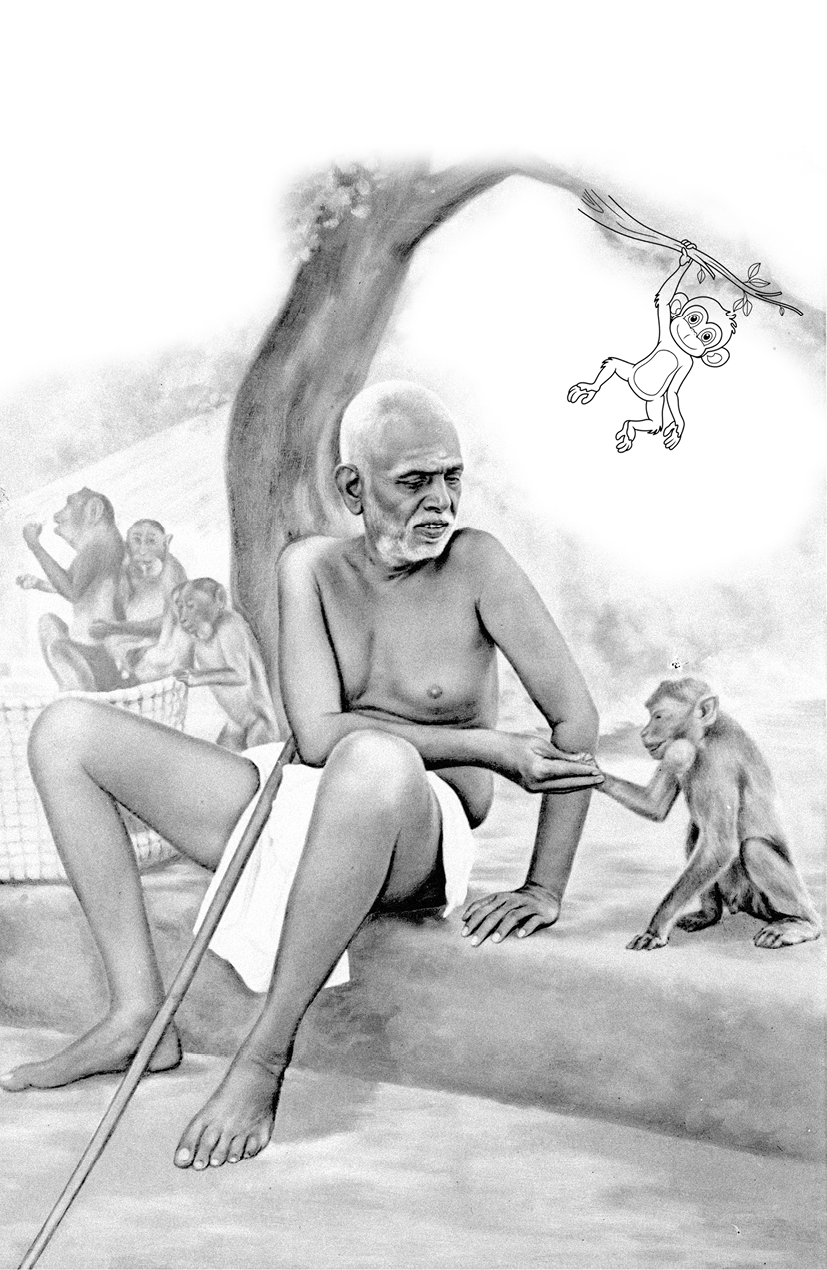
Nondi’s Corner
Hello young adults and children!
This is Nondi, a monkey devotee of Bhagavan. Welcome to the October 2026 edition of the Children/youth corner. In this section, I will share stories, anecdotes, puzzles and interesting facts to provide you spiritual nourishment every quarter. The aim is to inspire and help you blossom into kind, brave and decisive adults.
I look forward to engaging with all of you, all over the world, in the years to come. Please share your queries, feedback and articles with me at mountainpath@gururamana.org.
Sincerely,
Your friend,
“Nondi”
The Devotee Who Built Skandashram
Bhagavan’s closest devotees were often the most humble and unassuming. They lived as silent shadows of the Guru, dedicating their lives entirely to serving Him. Yet each rendered extraordinary service and earned His grace through deep devotion and selfless effort. There is so much we can learn from the lives of these blessed devotees who lived and moved with Bhagavan.
In this incident, narrated by Kunju Swami, one of Bhagavan’s senior devotees, we learn how Kandaswami, through tireless hard work and unwavering devotion, built Skandashram quietly and lovingly for Bhagavan.
Kandaswami and Skandashram
To the west of Virupaksha Cave, there is a black rock. Once, when Sri Bhagavan went towards the rock, he saw some water oozing out from under it. About that time, Jadaswami came there. Sri Bhagavan showed the moist area to Jadaswami and said there might be a spring there. Jadaswami had the place dug, and out came pure, sweet water. Whenever Sri Bhagavan went there, he used to collect the pure water in his Kamandala for use later.
Among the devotees who stayed in Virupaksha Cave was one Kandaswami. There was no water facility near the cave at that time. There was not enough room to cook or for people to stay. Kandaswami removed the stones around the spring, cut down the thorny shrubs, and leveled the ground. He put up a structure and planted mango, jackfruit, and coconut trees and some plants in front of it. Later, with the help of Perumalswami, he completed the present brick building and requested Sri Bhagavan to come and stay there.
He spent some time with Sri Bhagavan and later went to his own place of birth. He never returned to Tiruvannamalai. There was no further news of him. The Ashram which was constructed by him with great effort was named after him by Sri Bhagavan. This is the famous Skandashram. This is still looked after by Sri Ramanasramam and is a place of pilgrimage for the devotees of Sri Bhagavan.[101]
Here is an AI-generated comic strip to illustrate this story. If you have created or come across similar AI-generated content that conveys Bhagavan’s message accurately for our young readers, please share it with us at mountainpath@gururamana.org.
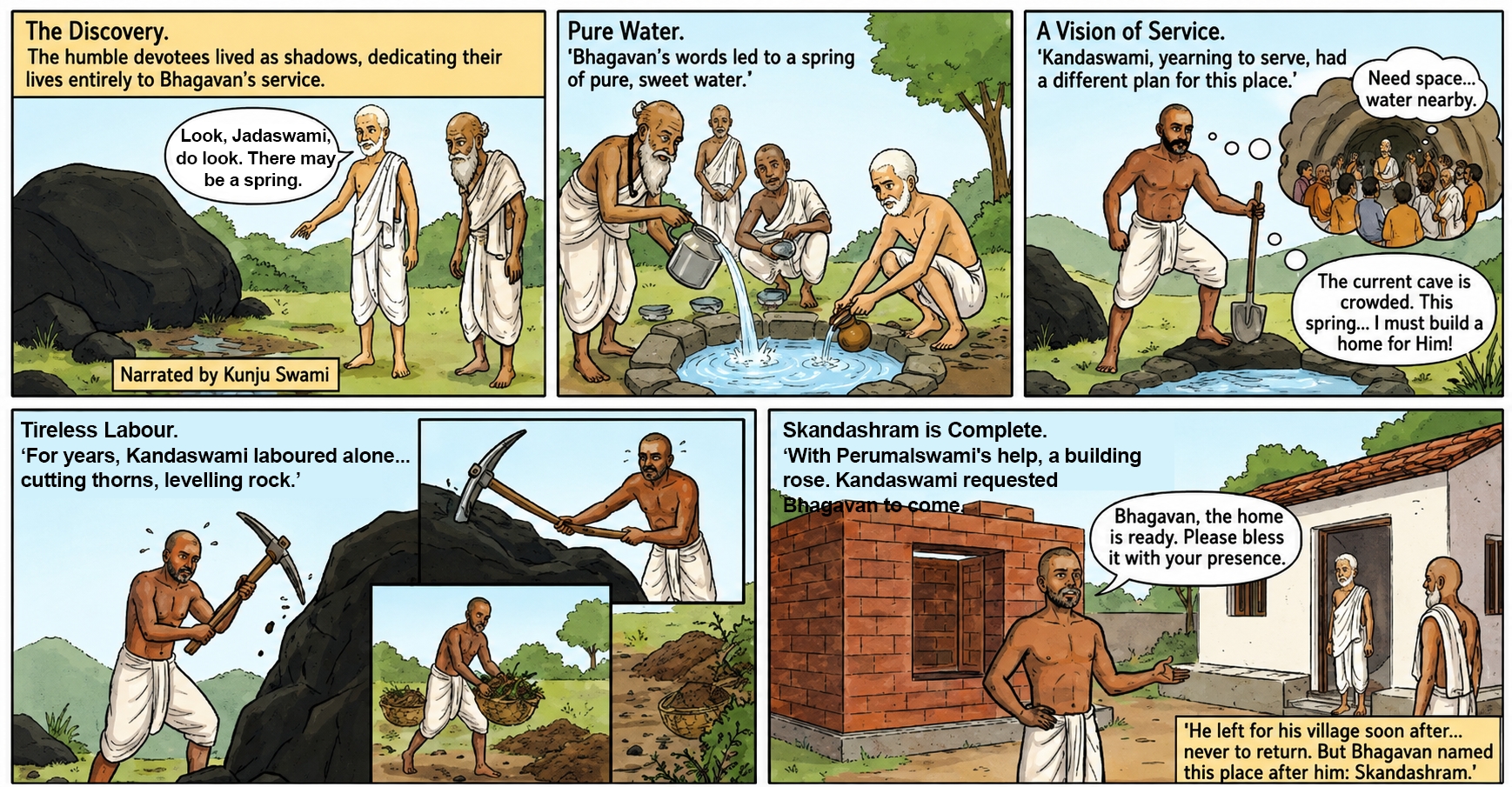
Youth Corner
Here’s a personal account from our young friend Vaynil Narayanan, a high school senior in California. He has begun studying business in college this fall. Vaynil and his family have been deeply involved in the Bay Area Ramana Satsang for many years. His father, Sathiya, composes devotional songs on Bhagavan in Tamil.
I will start with a prayer to Bhagavan that my appa write at least one song on Bhagavan with very simple words that I can pronounce, specifically with no ‘zha’s and ‘la’s. Someday I may understand appa’s complicated writing, but I believe Bhagavan is much simpler to understand.
As of this year, I have been coming to Satsang for nine years. Reflecting on all of those years, I am continually surprised by how much Satsang has taught me about myself.
Growing up, I never paid much attention to what my religious beliefs were. It was only as I entered high school that I began to wonder and question certain ideas. During those early years, there were many days when I felt lost — without direction or strength. It was then that I took an interest in Bhagavan and Satsang. Though concepts like Atma Vichara seemed complicated and far out of reach, over time, as I listened to more stories about Bhagavan — about his stillness, his kindness, his care for all — something began to settle in me. I started to understand what I truly believe in. Such clarity came due to Bhagavan words and explanations: simple, yet profound in their effect. And through Satsang, I came to understand that believing in Bhagavan unconditionally was the very source of the strength I had been searching for.
Satsang as a community has enriched my life in countless ways. What I respect most about the people I meet here is that they don’t just speak Bhagavan’s teachings — they live them. No ego. Genuine kindness. Quiet respect for others. The lessons are so simple, yet the difference they make inspires me to carry those same values into my own daily actions. Satsang has also given me opportunities I will carry with me for life. One of the memories I cherish most is that of recording my father’s composition Thiruthondarthogai. I may have earned some teasing from the uncles and aunties for being a little too stringent about flipping pages of the composition during live recordings. Beyond this, I also had the privilege of sitting in on recording, mixing, and audio engineering sessions for many other Ramana songs, narrations, and plays.
At home, my amma is my teacher, but in Ramananjali classes, amma learns with me as a student. Watching closely how amma learns Bhagavan’s songs has taught me self-discipline and opened me to the love his devotees had for Bhagavan.
Satsang also opened another unexpected door: photography. I distinctly remember the very first time I took pictures at a Bhagavan function. That moment marked the beginning of something that has grown into a true passion, and I am eternally grateful for the openness that Satsang has given me to explore it.
As a teenager, reaching the end of high school, I have finally come to understand why it is so important to have a strong belief system.
Through the pressures of junior and senior year — the exams, the uncertainty, the stress that every student knows — I found my devotion to Bhagavan quietly growing. Simple acts, like attending Satsang every week, became an anchor and a reminder that I was never facing anything alone.
I would like to thank all the aunties and uncles of Satsang. You have shared your love of gulab jamun with me, you have made bondas and paneer for me, you have sat with me and enquired about my life every single time we met, you have taught me Bhagavan’s songs, you have showered unconditional love on Mukil and I, you have given me space to hone my skills in music by giving me a stage, and so much more. I deeply cherish all of you and thank you all for being my Bhagavan’s family.
Annamalai thanile amarthirukkum arase — see how simple Sadhu Om’s words are. A hint for you, appa.
Youth Corner
Here’s this issue’s Fun Corner
Crossword Puzzle: Caves of Arunachala
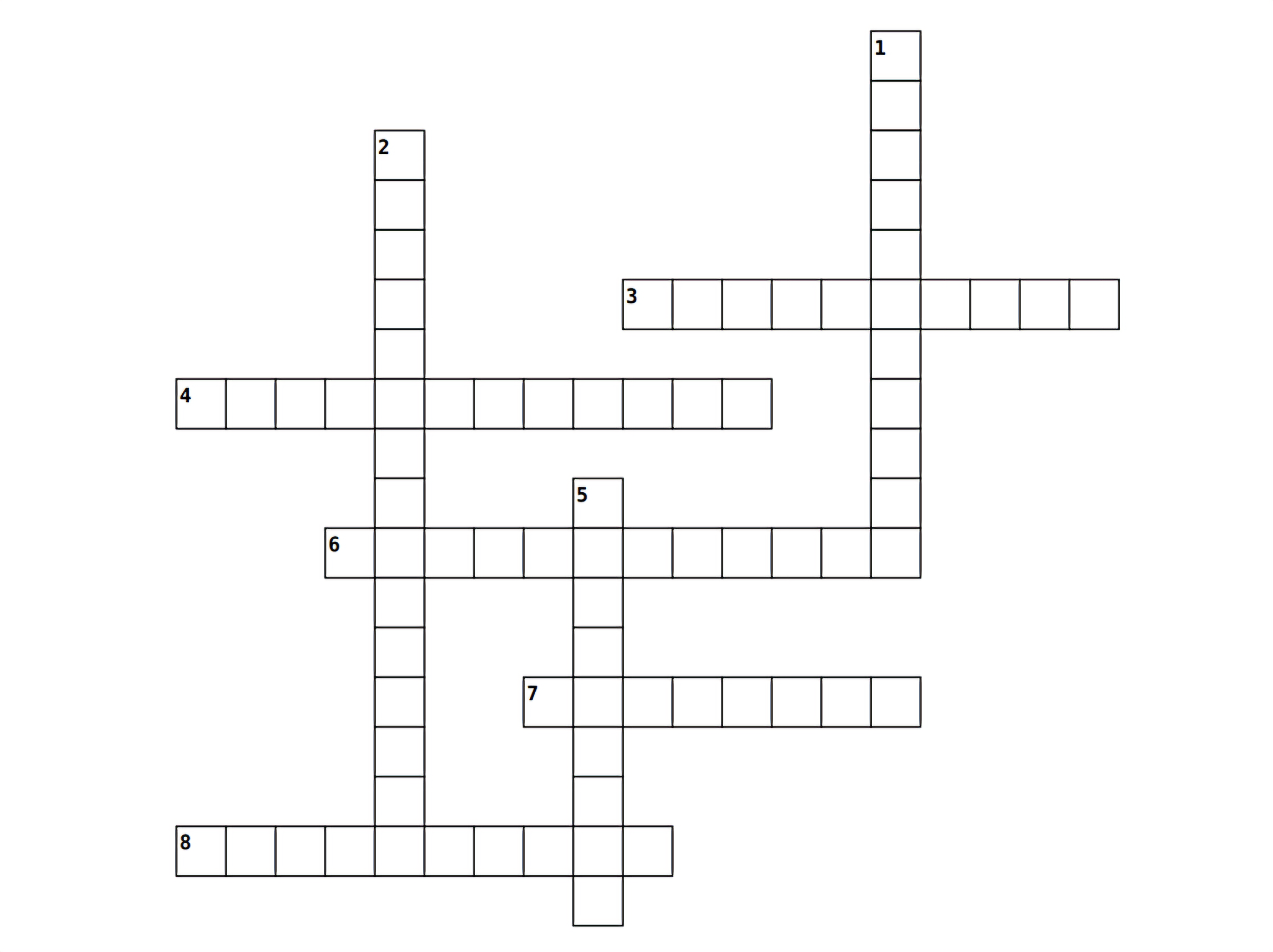
ACROSS
3. Cave where Bhagavan lived for 17 years; named after a 16th-century saint (10)
4. A natural, year-round water source located about 60% up Arunachala Hill (5,7)
6. Located in the underground vault of the Arunachaleswarar Temple (6,6)
7. Rock formation, site of Bhagavan’s “second death experience” (8)
8. The cave is just below Guhai Namasivaya Temple, also called Sadguru Swami Cave (6,4)
DOWN
1. Hermitage higher up the hill where the sage moved in 1916 (11)
2. This poet saint from Karnataka’s name has the Tamil word for cave (5,10)
5. Summer shelter for young Bhagavan during his early years on the mountain (5,4)
Solutions to July 2026 crossword puzzle
Ashram Goshala
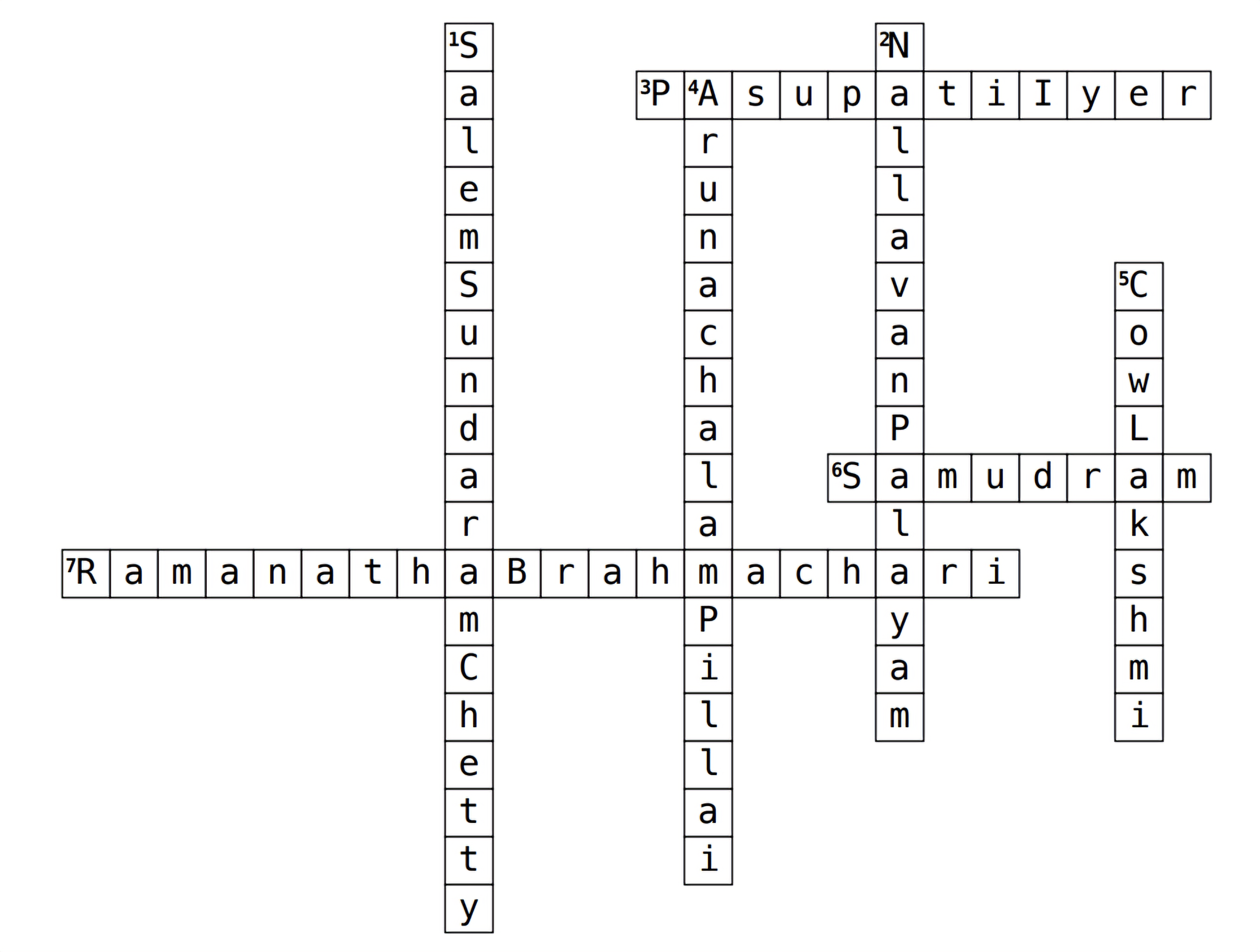
ACROSS
3. Devotee in town who took care of Cow Lakshmi in the early days (8,4)
6. One of the villages where the Ashram has built a sanctuary for aged cows (8)
7. The Ashram devotee who stepped up to look after Cow Lakshmi (9,11)
DOWN
1. A judge devotee who donated funds for the goshala (5,8,6)
2. One of the villages where the Ashram has built a sanctuary for aged cows (8,7)
4. The villager who brought Cow Lakshmi to Bhagavan (11,6)
5. Devotee who was the inspiration behind the goshala (3,7)
PHOTO CAPTION RESULT - JULY 2026
Ananda Sagara Goshala
Vijayalakshmi Ramsai
Shloka: Sri Ramana Ashtottaram
Let’s continue to memorize this wonderful composition by Sri Viswanatha Swami. These are 108 names of Bhagavan used to worship him. As each name is uttered by way of invocation, a flower is offered in worship. Let’s memorize one name at a time and understand its meaning. Here’s Name 12:
ओं सहायाम्बासहायवते नमः।
Oṁ sahāyāmbā sahāyavate namaḥ
Meaning: One who received the grace and help of Divine Mother Sahayamba
Sahayamba is the name of the Goddess of Tiruchuzhi. Once, as a child, Bhagavan left his home in a huff, ran to the temple opposite his house, and sat behind the Mother’s idol. In that moment, he not only became calm, but also experienced a profound thrill of joy.
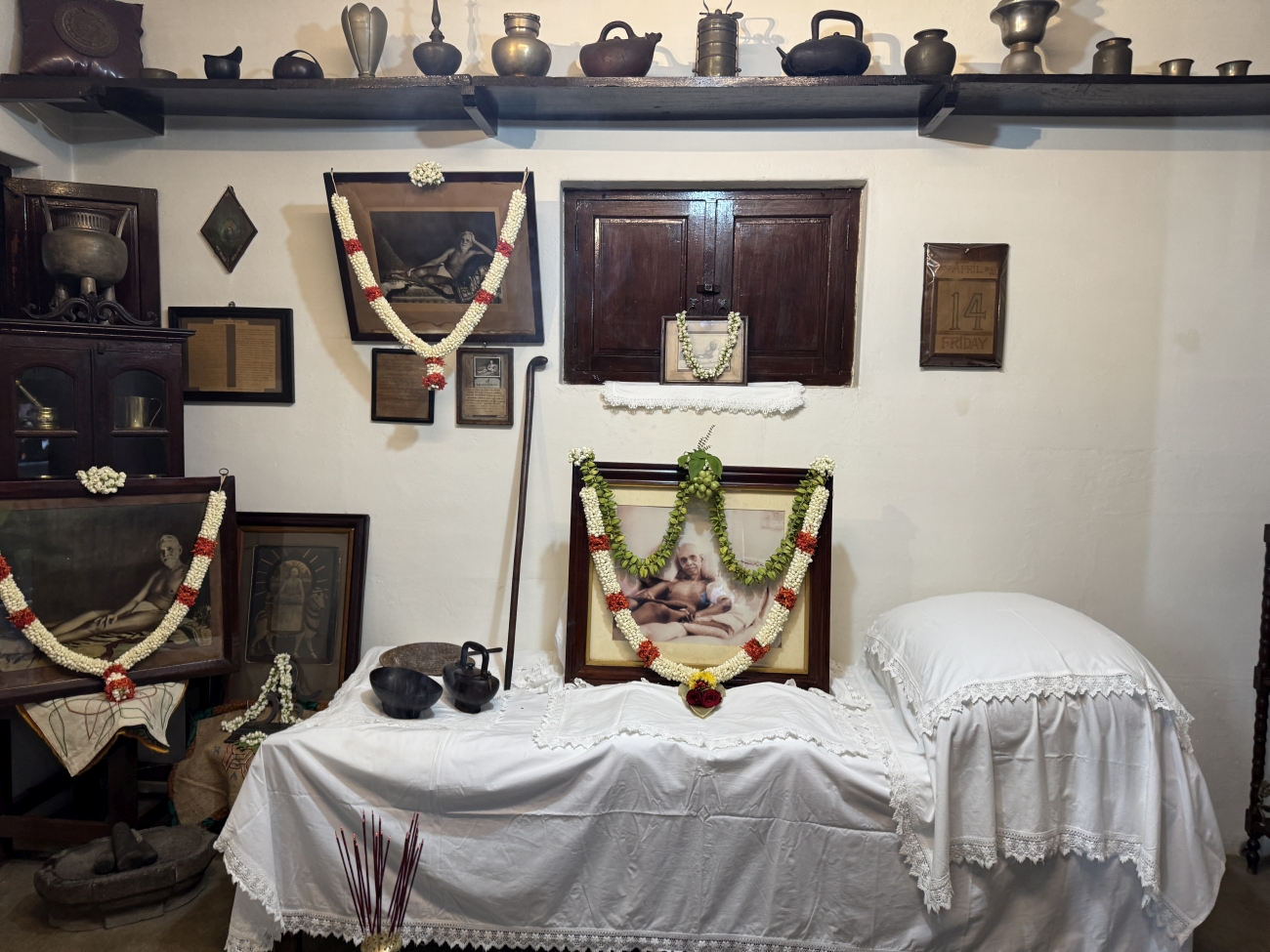
Photo Caption Contest open to All
Share your reflection
This is a photo of Bhagavan’s Nirvana room on April 14th, the day Bhagavan left the body 76 years ago.
What’s going on in this picture? Close your eyes for a moment and imagine it. Then write down the best caption you can!
Your caption can be thoughtful or inspiring. Please share it with us at mountainpath@gururamana.org. The winning caption will be published in our next issue.
Endnotes
101 Reminiscences of Kunju Swami (Enadu Ninaivugal in Tamil). ↩
ASHRAM BULLETIN
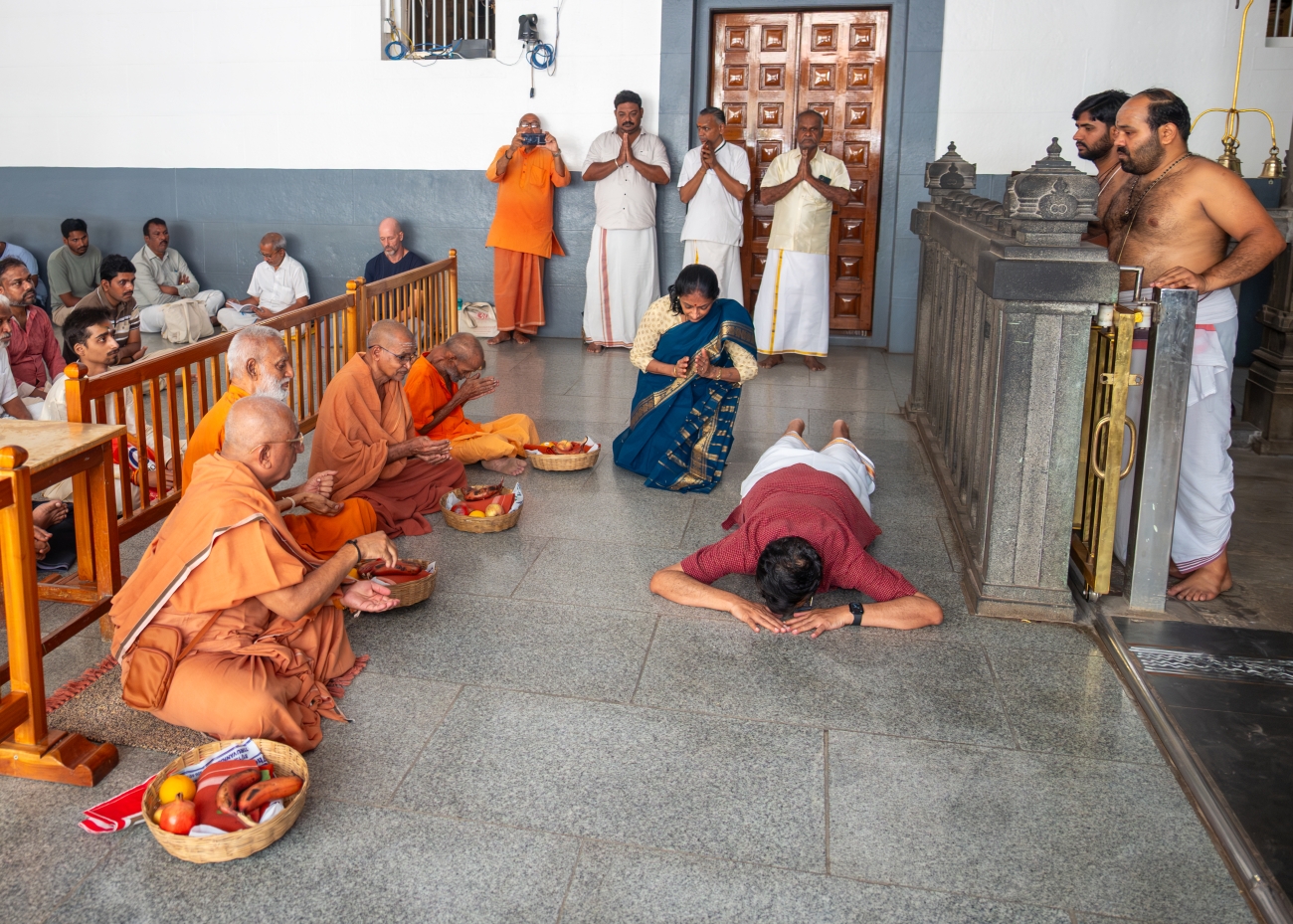
H.C. Khanna Day
The samadhi day of Sri Hari Chandra Khanna was observed on July 23. Devotees chanted Tiruvannamalai Thevaram and Aksharamanamalai, and conducted pujas at his samadhi, remembering him with devotion. Khanna, blessed by the grace of Ramana Maharshi, is among the rare householder devotees whose samadhi is located within the premises of the ashram.
Aradhana of Sri Kavyakanta Ganapati Muni
On 25 July 2026, the ashram was resplendent with the divine vibrations of Ramana Gita, as devotees gathered in the New Hall to celebrate the 90th Aradhana of Sri Kavyakanta Ganapati Muni and recited Ramana Gita. A sage of immense spiritual stature, Ganapati Muni shone brightly as a poetic seer and ardent disciple of Bhagavan. His departure from earthly realms on 25 July 1936 was observed with devotional fervour.
Guru Purnima
On the sacred day of Guru Purnima, 29 July 2026, the ashram reverently honoured its sannyasis, following a timeless tradition rooted in devotion and gratitude. In the sanctified silence of the Samadhi shrine of Bhagavan Sri Ramana Maharshi, new robes were offered to the renunciates—symbolic of spiritual renewal and surrender.
The profound wisdom of Bhagavan resounded: “The Guru is both ‘external’ and ‘internal.’ From the ‘exterior,’ he gives a push to the mind to turn inward; from the ‘interior,’ He pulls the mind towards the Self and helps in the quieting of the mind. That is Guru’s grace. There is no difference between God, Guru, and the Self.” This divine utterance reminds us that the Guru is the guiding light that unerringly leads the aspirant into the radiant Heart of Being.
Sri Kunju Swami Aradhana
On 7 August 2026, devotees observed the 34th Aradhana day of Sri Kunju Swami. Sacred rituals, including abhisheka and the chanting of Aksharamanamalai, filled the air with devotion at his samadhi.
Visit of the Union Home Minister
On Saturday, 8 August 2026, the Union Home Minister, Sri Amit Shah, made a special visit to Sri Ramanasramam. He flew in by helicopter from Chennai and offered prayers at Sri Arunāchaleśvara Temple before continuing to the Ashram. In keeping with his stature and importance to the nation, the visit was preceded by the highest level of security arrangements. His cavalcade drew up in the Ashram grounds behind the Mahanirvana Room at about 6.30 p.m., and the Ashram priests received him with pūrṇa kumbha honours. He was welcomed by the President of Sri Ramanasramam, Dr. Venkat S. Ramanan, and Dr. Nitya Ramanan, who offered him a bouquet of roses and a ceremonial shawl. Entering through the New Hall, he offered prayers at the Mātṛbhūteśvara Shrine and then at Sri Bhagavan’s Samādhi Shrine. He was afterwards presented with a basket of fruit as prasādam, a photograph of Sri Bhagavan, and books in Hindi, Gujarati, and English. He was also greeted by the President’s mother, Susila Ramanan, his sister, Dr. Aruna Ramanan, and her husband, Dr. Ramkumar Sankaran. He remarked to the President’s mother that he remembered meeting her on his previous visit in 2017. Although the current visit lasted only about twenty minutes, it is notable as his second to the Ashram, made amid Parliament’s Monsoon Session.
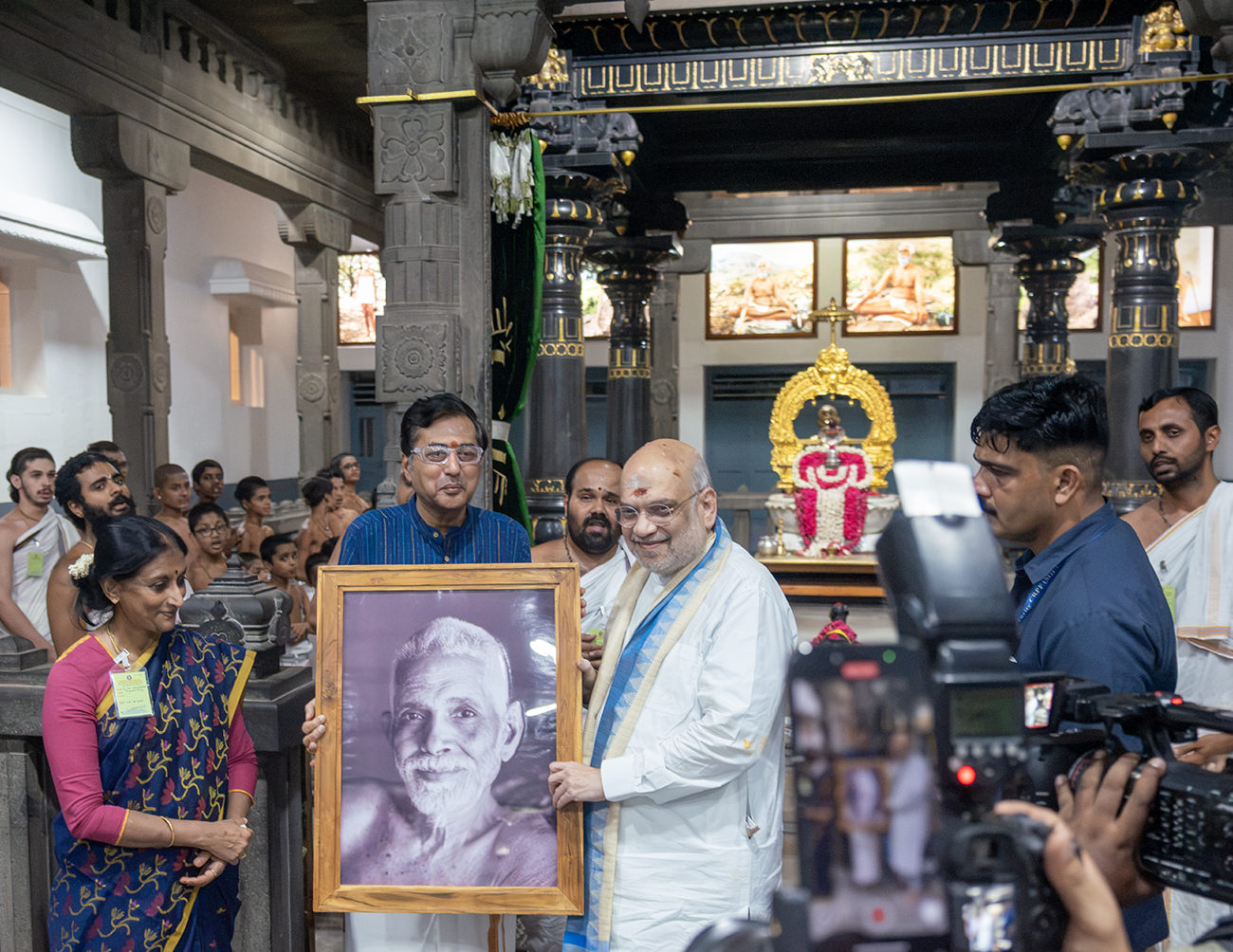
Independence Day
On August 15, Indian Independence Day was observed at Sri Ramana Ashram with solemn patriotic fervour and deep spiritual resonance, echoing the timeless spirit of India’s sacred freedom. The Indian tricolour was hoisted amid heartfelt singing of the national anthem.
As sweets were distributed and prayers offered for the welfare of the nation, memories rose unbidden of that poignant and hallowed morning in 1947. On that first Independence Day, it was none other than Bhagavan Sri Ramana Maharshi who raised the national flag in the presence of a group of Congress workers and government officials.
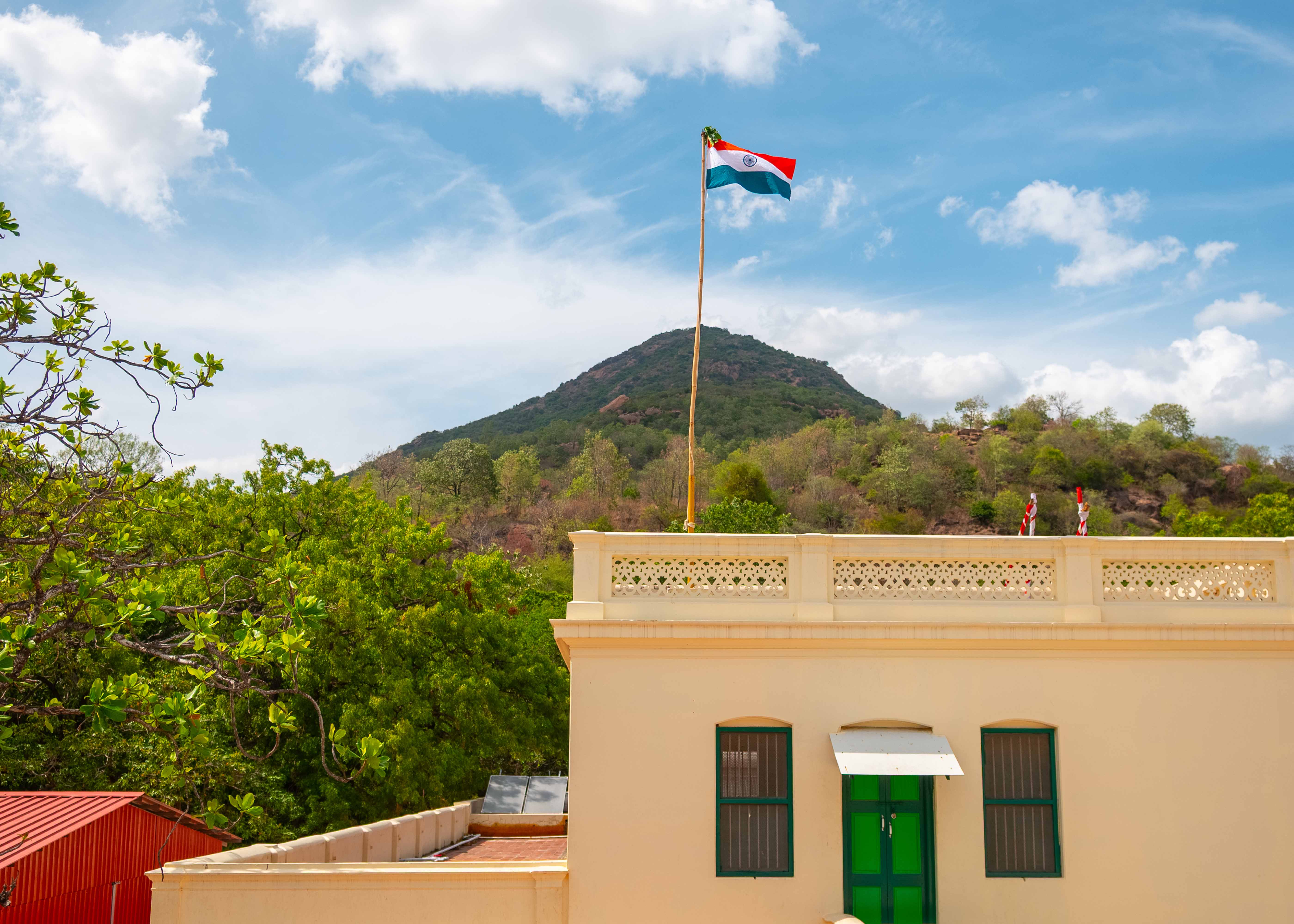
Bhagavan's Advent Day
The 130th anniversary of Śri Bhagavan’s arrival at Arunachala was celebrated at the Ashram on Tuesday, 1 September. One of the four principal celebrations in the Ashram calendar, this date marks the arrival of the young Venkataraman at Tiruvannamalai in 1896, and with it the beginning of a new outpouring of Grace from Arunachala in the form of Śri Ramana Maharshi. The Ashram arranged a special abhiṣekam for the linga at the Śri Arunachaleṣwara temple.
The Ashram programme began with the traditional mahānyāsa pūjā and abhiṣekam at the Samadhi Shrine. Devotees of the Ramana Mandiram, Madurai, made their annual pilgrimage and offered a special parāyaṇa, chanting Arunachala Akṣaramaṇamālai at the shrines of Sri Mātṛbhūteśvara and Sri Bhagavan and in the New Hall. The day’s events included the release of the Hindi translation of Arunachala Akṣaramaṇamālai. The Ashram President, Dr Venkat S. Ramanan, released the book, presenting the first copies to its translator, Dr Sanjay of Australia, and to Smt Susheela Ramanan. Specially prepared prasādam was served to devotees at breakfast and lunch. This year, the day also saw the commencement of a cycle of Kṛṣṇa Yajurveda Ghanapārāyaṇa in the Granthālaya and at Śri Bhagavan's Shrine, chanted daily through to 7 September in preparation for the first Saṃvatsara Abhiṣekam (see next).
First Samvatsara Abhishekam
The Kumbhābhiṣekam of August 2025 will be remembered by all who were present: three days of yāgaśālā pūjās and chanting, culminating in the placing of the kalaśams upon the vimānas, the mahābhiṣekam and the dīpārādhanai. A year having passed, the first Saṃvatsara Abhiṣekam of the Śrī Ramaṇeśvara and Śrī Mātṛbhūteśvara Shrines — an integral part of the Kumbhābhiṣekam observances, and fixed by the recurrence of Punarvasu, Bhagavan's birth star — was performed on Monday, 7 September.
The rites began at 5.30 a.m. with anujñai, Śrī Vighneśvara pūjā, saṅkalpam, puṇyāhavācanam, mahānyāsam and the japa of Śrī Rudram and the sūktas. The homas followed: Gaṇapati homam, Bhagavan mūlamantra homam, Durgā and Śrī Sūkta homam, Navagraha homam, Śrī Rudra homam and Parivāra homam. Vasordhārā was offered at 9.30 a.m. and mahā pūrṇāhuti with dīpārādhanai at 9.45 a.m. At 10.00 a.m. the mahābhiṣekam was performed for Sri Bhagavan, Sri Mātṛbhūteśvara and the Parivāra devatās, concluding with the mahā dīpārādhanai at 10.30 a.m.Mother’s and Bhagavan’s Shrines.